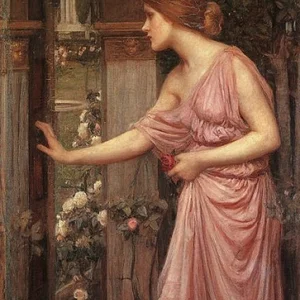

Psyche is a mortal of extraordinary beauty whose legend tells of her love for Eros (Cupid). Her myth, transmitted by Apuleius, symbolizes the soul's journey toward divine perfection through trial and love.
Psyche
Psyche
9 min read
Frequently asked questions
Key Facts
- Her myth is primarily known through Apuleius's 'Metamorphoses' (2nd century AD)
- Her Greek name 'ψυχή' means both 'soul' and 'butterfly', symbolizing spiritual transformation
- She completes four trials imposed by Aphrodite, who was jealous of her beauty
- Eros secretly marries her and forbids her to see him; her curiosity causes their temporary separation
- She is ultimately granted immortality by Zeus and marries Eros on Mount Olympus
Works & Achievements
The only complete ancient source for the myth of Psyche and Eros, embedded in the only fully preserved Latin novel. This narrative has served as the definitive reference for all artistic and philosophical retellings of the myth to this day.
A fresco cycle commissioned by the banker Agostino Chigi, illustrating the key scenes of the myth after Apuleius. This cycle stands as one of the great achievements of the Italian Renaissance and reignited European interest in the myth of Psyche.
A lavish spectacle commissioned by Louis XIV for the 1671 carnival, staging Psyche's ordeals before the court of Versailles. This grand production bears witness to the enduring popularity of the myth in the aristocratic culture of France's Grand Siècle.
A novel in prose and verse freely inspired by Apuleius, blending mythological narrative with reflections on beauty, friendship, and happiness. La Fontaine treats the myth as an allegory of the soul's aspiration toward knowledge and perfect love.
A Neoclassical masterpiece in marble depicting the moment Eros awakens Psyche from a death-like slumber, now held in the Louvre. This sculpture has become the iconic image of the union of Love and the Soul in Western culture.
A large academic painting depicting Eros carrying Psyche up to the heavens, emblematic of French academic painting at the close of the nineteenth century. This work illustrates the myth's enduring power as a major source of artistic inspiration well into the modern era.
Anecdotes
Psyche's beauty was so extraordinary that mortals abandoned Aphrodite's temples to come admire her as a living goddess. The goddess, humiliated by this unwitting competition, tasked her son Eros with punishing the young mortal by making her fall in love with a hideous creature — a plan that backfired on her in the most unexpected way.
Sent to punish Psyche, Eros was so dazzled by her beauty that he accidentally wounded himself with his own arrow, the very instrument of amorous desire. Falling victim to his own power, he became desperately smitten with the young woman and installed her in an enchanted palace, jealously guarding the secret of his divine identity.
Psyche lived in a sumptuous palace where invisible servants fulfilled her every wish, but her mysterious husband would only come to her in total darkness. Driven by the jealousy of her sisters, who suggested her husband was a monster, she lit an oil lamp while he slept — a burning drop fell upon Eros who, wounded and betrayed, flew away without a word.
Venus imposed four seemingly impossible tasks on Psyche: sorting an enormous pile of mixed grains in a single night (compassionate ants helped her), retrieving the golden wool from dangerous solar rams (a reed advised her to wait until nightfall), filling a vial with water from the Styx with the help of Zeus's eagle, and finally descending alone into the Underworld to bring back a beauty casket belonging to Persephone.
Zeus, moved by Psyche's faithfulness and perseverance through all her trials, summoned the council of the gods on Olympus. He himself offered the cup of ambrosia to the mortal, granting her immortality. Psyche became a goddess, and her wedding to Eros was solemnly celebrated on Olympus, symbolizing for the Ancients the eternal union of Love and the Soul.
Primary Sources
Once upon a time there lived a king and queen who had three daughters of remarkable beauty. [...] The youngest, Psyche, was so beautiful that the poverty of human language could neither express nor worthily praise her.
Jupiter then spoke to Psyche: [...] I grant you immortality. Receive these gifts of your new divinity, and live forever united with your husband Cupid.
The soul (*psyche*) is immortal and without beginning; it has traveled through heaven and earth in many forms, learning all things in turn.
Psyche means in Greek the soul; and since the soul can know divine pleasures only after passing through trial and suffering, Psyche earns her union with Love through her labors and perseverance.
Key Places
Home of the Greek gods and the site of Psyche's apotheosis. It was on Olympus that Zeus convened the assembly of the gods to celebrate the official wedding of Psyche and Eros, definitively transforming the mortal into an immortal goddess.
A promontory of the Peloponnese regarded by the Ancients as one of the entrances to the realm of the dead. It was here that Psyche is said to have begun her katabasis — the descent into the Underworld — to deliver the casket to Persephone, the final ordeal imposed by Venus.
A mysterious residence with golden columns and floors of precious stones where Eros installed Psyche, attended by invisible servants. She lived there in supernatural luxury but in absolute solitude, unaware of her husband's divine identity.
The symbolic seat of Venus's power, the jealous goddess behind Psyche's ordeals. It was before this deity that Psyche had to submit and complete four labors that would lead her, step by step, to immortality.
Birthplace of Apuleius (around 125 AD), the author who set down the complete version of the Psyche myth in his Metamorphoses. From this city in Roman North Africa comes the only Latin novel to have survived in its entirety.
Typical Objects

The central object of the myth's tragic turning point: Psyche lit this lamp to finally see the face of her mysterious husband, breaking the condition he had imposed on her. A drop of burning oil fell on the sleeping god, triggering his flight and the long separation of the lovers.

Object of the fourth and final trial imposed by Venus, this box contained the “divine beauty” of the queen of the Underworld. Psyche was warned never to open it, but yielded to curiosity — a mistake that nearly cost her her life before Eros intervened.

The third trial imposed by Venus, this crystal vial had to be filled with the icy water of the river of the Underworld, guarded by dragons. An eagle sent by Zeus flew to Psyche's aid and filled the vial himself.

The second trial of Venus: Psyche had to gather golden wool from solar rams of violent temperament. A talking reed advised her to wait until nightfall to collect the fleece caught on the bushes — a cunning triumph of wisdom over brute force.

The drink of immortality offered by Zeus to Psyche at her apotheosis on Olympus. By drinking the ambrosia, the mortal crossed the threshold of divinity and gained eternal life at the side of Eros.

In ancient and neoclassical iconography, Psyche is depicted with butterfly wings, since the butterfly (*psyche* in Greek) symbolized the soul escaping the body. These wings set her apart from other mortals and reflect her philosophical role as an allegorical figure.
School Curriculum
Vocabulary & Tags
Key Vocabulary
Daily Life
Morning
In Eros's enchanted palace, Psyche woke alone each morning: her husband had left their bed before dawn, in keeping with the condition he had imposed on her. Invisible servants brought her a scented bath, garments of linen and silk, and a sumptuous meal prepared by hands no one could see.
Afternoon
During her days in the enchanted palace, Psyche wandered through gardens of a beauty surpassing anything mortals could imagine, where unknown flowers bloomed and birds with golden feathers sang. She roamed halls adorned with frescoes and statues, all created for her pleasure alone, never encountering any other visible presence.
Evening
At nightfall, Eros would join Psyche in total darkness, conversing with her, sharing a feast accompanied by invisible music, and expressing his love. These nights were the only moments of true companionship available to Psyche, isolated from mortals and unaware of her husband's divine identity.
Food
In Eros's palace, Psyche enjoyed divine fare: dishes unknown to mortals, rare wines, and golden fruits brought by invisible hands. During her wandering after Eros's flight, she ate frugally on bread and water, like a suppliant seeking the mercy of the gods.
Clothing
In the enchanted palace, Psyche wore fine linen tunics and silk drapes in the colors of the gods, very different from the garments of ordinary mortal women. During the trials imposed by Venus, she appeared as a suppliant in modest dress, a sign of her willing humility before the jealous goddess.
Housing
Psyche's dwelling in Apuleius's tale is a divine palace whose columns are solid gold, whose ceilings are cedar inlaid with ivory, and whose floors are precious stones forming extraordinary mosaics. Before being carried off by Zephyr, Psyche lived in her father's palace — a mortal king — surrounded by the ordinary luxuries of ancient nobility.
Historical Timeline
Period Vocabulary
Liens externes & ressources
Références
Œuvres
Apulée, Métamorphoses (L'Âne d'or), Livres IV–VI
vers 160 apr. J.-C.
Raphaël, Cycle de fresques « Les Amours de Psyché » (Villa Farnesine, Rome)
1517–1518
Molière, Corneille et Quinault, Psyché (tragédie-ballet, musique de Lully)
1671
Jean de La Fontaine, Les Amours de Psyché et de Cupidon
1669
Antonio Canova, « Psyché ranimée par le baiser de l'Amour »
1787–1793
William-Adolphe Bouguereau, L'Enlèvement de Psyché
1895