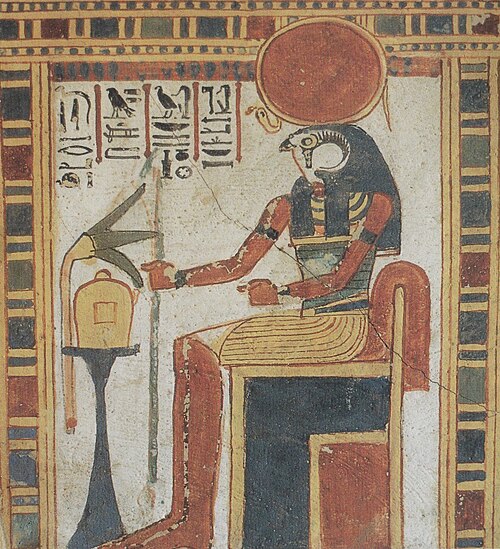
Ra
Ra
Ra is the principal solar deity of ancient Egypt, venerated as king of the gods and creator of the world. He traveled across the sky in his solar barque by day and confronted the darkness by night. His cult, centered at Heliopolis, was one of the most important throughout all of Egyptian history.
Key Facts
- Ra is attested as early as the 2nd Dynasty (around 2890 BCE), and his cult developed fully during the Old Kingdom
- From the 5th Dynasty onward (around 2494 BCE), pharaohs proclaimed themselves 'Sons of Ra'
- He merged with Amun to form Amun-Ra, the supreme deity from the Middle Kingdom onward
- His myth describes a daily journey by solar barque across the sky (the Maat barque by day, the Mesektet barque by night)
- The cult of Ra was absorbed and transformed during Akhenaten's reign (around 1353 BCE) with the cult of the solar disk Aten
Works & Achievements
The oldest of the underworld books, the Amduat describes hour by hour Re's nocturnal journey through the twelve caverns of the netherworld. Initially reserved for pharaohs alone, it is the primary source on Egyptian solar cosmology.
The oldest religious texts in the world, carved inside the royal pyramids of the 5th and 6th Dynasties, they describe the deceased pharaoh's ascent to Re and his participation in the eternal solar journey.
A liturgical composition cataloguing the 75 names and forms of the solar god, adorning the entrances of royal tombs in the Valley of the Kings to allow the pharaoh to identify with each manifestation of the sun.
A royal funerary text describing Re's nightly journey as a succession of twelve guarded gates, each associated with magical spells that the deceased had to master in order to reach the renewal of dawn.
One of the most beautiful lyrical texts of ancient Egypt, this hymn celebrates the rising of the sun with striking poetry, bearing witness to the deep popular devotion to Re that extended well beyond royal circles.
Anecdotes
Each day, Ra crossed the sky in his sacred barque called the Mandjet, accompanied by a divine court that included Thoth, Ma'at, and Horus. At night, he boarded the Mesketet barque to travel through the twelve hours of the underworld, facing the fearsome serpent Apophis, who sought to devour the sun and plunge the world into eternal chaos. Every sunrise was living proof of his renewed victory.
According to the Myth of the Celestial Cow, humans conspired against an aging Ra. Enraged, he sent his daughter Hathor in the form of the destructive lioness Sekhmet to punish them. But faced with the bloodshed, Ra regretted his decision: he had beer dyed red to resemble blood, and Sekhmet, drinking it and believing she was savoring the slaughter, fell into a deep sleep — sparing humanity from total destruction.
Isis, eager to learn Ra's secret name — the source of his absolute power — crafted a serpent from earth mixed with his own divine saliva. The creature bit the sun god, and the pain of the venom was so unbearable that Ra finally revealed his hidden name to Isis in exchange for a cure. This myth illustrates that a god's true name was a magical weapon of unmatched power.
Each night, deep within the Duat, Ra mystically merged with Osiris, god of the dead. This temporary union formed a single entity — 'the soul of Ra' and 'the soul of Osiris' — which made the sun's rebirth at dawn possible. This cycle of death and resurrection was the very foundation of the Egyptian belief in immortality.
During the 5th Dynasty (around 2494–2345 BCE), pharaohs officially adopted the title 'Sa Ra' (Son of Ra), asserting their direct divine lineage from the sun god. They commissioned grand solar temples at Abusir, oriented to capture the first rays of the rising sun — a striking fusion of architecture, religion, and royal legitimacy.
Primary Sources
O Ra-Atum, this king Unas comes to you, an imperishable spirit... You rise with him, you set with him, you illuminate him, you give him life.
The first hour: Ra enters the kingdom of night on his solar barque. The gods of the first cavern receive him, singing his praises. The light he carries illuminates the souls of the dead.
Hail to you, Ra, lord of truth, whose shrine is hidden... You traverse eternity, you are master of time, your barque is the heart of the world.
Homage to you, Ra-Horakhty, Khepri, self-created! When you rise on the eastern horizon of the sky, you pour forth your beauty upon the lands of the North, the South, the West, and the East.
I am Ra in his first risings... I am the Great God, self-begotten, he whose name is hidden, whose many forms dwell in the Duat.
Key Places
A sacred city dedicated to Ra since the dawn of Egyptian civilization, Heliopolis housed the great temple of Iunu and the sacred Benben stone, symbol of the primordial mound upon which the god created himself. Today buried beneath the Matariyya district of Cairo, only a single obelisk of Senusret I (c. 1950 BCE) still bears witness to its former glory.
Built by Ramesses II around 1264 BCE and dedicated in part to Ra-Horakhty, this rock-cut temple is aligned with extraordinary astronomical precision: twice a year, the rays of the rising sun travel the entire length of the sanctuary to illuminate the statues of the gods at the far end of the inner chamber.
The largest religious complex in ancient Egypt, dedicated primarily to Amun-Ra, whose massive pylons and gilded obelisks embodied solar power. At the equinox, the sun rose in perfect alignment with the temple's main axis, underscoring the cosmic dimension of its cult.
The realm of the dead that Ra traversed each night aboard his solar barque, divided into twelve caverns corresponding to the twelve hours of night. There Ra battled Apep, awakened sleeping souls with his passing light, and was reborn at dawn in the form of Khepri.
The royal necropolis of the New Kingdom, whose tombs are decorated with scenes depicting Ra's nightly journey (the Amduat, the Book of Gates, the Litany of Ra). The pharaohs hoped to merge with the solar god and be reborn eternally at his side.