
Roxana was a Bactrian princess, the first wife of Alexander the Great, whom he married in 327 BC following the conquest of Bactria. She was the mother of Alexander IV, the posthumous heir to the empire.
Roxana(346 av. J.-C. — 309 av. J.-C.)
Roxana
Bactriane
7 min read
Frequently asked questions
Key Facts
- Around 340 BC: born in Bactria (present-day Afghanistan/Uzbekistan), daughter of the Bactrian nobleman Oxyartes
- 327 BC: married Alexander the Great following the capture of the fortress of Oxyartes
- 323 BC: pregnant at the time of Alexander's death; she gave birth to Alexander IV
- 310 BC: assassinated along with her son by Cassander, who sought to eliminate the legitimate heirs
Works & Achievements
By marrying Roxana, Alexander sealed his alliance with the Bactrian aristocracy and eased resistance in the region. This marriage helped consolidate Macedonian dominance over Central Asia and inaugurated the policy of cultural fusion that came to define Alexander's empire.
Roxana gave birth to Alexander the Great's only legitimate son, just weeks after his death. Immediately recognized as co-king by the Macedonians, the child made Roxana the mother of the last heir to a colossal empire.
After Alexander's death, Roxana had Stateira II — the other royal wife and daughter of Darius III — assassinated, ensuring that no dynastic rival could emerge from the Persian line. A brutal political act that illustrates her determination to protect her son's succession.
For seven years, Roxana maneuvered between Alexander's generals — Perdiccas, Antipater, Olympias — to preserve her son's legitimacy and survival. Her trajectory reflects the precarious position of royal women caught in the succession conflicts of the Hellenistic era.
Anecdotes
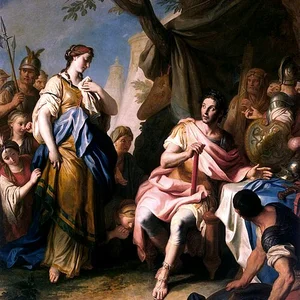
Roxana met Alexander in 327 BC during the siege of the Sogdian Rock, an apparently impregnable fortress defended by Oxyartes, her father. According to Arrian, Alexander was so captivated by the young princess that he chose to marry her rather than take her as a mere captive — an unusual gesture for a conqueror of his stature.
The marriage of Alexander and Roxana blended Macedonian and Eastern traditions: according to Quintus Curtius, they shared a loaf of bread cut with a sword, a Macedonian wedding rite symbolizing union. This hybrid ceremony reflected Alexander's policy of seeking to merge Greek and Persian cultures.
Upon Alexander's death in June 323 BC, Roxana, who was pregnant, had Stateira II murdered — Alexander's other royal wife and daughter of Darius III — to eliminate any rival who might bear a competing heir. This brutal but politically calculated act shows that Roxana knew how to wield the codes of Hellenistic power in defense of her son's interests.
Her son Alexander IV was born a few weeks after his father's death and was immediately proclaimed co-king alongside Philip III Arrhidaeus, Alexander's half-brother who had a mental disability. Roxana thus became the mother of the sole legitimate heir to the greatest empire ever assembled, making her a central prize in the Wars of the Diadochi.
Imprisoned in Amphipolis by Cassander from 316 BC onward, Roxana and her son were quietly executed in 309 BC on the orders of this Macedonian general, who feared that Alexander IV might one day claim the throne. Their deaths brought the direct line of Alexander the Great to an end.
Primary Sources
Alexander, seeing Roxana, daughter of Oxyartes, the most beautiful woman in Asia after the wife of Darius, fell in love with her. Though he loved her, he refused to dishonor her as a war captive, and instead made her his wife.
He had only one lawful wife, Roxana, a captive he had met during the Bactrian campaign, whom he married out of love rather than political calculation.
After Alexander's death, Roxana, who was pregnant, gave birth to a son who was given his father's name. The Macedonians elected him king jointly with Arrhidaeus.
Among the captives Alexander noticed the daughter of Oxyartes, a maiden of remarkable beauty. He was seized by so powerful a passion that he declared his intention to make her his lawful wife.
Key Places
Capital of Bactria and birthplace of Roxana. It was here that the wedding ceremony between Roxana and Alexander took place in 327 BC, following the submission of the region.
A mountain fortress defended by Oxyartes, Roxana's father, captured by the Macedonians in 327 BC. It was here that Alexander first met Roxana and decided to marry her.
Administrative capital of Alexander's empire, where he died in June 323 BC. Roxana, who was pregnant at the time, was there when her husband died and immediately had to assert herself in the power struggles of the Diadochi.
Capital of the Kingdom of Macedon, where Roxana and her son were brought to secure dynastic legitimacy before the Macedonian court following Alexander's death.
A Macedonian city where Cassander had Roxana and Alexander IV imprisoned from 316 BC onward, before having them secretly executed in 309 BC, putting an end to Alexander's direct bloodline.
Typical Objects

A gold headband adorned with precious stones (lapis lazuli, carnelian) worn by Bactrian nobles during ceremonies. As the daughter of Oxyartes, Roxana wore this type of ornament, a symbol of her princely rank even before her marriage to Alexander.

A signet ring engraved with a dynastic emblem, used to authenticate orders and official correspondence. After Alexander's death, control of his seal became a crucial political issue among the Diadochi, and Roxana sought to preserve its authority for her son.

According to Quintus Curtius, a sword was used to cut bread during the wedding ceremony of Alexander and Roxana, blending Macedonian ritual with its Eastern setting. A symbolic object of their union between two worlds.

The gowns of Bactrian aristocrats combined linen fabrics with richly embroidered Eastern textiles threaded with gold. Having become a Macedonian queen, Roxana most likely wore clothing that blended both traditions.

A ceramic or precious metal cup used at Macedonian banquets (symposia). After her marriage, Roxana had to learn the customs of the Greek symposium, a key moment in Macedonian political life.

Royal wives traveled in enclosed litters during military campaigns. Roxana accompanied part of Alexander's movements across Central Asia and later during the return convoys westward.
School Curriculum
Vocabulary & Tags
Key Vocabulary
Tags
Daily Life
Morning
Roxane rose at dawn in the royal gynaikeion, the women's quarters of the palace. Servants helped her style her hair and dress: linen or silk tunic, gold fibulae, diadem. In Bactria, she attended morning Zoroastrian rituals; in Macedonia, she had to adapt her customs to Greek practices.
Afternoon
Afternoons were devoted to the affairs of the gynaikeion: supervising servants, weaving, and receiving noblewomen of the court. After Alexander's death, Roxane also had to handle urgent political matters, corresponding with regents and Diadochi generals to defend her son's interests.
Evening
Evenings at the Macedonian court could include banquets (symposia) at which royal women attended in positions of honor. Roxane took part in dynastic ceremonies, ritual meals, and discussions about the succession — a constant concern throughout her years of widowhood.
Food
A Hellenistic queen's diet drew on local resources: wheat bread, roasted meats (lamb, game), dried fish, dates, figs, olives, and wine diluted with water in the Greek fashion. In Bactria, meals included millet bread, legumes, and fermented dairy products typical of Central Asian cuisine.
Clothing
After her marriage, Roxane wore the draped Greek tunic (chiton), embellished with Eastern ornaments: gold-thread embroidery, fabrics dyed with saffron or royal purple, and a gemstone-studded belt. Her diadem and gold jewelry set with lapis lazuli were a constant reminder of her Bactrian origins.
Housing
Before her marriage, Roxane lived in her father's mountain stronghold in Sogdia, with thick rammed-earth walls. After 327 BCE, she resided in Alexander's itinerant palaces — large royal tents during campaigns, then the palace of Babylon — and finally in the marble-columned royal residences of Macedonia.
Historical Timeline
Period Vocabulary
Visual Style
Un style visuel alliant l'art hellénistique grec à l'esthétique iranienne et bactrienne : bijoux dorés, étoffes riches en safran et pourpre, et architecture de cour pour une figure royale à la croisée de deux civilisations.
Sound Ambience
Une atmosphère mêlant les vents des hauts plateaux bactriens, les sons d'un camp militaire macédonien et les murmures d'une cour royale orientale, reflet du destin biculturel de Roxane.
Liens externes & ressources
Références
Œuvres
Alliance matrimoniale avec Alexandre le Grand
327 av. J.-C.
Naissance d'Alexandre IV, héritier de l'empire
323 av. J.-C.
Élimination de Stateira II
322 av. J.-C.
Résistance aux guerres des Diadoques
323–316 av. J.-C.