
Christian martyr of the 4th century, a Roman officer put to death under Diocletian around 303. His medieval legend — the fight against a dragon to rescue a princess — made him the symbol of chivalry and the victory of good over evil.
Saint George
Parish of Saint George
9 min read
Frequently asked questions
Key Facts
- Around 280: probable birth in Cappadocia or Palestine (Lydda)
- 303: martyred under Emperor Diocletian after refusing to renounce Christianity
- 11th century: his cult spreads to the West through the Crusades
- 1222: April 23 is declared a national feast day in England, of which he is the patron saint
- His dragon legend appears in the Golden Legend by Jacobus de Voragine (13th century)
Works & Achievements
The earliest hagiographic account of the martyrdom of George, condemned as apocryphal by Pope Gelasius I yet widely copied and circulated throughout Christendom. A foundational text that established the principal elements of the martyr's story.
A hagiographic compilation that gave the definitive version of the battle against the dragon of Silene. Translated into every European language, it made George one of the most popular and most depicted saints of the Middle Ages.
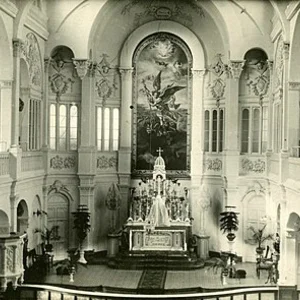
A shrine erected over the supposed tomb of Saint George, destroyed by the Mamluks and later rebuilt. A major Christian pilgrimage site in the Holy Land, today administered by the Greek Orthodox Patriarchate of Jerusalem.
Among the oldest frescoes in Germanic Romanesque art, listed as a UNESCO World Heritage Site. They testify to the early spread of the cult of George throughout Carolingian Europe.
A chivalric order founded under the patronage of Saint George, the oldest and most prestigious in the English-speaking world. Still active today, it embodies the union of military, religious, and monarchical ideals personified by the saint.
A painting held at the National Gallery in London, celebrated for its dynamic perspective and vivid colours. It captures with striking narrative force the moment the saint strikes down the dragon before the eyes of the princess.
An oil painting held at the National Gallery of Art in Washington, commissioned for King Henry VII of England. A Renaissance masterpiece that crystallises the ideal image of the knight-martyr sheltered by divine grace.
Anecdotes
According to Christian tradition, George was a military tribune in the Roman army, probably of Cappadocian origin, when Emperor Diocletian decreed the Great Persecution of Christians in 303. Rather than renounce his faith, he reportedly presented himself publicly before the governor to denounce the injustice of this edict, knowing his life was at risk.
The medieval legend, popularized by the *Golden Legend* of Jacobus de Voragine in the 13th century, tells that George arrived in the city of Silene, in Libya, which was terrorized by a dragon demanding human victims. The king's daughter had been chosen as the next offering. George fought the dragon, wounded it with his lance, and the princess tied it with her belt to lead it into the city. In exchange for the conversion of the entire population to Christianity, George finished off the monster.
After refusing to sacrifice to the Roman gods, George is said to have endured multiple tortures — a wheel fitted with blades, a cauldron of boiling lead, being buried alive — before finally being beheaded on April 23, 303. Tradition attributes his miraculous endurance with the conversion of Empress Alexandra herself, who was then executed alongside him.
George was adopted as patron saint by many countries and cities: England, Georgia, Portugal, Catalonia, Venice, Genoa... The Crusaders of the 11th century brought back his legend and cult from the East. In 1222, the Council of Oxford proclaimed April 23 a national holiday in England. His emblem — a red cross on a white background — became the English flag.
The Basilica of Saint George in Lydda, today Lod in Israel, stands on the supposed site of his martyrdom and tomb. Destroyed and rebuilt several times over the centuries, it remains to this day a pilgrimage site shared by Christians and Muslims, who venerate George under the name of the prophet Al-Khidr, a figure of divine wisdom.
Primary Sources
At that time, a man of the highest distinction, moved by ardent zeal for God, tore and ripped to pieces the edict posted against the Christians. He was led out in public and endured with heroic steadfastness every torment that could be devised.
George, servant of Christ, military tribune, from Cappadocia, having seen the imperial edict ordering the persecution of Christians, tore up the edict and publicly confessed the name of Christ before Governor Dacianus, without fearing death.
George, a knight from Cappadocia, passing through the province of Libya, drew near to a city called Silene, beside which lay a lake as vast as a sea, wherein dwelt a pestilential dragon that had many times put an entire army to flight.
George, whose deeds are better known to God than to men, is among the saints whose memory we shall celebrate with veneration, even though his Acts are held to be apocryphal.
It is reported that Saint George, together with other holy soldiers of Christ, came to fight alongside the Christians at the siege of Antioch, riding a white horse and bearing a white banner with a red cross.
Key Places
The traditional site of Saint George's martyrdom and burial. The Basilica of Saint George, built and later rebuilt over his tomb, remains a pilgrimage site shared by Christians and Muslims, who venerate Al-Khidr at the same location.
A region of Asia Minor regarded as the birthplace of Saint George according to hagiographic tradition. This Christian province of the Roman Empire was known for the fervor of its believers and its martyrs.
A legendary Libyan city where, according to the *Golden Legend*, a dragon terrorized the population and demanded human sacrifices. Its precise location remains uncertain — this is the setting at the heart of Saint George's chivalric myth.
Diocletian's eastern capital, where the first edict of persecution was proclaimed in 303. According to some hagiographic sources, it was here that George was arrested after publicly tearing up the imperial edict.
Home of the Order of the Garter, founded in **1348** by **Edward III** under the patronage of Saint George. The castle's St George's Chapel serves as the sanctuary of England's most illustrious chivalric order, which remains active to this day.
Typical Objects

The saint's emblematic weapon, with which he pierces the dragon. In Christian iconography, the lance symbolizes the victory of faith over evil and the power of the believer armed by God.

A red cross on a white background, the saint's heraldic emblem popularized by the Crusades. It adorns the flag of England today and features in the British Union Jack.

The monstrous creature George vanquishes, a symbol of evil, paganism, or the devil depending on the theological reading. In the legend of Silene, it embodies the demonic forces over which Christianity triumphs.

Though originally a Roman legionary, George has been depicted as a medieval knight in gleaming armor since the Middle Ages — a reflection of how every era reinvents its heroes according to its own ideals.

A palm branch, the traditional attribute of Christian martyrs since the fourth century. George holds it in depictions where he is not shown in combat, a reminder that he shed his blood for his faith.

In the legend, it is with the princess's own girdle that George binds the wounded dragon to lead it into the city. A symbolic detail: feminine fragility tames the monster after the knight's strength has subdued it.

The war banner of Saint George, carried by crusaders who fought under his protection. It signified the purity of the Christian warrior and became one of the most recognizable emblems of medieval Europe.
School Curriculum
Vocabulary & Tags
Key Vocabulary
Tags
Daily Life
Morning
As a Roman military officer, George began his day with troop inspection and military drills at dawn. As a Christian, he also devoted part of his mornings to prayer — a clandestine practice at a time when Christianity was still poorly tolerated within the imperial army.
Afternoon
His afternoons were taken up with the administrative duties of his rank as tribune: overseeing garrisons, inspecting equipment, and drafting reports for his superiors. According to hagiographic tradition, he also distributed a portion of his wealth to the poor in the period before his martyrdom.
Evening
According to hagiographic texts, George would withdraw in the evenings to pray and study the Scriptures alongside other Christians in his garrison. It was reportedly during one of these secret gatherings that he learned of the proclamation of the edict of persecution, whereupon he resolved to make his faith publicly known.
Food
Like any Roman soldier, George consumed the standard army ration: hard bread (bucellatum), vegetable broth, legumes, cheese, and occasionally meat during official distributions. Wine diluted with water (posca) was the soldiers' daily drink. Hagiographic texts emphasize his frequent fasts as an expression of Christian devotion.
Clothing
On duty, George wore the armor of a Roman officer: *lorica segmentata*, crested helmet, and *paludamentum* (red military cloak). Medieval tradition, however, depicts him as a knight clad in gleaming armor with a white surcoat bearing a red cross — an anachronism that reveals how the Middle Ages recast this ancient hero in their own image.
Housing
As an officer of tribune rank, George was quartered in accommodations reserved for military officers, kept distinctly separate from the barracks of common soldiers. These more comfortable lodgings were found in major imperial garrisons such as Nicomedia or Antioch. Tradition holds that he came from a prosperous family in Cappadocia.
Historical Timeline
Period Vocabulary
Liens externes & ressources
Références
Œuvres
Passio Georgii (Passion de saint Georges)
Ve-VIe siècle
La Légende dorée — Jacques de Voragine
vers 1261-1266
Basilique Saint-Georges de Lydda
IVe siècle (fondation), reconstruite en 1872
Fresques de l'église Saint-Georges — île de Reichenau (Oberzell)
vers 896-920
Ordre de la Jarretière — fondation par Édouard III d'Angleterre
1348
Saint Georges et le Dragon — Paolo Uccello
vers 1470
Saint Georges et le Dragon — Raphaël
1506