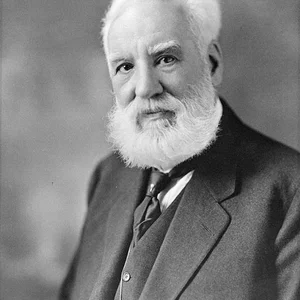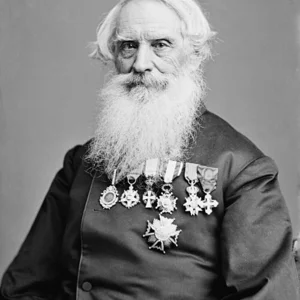

American inventor and painter (1791–1872), Samuel Morse is famous for developing the electric telegraph and the code that bears his name. His invention revolutionized long-distance communications in the 19th century.
Samuel Morse(1791 — 1872)
Samuel Morse
États-Unis
8 min read
Frequently asked questions
Famous Quotes
« What hath God wrought? — first official telegraphic message, May 24, 1844»
Key Facts
- 1791: born in Charlestown, Massachusetts
- 1837: filing of the patent for the electric telegraph
- 1838: development of Morse code (dots and dashes)
- 1844: first telegraphic link between Washington and Baltimore
- 1872: died in New York, leaving a worldwide telegraph network as his legacy
Works & Achievements
Morse's landmark invention, developed with Alfred Vail and Leonard Gale: a device capable of transmitting coded electrical signals over long distances through a conducting wire. It revolutionized global communications and was adopted on every continent.
A system for encoding letters and numbers using combinations of dots and dashes (short and long signals). Designed with Alfred Vail, it became the worldwide standard for telegraphy and remained in use well into the twentieth century.
An imposing full-length portrait of the hero of the American Revolution, commissioned by the city of New York during Lafayette's visit to the United States. It is one of Morse's most celebrated paintings.
A large-scale painting depicting the walls of the Salon Carré in the Louvre covered with reproductions of European masterpieces. Morse worked on it during his stay in Paris with the aim of giving Americans a sweeping survey of the great painting tradition.
Construction of this 64-kilometer line, funded by the United States Congress, demonstrated the economic and social value of the telegraph and launched its large-scale deployment across the United States and the world.
Anecdotes
In 1825, Samuel Morse was in Washington painting the portrait of a dignitary when he received, several days after the fact, a letter announcing the death of his wife Lucretia. Devastated to have learned the news too late to say goodbye, he vowed to find a way to transmit information instantly over long distances. This personal grief was the true driving force behind his commitment to inventing the telegraph.
In 1832, during an Atlantic crossing aboard the ship Sully, Morse attended a demonstration on electromagnetism led by Dr. Charles Jackson. He spent the rest of the voyage filling his notebooks with diagrams and notes, laying the groundwork for what would become the electric telegraph. His fellow travelers would later recall seeing him scribbling frantically day and night.
On May 24, 1844, Samuel Morse sent the first official telegraph message by wire from the Supreme Court in Washington to Baltimore, over 60 kilometers away. These words from the Bible — “What hath God wrought” — marked the beginning of a revolution in human communication and left the assembled crowd speechless.
To decide on the symbols for their code, Morse and his collaborator Alfred Vail visited a print shop and counted the number of type characters available for each letter. The most frequently used letters in English, such as E, received the shortest codes (a single dot), while rare ones like Q inherited the longest sequences. This purely empirical approach made the code both simple and remarkably effective.
Before becoming an inventor, Morse was a recognized and ambitious painter. He notably painted a large portrait of General Lafayette during the latter’s visit to the United States in 1825, now held in New York. For years he sought an official commission to decorate the Capitol, but faced repeated rejections — a bitterness that drove him all the more to dedicate himself to his scientific research.
Primary Sources
What hath God wrought. First message transmitted by telegraph from the Supreme Court of the United States in Washington to Baltimore.
I have sketched a plan for transmitting intelligence at a distance by means of electromagnetism. If this is feasible — and I see no reason why it should not be — it will change the way the world communicates.
Invention of a new and useful electromagnetic telegraph apparatus for transmitting intelligible signals at a distance by electrical impulses.
I affirm that I was the first to conceive and reduce to practice an electromagnetic telegraph capable of automatically recording signals received at a distance.
Key Places
Samuel Morse's birthplace, born on April 27, 1791. He grew up in a cultured and religious family that encouraged his education and intellectual curiosity.
Morse studied here from 1805 to 1810, developing an interest in both the arts and early lectures on electricity, which awakened his precocious scientific curiosity.
The city where Morse lived and worked as a professor of painting at New York University while developing his telegraph during the 1830s. He died there in 1872 and is honored by a statue in Central Park.
The starting point of the first commercial telegraph line in 1844. Morse sent the first historic message from the Supreme Court chamber to Baltimore.
The terminus of the first Washington–Baltimore telegraph line (1844). The 40-mile distance between the two cities served as the first successful large-scale test of the system.
Morse stayed here during the 1830s for his artistic training and attempted to patent his telegraph there. He met Louis Daguerre and developed an interest in the nascent art of photography.
Typical Objects

A small metal lever that, when pressed down, closes the electrical circuit and produces a short or long signal. It is the central tool of Morse code transmission, used by operators to tap out messages dot by dot.

A fundamental component of Morse's telegraph receiver: the incoming electrical current activates an electromagnet that attracts a metal strip, producing a click or a mark on a paper tape. Morse drew on the work of Ampère and Oersted to incorporate it into his system.

In Morse's original system, signals were printed as dots and dashes on a mechanically driven paper tape, providing a lasting written record of the received message.

The essential electrical power source for operating the telegraph. Morse used these batteries to power his lines and thereby solved the problem of signal attenuation over long distances.

Before becoming an inventor, Morse was a respected artist who specialized in portraiture. His palette and brushes symbolize this earlier career, which took him to Europe and brought him into contact with the great scientific advances of his time.

Copper wire wrapped in an insulating sheath, strung between wooden poles along railway lines and roads. Morse and his teams laid thousands of kilometers of it across the United States during the 1840s and 1850s.
School Curriculum
Vocabulary & Tags
Key Vocabulary
Tags
Daily Life
Morning
In the 1840s, Morse rose early and often began his day with prayer, true to his strict Calvinist upbringing. He devoted his mornings to experimental work in his laboratory at New York University, adjusting his apparatus and testing new electrical circuits with his assistants Alfred Vail and Leonard Gale.
Afternoon
His afternoons were divided between administrative tasks — meetings with investors, patent procedures, correspondence with senators to secure Congressional funding — and the painting lessons he taught to make ends meet. For years, he pursued his artistic career and his scientific research in parallel, driven by insufficient income.
Evening
In the evenings, Morse wrote his voluminous correspondence: letters to his partners, records of experiments, and dispatches to family and friends. An avid reader, he kept up with European scientific advances through specialist journals and newspapers of the day, particularly the work of Ampère, Faraday, and Henry.
Food
Like most middle-class Americans of the nineteenth century, Morse ate hearty meals of roasted meats, boiled vegetables, cornbread, and puddings. Meals were taken with family or colleagues in a sober atmosphere, in keeping with his Protestant convictions, which frowned upon excess.
Clothing
Morse dressed in the bourgeois fashion of his era: a dark frock coat with a high collar, a double-breasted waistcoat, a high-knotted cravat, and a top hat for formal outings. In the studio or laboratory, he wore a work smock to protect his clothes from paint stains or the acids of galvanic batteries.
Housing
Morse lived for several years in modest lodgings in New York, sometimes in his own painting studio at the university, at a time when his inventions had yet to earn him anything. Later, with the royalties from his patents, he acquired a handsome estate called Locust Grove in Poughkeepsie, New York, where he lived comfortably for the rest of his life.
Historical Timeline
Period Vocabulary
Liens externes & ressources
Références
Œuvres
Le télégraphe électrique
1837-1844
Le code Morse
1838
Portrait du marquis de Lafayette
1825-1826
La Galerie du Louvre (tableau)
1831-1833
Première ligne télégraphique commerciale Washington-Baltimore
1844