
A major goddess of the Hindu tradition, Saraswati is venerated as the deity of knowledge, speech, the arts, and music. Rooted in the Vedic civilization of ancient India, she is mentioned as early as the hymns of the Rig-Veda (c. 1500–1200 BCE). She embodies the ideal of pure knowledge and spiritual creativity.
Sarasvati
Sarasvatī
8 min read
Frequently asked questions
Key Facts
- Mentioned as early as the Rigveda (c. 1500–1200 BCE) as a river goddess and later as goddess of sacred speech
- Part of the Tridevi alongside Lakshmi and Parvati, the three great goddesses of the Hindu pantheon
- Her name means "she who possesses knowledge of the Vedas" in Sanskrit
- Celebrated during Sarasvati Puja (Vasant Panchami), when students place their books before her effigy
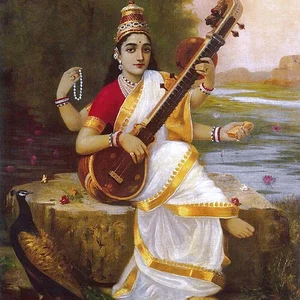
- Depicted with four arms holding a vînâ, a rosary, a book and a lotus
Works & Achievements
According to Hindu tradition, Sarasvati shaped the phonemes of Sanskrit, the “language of the gods,” enabling the composition and transmission of the Vedas. Panini later codified its grammar into 3,959 rules, still taught to this day.
Sarasvati is the guardian and inspirer of the four Vedas, the foundations of Hindu religious thought. She ensures their faithful transmission by the rishis (visionary sages) through an oral tradition of remarkable precision.
Sarasvati is credited with inventing the Devanagari script, the Hindu calendar, and the musical arts, making her the patron goddess of all forms of intellectual and artistic creation in Indian civilization.
Tradition attributes to Sarasvati’s blessing the composition of the Ramayana by Valmiki and the Mahabharata by Vyasa, the two great founding epics of Indian culture and all the classical literature of the subcontinent.
Kālidāsa, considered the greatest Sanskrit poet, claimed to be inspired by Sarasvati. His works — Shakuntala, Meghaduta, Kumarasambhava — represent the pinnacle of classical Indian literature, still read and performed today.
This early spring festival, dedicated to Sarasvati, has become India’s national celebration of learning. Students honor the goddess by placing books and instruments before her image, perpetuating a living bond between divinity and knowledge.
Anecdotes
According to Hindu tradition, Sarasvati is the creator of Sanskrit, the sacred language in which the Vedas were composed. It is said she shaped the sounds of the cosmos into syllables, giving humanity the instrument of knowledge and prayer. Sanskrit is still considered by linguists today as one of the most regular and precise languages ever constructed.
The Sarasvati River, celebrated in the Rigveda as “the best of mothers, the best of rivers, the best of goddesses,” flowed between the Indus and the Ganges. Archaeologists have identified its dried-up bed beneath the present-day Ghaggar-Hakra river in Rajasthan, confirming that the myth rests on an ancient geographical reality dating back to the 2nd millennium BCE.
During the Vasant Panchami festival, which marks the end of winter in India, students and artists place their books, musical instruments, and styluses before Sarasvati’s image to receive her blessing. No classes are held that day: to study would be to offend the goddess by not devoting this time of worship entirely to her.
In Hindu mythology, Sarasvati is said to flee places where money holds sway. A popular saying goes: “Where Lakshmi dwells (goddess of wealth), Sarasvati departs.” This paradox illustrates the tension between knowledge and material wealth, a recurring theme in Vedic thought that prizes learning sought for its own sake.
The poet Kālidāsa, considered the Shakespeare of classical India (5th century CE), claimed to draw his inspiration directly from Sarasvati. According to legend, originally illiterate, he is said to have received the gifts of speech and wisdom after praying fervently to the goddess, going on to compose masterpieces such as *Shakuntala* and the *Meghaduta*.
Primary Sources
“Sarasvati, you who possess seven sisters, who are the best of mothers, the best of rivers, the best of goddesses, grant us abundance and glory.”
“May she, great among the great, the most illustrious among the illustrious, divine Sarasvati, be present with us and grant us her favor.”
“She holds in her four hands the *vina*, the rosary, the book of the Vedas, and the lotus flower. Her garment is white as snow, a symbol of pure knowledge, and her vehicle is the white swan.”
“Yā Kundendu tushhāra hāra dhavalā — You who are white as jasmine, as the moon, as mountain snow, I invoke you, O Sarasvati, you who dispel the darkness of ignorance.”
“The sages invoked Sarasvati before dictating the sacred words to Vyasa, for she alone could ensure that the Vedas would be passed down without error from generation to generation.”
Key Places
The Sarasvati River celebrated in the Rigveda is today identified with the dried bed of the Ghaggar-Hakra. This site unites physical geography and mythological memory, attesting that the Vedic myth is rooted in an ancient reality.
A holy city associated with Brahma, husband of Sarasvati, Pushkar is home to one of the few temples dedicated to the creator god in the Hindu world. Sarasvati is venerated here during the great annual pilgrimages.
This spiritual center founded by Adi Shankaracharya in the 8th century houses a celebrated temple of Sharada, a local form of Sarasvati. It remains one of the most revered seats of Brahminic learning in South India.
The spiritual capital of India and a center of Vedic learning since antiquity, Varanasi is intimately linked to Sarasvati as a pre-eminent site for the transmission of sacred knowledge and the composition of great philosophical texts.
The cosmic mountain at the center of the universe in Hindu tradition, Meru is the dwelling place of the gods, including Brahma and Sarasvati. It symbolizes the summit of knowledge, inaccessible to the uninitiated.
Typical Objects

The emblematic stringed instrument of Sarasvati, the vīṇā symbolizes the harmony of the cosmos and mastery of the arts. To play the vīṇā is to take part in the divine order that keeps the universe in balance.

Sarasvati always holds a book or a scroll of palm leaves representing the Vedas, the source of all sacred knowledge. This book is a reminder that wisdom must be passed down faithfully from teacher to student.

This string of 108 beads held in one of Sarasvati's hands symbolizes time, meditation, and the recitation of mantras. Each bead represents a letter of the Sanskrit alphabet.

The white lotus on which Sarasvati sits, or which she holds, symbolizes the purity of knowledge, rising above the troubled waters of ignorance and the material world.

The swan is Sarasvati's *vahana* (vehicle); in the Hindu tradition, it symbolizes the ability to discern the essential from the superficial, just as the sage distinguishes truth from falsehood.

This vessel containing pure water represents the inexhaustible source of knowledge and ritual purity. It is also the attribute of ascetics and Brahmins who seek knowledge for its own sake.

Unlike other Hindu goddesses who are often depicted in red or gold, Sarasvati is always shown in white — the color of purity, truth, and knowledge freed from passion.
School Curriculum
Vocabulary & Tags
Key Vocabulary
Daily Life
Morning
At dawn, when brahmins begin their recitation of Vedic hymns, the presence of Sarasvati is invoked through the Sarasvati Vandana, a prayer sung at sunrise. Students in gurukula (Vedic schools) memorize their first lessons during this golden hour, believing that the goddess is then closest to humankind.
Afternoon
During the day, Sarasvati presides over philosophical discussions and debates among sages in the ashrams. Artists dedicate their musical compositions to her, placing the vînâ before her image before they play. Scribes copying manuscripts onto palm leaves invoke her blessing to avoid errors in transmission.
Evening
At sunset, oil lamps are lit before her image in temples and homes. Storytellers and poets recite epics by the light of the flames, perpetuating the oral tradition that Sarasvati established. Students end their day by meditating on the sacred syllables of Sanskrit.
Food
As a goddess, Sarasvati does not consume ordinary food, but her devotees offer her white foods symbolizing purity: rice pudding, white khichdi, hazelnuts, and dried fruits. These strictly vegetarian offerings reflect her association with knowledge untainted by material desires.
Clothing
Sarasvati is invariably depicted wearing immaculate white silk, the color of pure and selfless knowledge, in contrast to the red of passion or the gold of worldly wealth. She wears simple gold ornaments — necklaces, bracelets, and a diadem — for true wealth, to her, is wisdom rather than adornment.
Housing
Sarasvati dwells in places consecrated to knowledge: the ashrams of sages, manuscript libraries, and brahmin temples where texts are studied and handed down. In Hindu cosmology, she shares Brahmaloka with her consort Brahma, at the summit of the cosmos, yet is also present wherever a being sincerely seeks knowledge.
Historical Timeline
Period Vocabulary
Visual Style
Style iconographique classique de l'Inde védique et de la période Gupta : déesse blanche aux quatre bras sur fond doré et lotus, mêlant la précision de la sculpture du Ve siècle et la délicatesse des miniatures du Rajasthan.
Sound Ambience
Ambiance sonore d'un ashram védique à l'aube : récitation des hymnes sacrés, musique de vînâ et murmure d'une rivière sacrée, évoquant le monde de la connaissance et de la création poétique.
Liens externes & ressources
Références
Œuvres
Don de la parole et de la connaissance (Vâc)
depuis l'âge védique
Invention de l'écriture sanskrite et du devanagari
tradition classique
Patronage des Veda et des arts (64 arts, kalâ)
Inde hindoue ancienne
Fête de Vasant Panchamî
attestée dès le Moyen Âge indien
Rite de l'akshara abhyasam (première écriture)
tradition classique et moderne
Diffusion en Asie sous le nom de Benzaiten
à partir du VIe-VIIe siècle apr. J.-C.