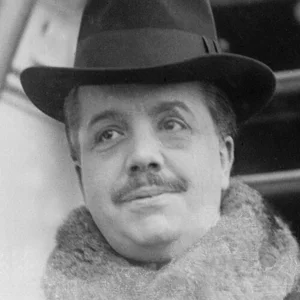

Russian impresario and patron of the arts, Diaghilev founded the Ballets Russes in 1909, revolutionizing choreographic art by bringing together the greatest artists of his era. He collaborated with Stravinsky, Picasso, Matisse, and Nijinsky to create total spectacles blending dance, music, and the visual arts.
Serge de Diaghilev(1872 — 1929)
Serge de Diaghilev
Empire russe
9 min read
Frequently asked questions
Famous Quotes
« Astonish me!»
« I am first of all a great charlatan, secondly a great charmer, thirdly a sort of shameless fellow, fourthly a man with a great deal of logic and very few scruples.»
Key Facts
- 1872: Born in Selichtchi, Russia
- 1909: Founding of the Ballets Russes in Paris
- 1913: Premiere of Stravinsky's The Rite of Spring, a resounding scandal at the Théâtre des Champs-Élysées
- 1917: Collaboration with Picasso and Cocteau on the ballet Parade
- 1929: Death in Venice, leaving the Ballets Russes without a successor
Works & Achievements
A revolutionary dance company created by Diaghilev in Paris, bringing together the finest dancers, choreographers, composers, and visual artists of the era to produce total works of art.
The first ballet created in collaboration with Stravinsky, drawn from a Russian folk tale, whose blazing score and orientalist sets by Bakst caused a sensation in Paris.
An expressionist ballet based on a libretto by Stravinsky and Benois, depicting the life of a fairground puppet — a meditation on art and freedom regarded as one of the masterworks of the twentieth century.
The defining scandal of modern music, with Stravinsky's score and Nijinsky's ground-breaking choreography, this work permanently shattered the aesthetic conventions of both dance and music.
A cubist ballet conceived with Satie, Picasso, and Cocteau, in which sculptural costumes and mechanical sounds replace traditional music — a manifesto of the Parisian avant-garde brought to the stage.
A choreographic cantata by Stravinsky set to Russian folk texts, with stark sets by Goncharova, prepared over ten years and considered the absolute pinnacle of the Ballets Russes aesthetic.
Russia's first publication devoted to the European Art Nouveau movement and the revival of Russian decorative arts, founded by Diaghilev in Saint Petersburg — his earliest act as a patron and publisher.
Anecdotes
Diaghilev was famous for his absolute demands on his collaborators. When the young Jean Cocteau submitted show ideas to him, Diaghilev simply told him: “Astonish me!” This phrase became a rallying cry for an entire generation of Parisian artists, driven to surpass convention.
The premiere of The Rite of Spring, on May 29, 1913 at the Théâtre des Champs-Élysées, caused a resounding scandal. Stravinsky's dissonant score and Nijinsky's angular choreography shocked the bourgeois audience to the point that fistfights broke out in the hall — one of the most tumultuous evenings in the history of music.
Diaghilev suffered from a profound thalassophobia, a morbid fear of the sea. He avoided sea crossings as much as possible and considered water a bad omen. As fate would have it, he died in Venice in August 1929, in a city built entirely on water.
A great discoverer of talent, Diaghilev spotted the young dancer Vaslav Nijinsky in 1908 and made him the greatest star of his era. But when Nijinsky married in 1913 without telling him, he dismissed him on the spot — a mixture of personal jealousy and a sense of betrayal that left a lasting mark on both men.
To finance the Ballets Russes during difficult periods, Diaghilev did not hesitate to call on wealthy patrons. Coco Chanel, who deeply admired his work, advanced him a considerable sum to save the company in 1921 and notably funded the revival of The Rite of Spring. The worlds of fashion and art were thus intimately intertwined around him.
Primary Sources
“I want this music to be new, brutal, primitive. Give me something no one has ever heard.” Diaghilev, letter to Stravinsky, 1912.
“Diaghilev had the gift of seeing in an artist what that artist had not yet suspected in himself. His gaze went through you, revealed you to yourself.”
“Diaghilev was the first to teach me that shame at the beautiful gesture is a virtue, that true elegance lies in refusing the easy way out.”
“In rehearsals, Diaghilev was everywhere at once — he listened to the music, watched the costumes, corrected the dancers. Nothing escaped him. He was a demiurge.”
“He often went hungry so that his artists could be paid. He slept little, spent everything, lived for one thing only: that the show be perfect.”
Key Places
The venue for the Ballets Russes' first season in 1909, this Parisian theatre was the starting point of Diaghilev's choreographic revolution and the birthplace of his legend in Europe.
The scene of the Rite of Spring scandal in May 1913, this Art Deco theatre — inaugurated that same year — was the setting for one of the most famous evenings in twentieth-century musical history.
The winter home of the Ballets Russes from 1911 onwards, Monte-Carlo gave Diaghilev a permanent rehearsal space and the financial backing of the principality, making it his Mediterranean base of operations.
It was in this grand Venetian hotel on the Lido that Diaghilev died on 19 August 1929, surrounded by Coco Chanel and Serge Lifar. He was buried on the island of San Michele, Venice's cemetery for artists.
Diaghilev's birthplace and the cradle of his cultural formation, Saint Petersburg was where he made his first artistic commitments and founded the journal *Mir Iskusstva* in 1898.
Covent Garden regularly hosted the Ballets Russes during their British tours, and London was one of the three great centres — alongside Paris and Monte-Carlo — of Diaghilev's activity.
Typical Objects

An emblematic accessory of Diaghilev, his monocle underscored his authority and his piercing gaze. He used it expressively during rehearsals to signal his attention or disapproval.

Diaghilev always carried notebooks in which he jotted down ideas for productions, lists of artists to contact, and draft programmes. These notebooks bear witness to his ceaseless creative activity.

The cardboard and fabric maquettes made by Bakst, Picasso, or Matisse were Diaghilev's everyday working objects; he personally supervised every visual detail of his productions.

Before the telephone, Diaghilev managed his European artistic network by telegram. Hundreds of these have been preserved, bearing witness to frantic negotiations with composers, dancers, and patrons.

The scores of works created by the Ballets Russes were covered in Diaghilev's annotations; he followed the musical composition closely and intervened directly with the composers.

The Ballets Russes posters — often created by artists such as Cocteau or Picasso — were works of art in their own right. Diaghilev attached as much importance to visual communication as to the performances themselves.

The costumes created for the Ballets Russes by Bakst, Goncharova, or Picasso were unique artistic works. Diaghilev regarded them as an integral part of the total work of art he sought to create.
School Curriculum
Vocabulary & Tags
Key Vocabulary
Daily Life
Morning
Diaghilev rarely rose before ten o'clock. He had breakfast while reading the Parisian press and reviews of recent performances, annotating the critics. His morning was devoted to correspondence — dozens of letters and telegrams to composers, dancers, patrons and theatre directors across Europe.
Afternoon
The afternoon was the time for rehearsals. Diaghilev spent hours in the studio observing dancers and choreographers, sometimes intervening directly to correct a posture or an interpretation. He would then receive visitors — artists, journalists, wealthy aristocrats whose financial support he sought for his upcoming seasons.
Evening
Performance evenings were his favoured domain. Diaghilev attended every show from the wings or the auditorium, scrutinizing the audience's reactions. After the curtain fell, he would hold court in Parisian salons or restaurants on the Right Bank, mingling Russian aristocrats in exile, avant-garde artists and the world of fashion.
Food
Diaghilev enjoyed fine cuisine and great wines, particularly in the Parisian restaurants he frequented assiduously. On tour, he often subsisted on quick meals grabbed between rehearsals. His fragile health and late-diagnosed diabetes sometimes constrained his diet, which he rarely respected.
Clothing
Impeccably dressed, Diaghilev wore bespoke suits tailored by the finest Parisian and London tailors. The white streak in his black hair, his monocle and cane were his instantly recognizable visual signature throughout Paris. He attached to sartorial elegance the same importance as to the costumes of his productions.
Housing
Diaghilev lived from hotel to hotel, with no fixed address, perpetually on tour between Paris, Monte Carlo, London and the European capitals. The grand suites of luxury hotels — the Hôtel de France in Paris, the Hôtel de Paris in Monte Carlo, the Savoy in London — served as his temporary offices and artists' salons, strewn with scores, set models and telegrams.
Historical Timeline
Period Vocabulary
Visual Style
Le style visuel de Diaghilev fusionne l'orientalisme flamboyant de Bakst, le cubisme de Picasso et l'art populaire russe, créant une esthétique théâtrale révolutionnaire entre tradition et avant-garde.
Sound Ambience
L'univers sonore des Ballets Russes mêle les coulisses agitées d'un grand théâtre parisien, les répétitions musicales au piano et la rumeur du public bourgeois et bohème de la Belle Époque.