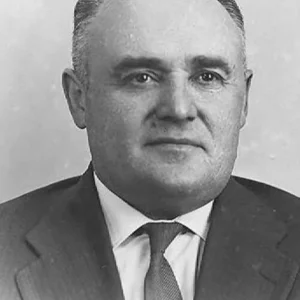

Soviet engineer of Ukrainian origin, Korolev is the father of the Soviet space program. He designed Sputnik, the first artificial satellite, and the Vostok capsule that allowed Gagarin to fly in space.
Sergei Korolev(1907 — 1966)
Sergei Korolev
Union soviétique
8 min read
Frequently asked questions
Key Facts
- 1957: launches Sputnik 1, the first artificial satellite in history
- 1961: designs the Vostok capsule that carries Yuri Gagarin into space
- Arrested during the Stalinist purges (1938), he survives the Gulag
- 1959: his Luna probes reach the Moon for the first time
- Dies in 1966, before he could see man walk on the Moon
Works & Achievements
The world's first operational intercontinental ballistic missile, capable of delivering a nuclear warhead over 8,000 km. A modified version served as the launch vehicle for Sputnik and all early Soviet space missions.
Humanity's first orbital achievement, rushed into development to beat the Americans. Its launch triggered the “Space Race” and left a lasting mark on Cold War geopolitics.
The first living creature sent into orbit, the dog Laika helped confirm that space conditions were not immediately lethal to a living organism, paving the way for human spaceflight.
Designed by Korolev, this spherical capsule carried Yuri Gagarin on a complete orbit of the Earth in 108 minutes. The flight remains one of the most landmark events in the history of science and exploration.
An evolution of the Vostok capable of carrying multiple cosmonauts and performing activities outside the capsule. Alexei Leonov completed the first “spacewalk” in March 1965.
An improved version of the R-7 launch vehicle, developed under Korolev's direction shortly before his death. The Soyuz went on to become the most reliable and most-used launch vehicle in spaceflight history, and remains in service today.
Anecdotes
Korolev survived Stalin's Gulag: arrested in 1938 on charges of sabotage, he was sentenced to forced labor in Siberia. He lost several teeth from scurvy and nearly died in the Kolyma mines. His survival was due in part to the intervention of a celebrated aviator, Valentina Grizodubova, who signed a petition on his behalf.
Throughout his lifetime, Korolev was publicly identified only as the anonymous “Chief Designer” (*Glavny Konstruktor*): his true identity was an absolute state secret. The Western world did not even know his name. Only after his death, in 1966, did the Soviets reveal that he was the architect of their space triumphs.
The launch of Sputnik 1 on October 4, 1957 lasted 98 minutes — the time it took to complete one full orbit. The satellite’s radio signal, a simple, steady “beep beep,” was picked up by amateur radio operators around the world. Korolev, in the control room, wept with joy when he heard that sound coming from space.
Korolev died on January 14, 1966, on the operating table, from a hemorrhage during what was meant to be a routine polyp removal. The surgeon discovered an undiagnosed colon cancer. A tragic irony: damage to his jaw sustained in the Gulag made it impossible to properly intubate the patient — he could not be saved. He never lived to see astronauts walk on the Moon.
Captivated by space from childhood, Korolev had met the pioneer Konstantin Tsiolkovsky in 1931. This solitary old scientist from Kaluga had theorized as early as 1903 that liquid-fueled rockets could make it possible to leave Earth. For Korolev, this encounter was a founding revelation that shaped his entire career.
Primary Sources
I am working, I am holding on. My only hope is to return and continue my work. I think of our dreams — they are not dead.
The R-7 intercontinental ballistic vector demonstrates the capability to place a payload in low Earth orbit. Trajectory calculations confirm the feasibility of an artificial satellite.
I propose to leverage the R-7's capabilities to place an artificial object in orbit before the Americans, which would represent an unprecedented political and scientific achievement for the Soviet Union.
Today, a Soviet citizen has traveled into space. What Tsiolkovsky dreamed of, we have accomplished. The space age has begun.
The capsule must ensure the cosmonaut's survival under all circumstances. The ejection system is the ultimate safeguard. We cannot afford the slightest human error.
Key Places
Korolev's birthplace, then part of the Russian Empire. He spent his early years there before moving to Odessa and then Kyiv for his studies.
The headquarters of Korolev's design bureau on the outskirts of Moscow, where Sputnik, Vostok, and all of the Soviet space program's major achievements were conceived. Today renamed "the city of Korolev," it still hosts Russian space industry facilities.
The launch facility built in the Kazakh desert under Korolev's direction. Sputnik 1 and Vostok 1 — carrying Gagarin — lifted off from here. The site, leased to Russia, is still in use today for Soyuz missions.
The region of Stalinist Gulag camps where Korolev was imprisoned from 1938 to 1940. He survived there under extreme conditions before being transferred to work in a *sharashka* (a prison research laboratory).
The city where Konstantin Tsiolkovsky, the theoretical father of astronautics, lived and worked. Korolev traveled there in 1931 to meet the elderly scientist — a decisive visit that cemented his calling in space exploration.
Typical Objects

An indispensable tool for Soviet engineers of the era, Korolev used it to perform ballistic trajectory and propulsion calculations before the age of computers. It symbolizes the mathematical rigor that defined his daily work.

The R-7 Semyorka was the world's first operational intercontinental ballistic missile, designed by Korolev. It was this same rocket, slightly modified, that carried Sputnik and then Gagarin into orbit.

A metal sphere 58 cm in diameter weighing 83.6 kg, fitted with four radio antennas, Sputnik was designed by Korolev's teams in a matter of weeks. Its "beep beep" signal alone came to symbolize humanity's entry into the space age.

Developed to protect the cosmonaut in the event of cabin depressurization, this suit was refined under Korolev's supervision. It reflects his constant concern for the safety of the pilots he was sending into space.

Korolev was renowned for filling entire notebooks with calculations and diagrams in his own hand, particularly for launch windows and orbital maneuvers. These handwritten notes reveal an engineer who was as much an inventor as a manager.

Like all senior figures in the Soviet military-industrial complex, Korolev communicated with the Kremlin over secure lines. This telephone symbolizes the permanent link between space science and Soviet political power.
School Curriculum
Vocabulary & Tags
Key Vocabulary
Daily Life
Morning
Korolev arrived at OKB-1 early in the morning, often before 8 a.m., to go through the night's technical reports and meet with his on-duty engineers. He imposed military discipline but took the time to listen to technical problems one by one, pen in hand.
Afternoon
Afternoons were devoted to coordination meetings between the bureau's various departments — propulsion, guidance, structures — and to technical decisions on ongoing projects. During launch preparations, he could spend hours personally supervising tests at the Baikonur launch pad.
Evening
In the evenings, Korolev often returned late to his dacha near Moscow, where he would review plans or draft memorandums for the Central Committee. He was known for never truly “switching off” from work, calling his engineers late at night whenever a project ran into trouble.
Food
Like the vast majority of Soviet citizens of his generation, Korolev ate simply: cabbage soup (shchi), black bread, kasha (buckwheat porridge), and canned goods. His health, weakened by the Gulag, required a certain frugality, and he suffered from heart problems in his later years.
Clothing
At work, Korolev typically wore a lab coat or a plain dark suit, with no ostentation. During launches at Baikonur, he donned a thick winter coat and a fur ushanka — essential gear against the freezing temperatures of launch nights in the Kazakh desert.
Housing
Korolev lived in a comfortable dacha near Moscow, a privilege granted to high-ranking officials in the Soviet military-industrial complex. He had a personal study but led a relatively modest life, forgoing the ostentatious luxury his rank could have afforded him.
Historical Timeline
Period Vocabulary
Liens externes & ressources
Références
Œuvres
Spoutnik 1 — premier satellite artificiel de la Terre
4 octobre 1957
Spoutnik 2 et le vol de Laïka
3 novembre 1957
Capsule Vostok 1 — premier vol humain dans l'espace
12 avril 1961
Programme Voskhod — sorties extravéhiculaires
1964–1965
Fusée Soyouz (R-7 modifié, version finale)
1966