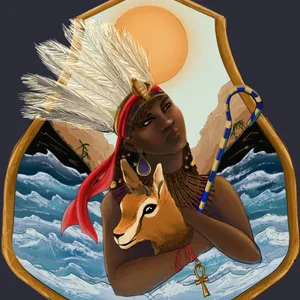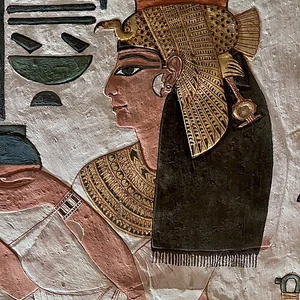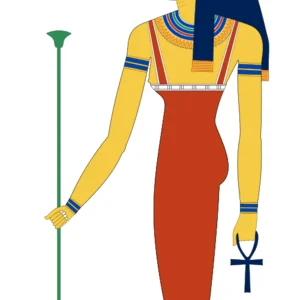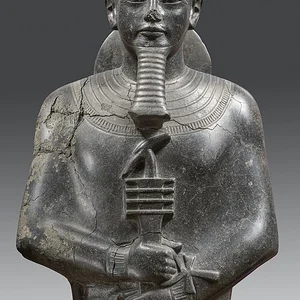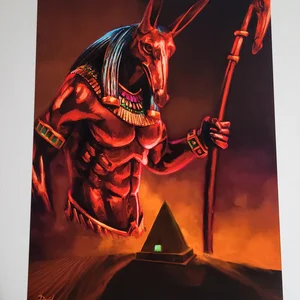

Set is the Egyptian god of chaos, storms, and the desert. Brother of Osiris, whom he murdered to seize the throne of Egypt, he was later defeated by his nephew Horus. An ambivalent figure, he was also venerated as the protector of Ra against the serpent Apophis.
Set
Set
8 min read
Frequently asked questions
Key Facts
- Worshipped as early as the Predynastic period at Naqada (c. 3500 BCE), where he was the tutelary deity
- According to the Osirian myth, he killed and dismembered his brother Osiris to seize power
- His conflict with Horus over the throne of Egypt is one of the founding myths of pharaonic kingship
- Particularly honored during the 19th and 20th Dynasties (c. 1295–1069 BCE) — the pharaohs Seti I and Seti II bore his name
- Each night he protected the bark of Ra by repelling the serpent Apophis, symbolizing the victory of order over chaos
Works & Achievements
A grand mythological saga in which Set is the main antagonist: the murder of Osiris, the dismemberment of his body, and the battle against Horus. This cycle forms the foundation of pharaonic legitimacy and the Egyptian belief in resurrection.
A literary account of the trial between Set and Horus before the gods. A major text that blends divine epic, humor, and political reflection on justice and the legitimacy of power.
Religious compositions commissioned by Ramesses II celebrating Set as god of victory and protector of the royal family, attesting to his positive status under the Nineteenth Dynasty.
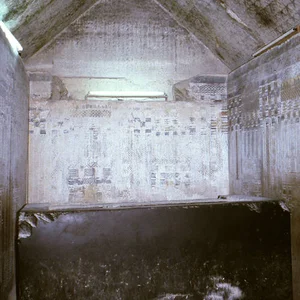
The oldest religious texts in which Set is mentioned, carved into the burial chambers of the pyramids of the Fifth and Sixth Dynasties. They reveal his ambivalent nature from the very beginning.
A ritual text describing Set's nightly battle against the serpent Apophis, recited daily in temples to symbolically ensure the rising of the sun and the preservation of cosmic order.
Anecdotes
Jealous of Osiris's power, Set lured him into a trap by crafting a chest made to the exact measurements of his body during a banquet. When Osiris lay down inside it, Set slammed the lid shut, sealed the chest with molten lead, and threw it into the Nile. This premeditated murder set in motion one of the great mythological sagas of ancient Egypt.
Not content with having drowned Osiris, Set found the body that Isis had recovered and cut it into fourteen pieces, scattering them across the four corners of Egypt. Isis and Nephthys traveled the entire land to gather the fragments, but the phallus — swallowed by a Nile fish — was never found.
Each night, during the sun's journey through the underworld (the Duat), Set stood at the prow of Ra's solar barque to face the giant serpent Apophis, embodiment of absolute chaos. His mastery of chaotic forces made him indispensable for this task: only he could repel the monster and ensure the sun rose again each morning.
During the New Kingdom, the Nineteenth Dynasty placed itself explicitly under Set's protection: the pharaoh Seti I bears a name that literally means 'man of Set.' His son Ramesses II had hymns in Set's honor carved at Avaris, the former Hyksos capital. Set was therefore far from being simply an evil deity in Egyptian eyes.
The rivalry between Horus and Set for the throne of Egypt lasted, according to the texts, eighty years. The divine tribunal of the Ennead of Heliopolis struggled to reach a verdict: Set argued his strength and his protective role, Horus his filial legitimacy. The two gods clashed in many forms before Thoth finally declared Horus the victor.
Primary Sources
Set is struck down by the servants of Horus; his power is turned against him. The king ascends to the sky, the king crosses the firmament.
Then Set said: 'Give me the office of Osiris.' And the gods said: 'Let Horus and Set be summoned, and let their words be heard.' And they pleaded for eighty years before the tribunal of Re.
I am Set, great of strength, who slays Apophis each day upon the bark of millions of years. I am he who protects Re against the serpents of chaos.
Typhon, in a fit of jealousy and hatred, sought to destroy Osiris. He secretly had a chest crafted to the exact measurements of Osiris's body, and at a banquet presented it as a gift to whoever could fit inside it.
Set is bound, his arms tied behind him. Horus triumphs over Set before the tribunal of the Great Ennead of Heliopolis.
Key Places
The primary cult center of Set since the Predynastic period. This is where his veneration is oldest and deepest, long before the unification of Egypt.
Capital of the Hyksos, who adopted Set as their supreme god by identifying him with their storm deity Baal. Ramesses II later built temples in his honor there after founding Pi-Ramesses nearby.
Set's mythological domain: the deserts stretching east and west of the Nile were his realm of choice. The Egyptians called it the 'Red Land,' in contrast to the fertile 'Black Land.'
A cult site of Set in the Western Desert, where he was invoked as the protector of caravans and travelers facing the perils of the desert.
Seat of the great divine tribunal (the Great Ennead), where Horus and Set pleaded their cases for eighty years. Ra-Atum presided over the proceedings that determined the fate of Egypt's throne.
Typical Objects
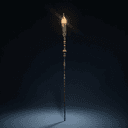
A staff topped with the head of Set's animal, symbolizing divine power. Set is often depicted holding it, a sign of his dominion over the forces of chaos.
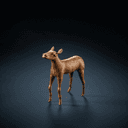
An unidentified creature with long, straight pointed ears and a forked tail, the exclusive emblem of Set. No real animal matches this depiction exactly, which reinforces the mysterious and otherworldly nature of the god.
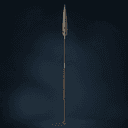
The weapon with which Set pierces the serpent Apophis each night aboard Ra's solar barque. It symbolizes his warrior function and his indispensable role in maintaining cosmic order.
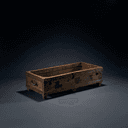
The central object of the Osirian myth: Set had this chest crafted to Osiris's exact measurements in order to trap him inside it during a banquet. It symbolizes cunning and treachery as instruments of chaos.
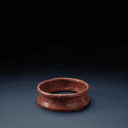
Associated with Lower Egypt, the red crown was worn by Set in certain dynastic depictions, recalling the original balance between the two gods Set and Horus over the Two Lands.
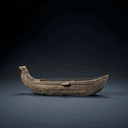
The divine vessel on which Ra crosses the sky and the nocturnal underworld. Set holds a place of honor at the prow to repel Apophis, with desert storms interpreted as his protective breath.
School Curriculum
Vocabulary & Tags
Key Vocabulary
Tags
Daily Life
Morning
At dawn, Set boards the solar barque of Ra to begin the celestial crossing of the day. His mission starts the very moment Apophis is defeated and the sun rises above the horizon. The priests of his temples invoke him at this precise moment so that the desert remains within its bounds.
Afternoon
During Ra's daytime crossing of the sky, Set stands guard against the enemies of cosmic order. He roams the edges of the red desert — his jealously guarded domain — unleashing sandstorms as a display of his power. Caravans crossing his lands offer prayers to win his mercy.
Evening
At nightfall begins Set's true ordeal: Ra's barque descends into the Duat, the underworld. Set takes his post at the prow, weapon in hand, to face Apophis. The nocturnal battle is fierce and its outcome never certain — each sunrise is a renewed victory of Set over absolute chaos.
Food
As a god, Set has no human needs. In the ritual offerings of his temples, priests would present him with oryx and gazelles — desert animals associated with his domain — along with red-colored loaves of bread whose hue recalled the desert and the god's chaotic power.
Clothing
Set is depicted wearing the shendyt, the short white linen kilt worn by gods and pharaohs alike. He sometimes wears a red tunic, the color of the desert and chaos. His most distinctive feature is his headdress topped with the head of the Set animal, whose long, pointed ears are his unmistakable hallmark.
Housing
Set's mythological realm is the red desert (deshret), the arid expanses to the east and west of the Nile. In ancient texts, he dwells in a celestial palace from which he commands the storms. On earth, his principal sanctuary stood at Ombos (Nubt), where a community of priests maintained his cult from as far back as the Predynastic period.
Historical Timeline
Period Vocabulary
Visual Style
Style égyptien classique du Nouvel Empire avec des aplats de rouge ocre et de bleu nuit, représentant Set dans toute son ambivalence entre chaos destructeur et gardien cosmique.
Sound Ambience
Ambiance de tempête désertique, de chaos nocturne et de combat cosmique, entre les grondements du tonnerre sur le désert rouge et le sifflement d'Apophis dans les ténèbres du Douat.
Liens externes & ressources
Références
Œuvres
Le Mythe d'Osiris (cycle osirien)
v. 2400 av. J.-C. (première attestation)
Les Aventures d'Horus et de Set (Papyrus Chester Beatty I)
v. 1160 av. J.-C.
Hymnes à Set de Pi-Ramsès
v. 1270 av. J.-C.
Textes des Pyramides — Chapitres de Set
v. 2400-2300 av. J.-C.
Rituel de destruction d'Apophis (Livre d'Apophis)
Nouvel Empire, v. 1550-1070 av. J.-C.