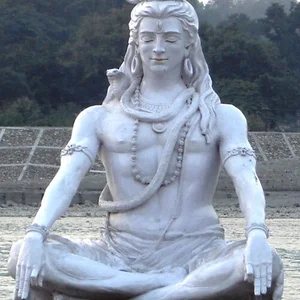

Shiva is one of the three principal deities of Hinduism, forming the Trimūrti alongside Brahmā and Vishnu. God of destruction and transformation, he also embodies meditation, the arts, and fertility. His cult, rooted in the Indus Valley civilization, is one of the oldest in the world.
Shiva
Shiva
9 min read
Frequently asked questions
Key Facts
- Mentioned as early as the Rigveda (c. 1500 BCE) under the name Rudra, a forerunner of Shiva
- Depicted as Nataraja (Lord of the Dance) in classical iconography, symbolizing the cosmic cycle
- The lingam cult, a symbol of Shiva, is attested in the Indus Valley civilization (c. 2500 BCE)
- Father of Ganesha and Kartikeya, husband of Parvati (the benevolent form of the Goddess)
- Shaivism is one of the two major devotional traditions of Hinduism, alongside Vaishnavism
Works & Achievements
Shiva's cosmic dance, represented by the Nataraja statue, is a symbol of the cyclical creation and destruction of the universe. It is regarded as the source of all performing arts in the Indian tradition.
According to tradition, Shiva is the first master of yoga, having transmitted 112 techniques of meditation and enlightenment to the seven sages (Saptaṛṣi) gathered on the shores of Lake Kantisarovar. This myth establishes him as the father of all yogic practice.
A foundational yoga treatise presented as Shiva's direct teaching to his consort Pārvatī, describing prāṇāyāma techniques, energy centers (chakras), and pathways to spiritual liberation.
A powerful Vedic mantra addressed to Rudra-Shiva, regarded as a protection against death and disease. Still recited daily by millions of devotees, it is one of the oldest religious texts in the world still in active liturgical use.
An iconographic representation of Shiva merged halfway with Pārvatī — half male, half female — symbolizing the unity of masculine and feminine principles in the cosmos. This philosophical concept anticipates modern ideas about the complementarity of genders.
A bronze sculpture depicting Shiva dancing within a ring of flames, holding the drum of creation and trampling the demon of ignorance. Considered one of the pinnacles of sculptural art worldwide, it is displayed in the greatest museums on earth.
Anecdotes
During the churning of the cosmic ocean (Samudra Manthan), a deadly poison called Halahala escaped from the depths and threatened to annihilate the universe. To save all of creation, Shiva drank the poison himself. His throat turned blue as a result, earning him the epithet Nīlakaṇṭha, meaning 'the blue-throated one.' This act of absolute self-sacrifice is one of the most celebrated stories in Hindu mythology.
Shiva is the master of the cosmic dance known as Tāṇḍava. According to sacred texts, this fierce and frenzied dance represents both the destruction of the old universe and the birth of a new world. It is contrasted with the Lāsya, the graceful dance associated with his wife Pārvati — together, the two dances symbolize the balance between creative destruction and gentleness.
The goddess Gangā, a celestial river of devastating power, was destined to descend to Earth. Had she fallen directly, she would have swallowed everything in her path. Shiva agreed to catch the Ganges in his long, tangled locks (the jaṭā), allowing the water to flow down in calm, gentle streams toward the plains. This legend explains why the Ganges is considered sacred and purifying in India.
Kāma, the god of love, was sent to distract Shiva from his meditation and persuade him to unite with Pārvati. Enraged at being interrupted, Shiva opened his frontal third eye and reduced Kāma to ashes with a single glance. This myth illustrates the supreme power of spiritual concentration and explains why Kāma was sometimes called Ananga, meaning 'the bodiless one.'
On Mount Kailāśa, Shiva's eternal abode, the god spends entire centuries in deep meditation, covered in funeral ashes, surrounded by serpents and demons. This image — the supreme deity choosing to live as an ascetic stripped of all worldly possessions — has captivated devotees for millennia and makes Shiva the patron god of yogīs and renunciants.
Primary Sources
O Rudra, may your grace reach us, you who heal, whose hand holds remedies. Drive away the evils you have sent upon us, and let your arrows pass beyond us.
Homage to Rudra in the forests, in the trees, in the flowers, in the waters, in the armies, in the dust of the roads — he is present everywhere in a thousand forms.
Whoever fasts and keeps vigil through the night of Śivarātri, even unknowingly, is cleansed of all transgressions and attains the abode of Śiva.
Śiva is the lord of all beings, the great yogī, the one whose body is smeared with ash, who bears the moon in his hair and whose gaze can reduce to ashes whatever it beholds.
You are the light that dwells in the hearts of the devoted, O Śiva; you are closer to me than my own life, more intimate than my most secret thoughts.
Key Places
The eternal abode of Shiva in Hindu mythology, this snow-capped peak in the Tibetan Himalayas is regarded as the axis of the world (axis mundi). A sacred pilgrimage site for Hindus, Buddhists, and Jains alike, it has never been officially climbed out of religious reverence.
The holiest of Shiva's cities, founded according to tradition by the god himself, Varanasi has been the living heart of Shaivism for over 3,000 years. Dying in Varanasi is believed to guarantee liberation (moksha), and the Kashi Vishwanath temple there is the most venerated in all of Shaivite worship.
An archaeological site of the Indus Valley Civilization where the so-called "Pashupati seal" was discovered (c. 2500 BCE), depicting a horned figure in meditation that many scholars interpret as a proto-form of Shiva. This find is one of the earliest known traces of Shaivite worship.
A temple dedicated to Shiva Nataraja, the dancing deity, this site is one of the five great Shaivite temples representing the cosmic elements (here, space/ākāśa). The inner sanctum houses an aniconic representation of Shiva as empty space — the void as divine essence.
A Himalayan cave at an altitude of 3,888 meters, where a naturally forming ice liṅga is venerated each year as a manifestation of Shiva. Hundreds of thousands of pilgrims make the arduous climb every summer under extreme conditions.
Typical Objects

Shiva's iconic weapon and symbol, the trident represents his three cosmic functions: creation, preservation, and destruction. It also symbolizes mastery over the three states of consciousness (waking, dreaming, and deep sleep).
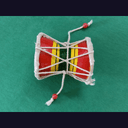
This small hourglass-shaped drum, held in the right hand of Shiva Nataraja, represents the primordial sound of creation (the sound "Om"). Its beat accompanies the cosmic dance and sustains the rhythm of the universe.
📷 CC BY-SA 4.0 · Wikimedia Commons ↗
The principal object of worship in Shaivite temples, the liṅga is a cylindrical pillar symbolizing Shiva's regenerative power. Twelve great luminous liṅgas (jyotirliṅgas) are venerated across India as direct divine manifestations.
📷 CC BY-SA 4.0 · Wikimedia Commons ↗
Shiva perpetually wears the king of serpents coiled around his neck, a sign of his absolute mastery over death and poison. The serpent also symbolizes Kundalini, the spiritual energy said to lie dormant at the base of the spine.

Shiva wears a crescent moon in his matted hair, a symbol of cyclical time and light within darkness. According to myth, he wears the moon to show his compassion for the lunar god, whom he rescued from a curse.
📷 CC BY 4.0 · Wikimedia Commons ↗
Shiva smears his body with ash from funeral pyres, asserting his dominion over death and the impermanence of all material things. His devotees apply three horizontal lines of ash to their foreheads during rituals.
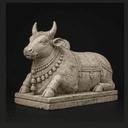
Shiva's mount and guardian, the bull Nandī stands watch at the entrance of every Shaivite temple, facing the inner sanctuary. He symbolizes pure devotion and disciplined strength in service of the divine.
School Curriculum
Vocabulary & Tags
Key Vocabulary
Tags
Daily Life
Morning
At dawn on Mount Kailāśa, Shiva emerges from his deep meditation (samādhi) after centuries of stillness. He rises, shakes his long matted locks from which the Ganges flows, and applies the three lines of sacred ash to his forehead before welcoming the gods and sages who come seeking his blessing.
Afternoon
Shiva devotes his afternoons to instructing his devotees: he teaches yoga to sages seated at his feet, counsels gods troubled by demons, and plays dice with Pārvatī on the snowy heights of Kailāśa. He also receives offerings of bel (bilva) leaves brought by his faithful from the plains below.
Evening
As the sun sets, Shiva dons his tiger skin and ventures into the forest to roam among the funeral pyres, accompanied by spirits and demons who form his procession. When night falls, he performs the Tāṇḍava dance that shakes all three worlds, the sound of his drum beating out the pulse of the entire universe.
Food
Shiva, an ascetic at heart, consumes poison (Halahala) without being harmed by it, drinks the celestial soma, and takes bhang (sacred cannabis) to deepen his meditation. Following the tradition of the renunciants (sannyāsins) who emulate him, he eats sparingly — forest fruits, Ganges water — or fasts entirely during the great nights of Śivarātri.
Clothing
Shiva wears a tiger skin around his waist — a symbol of his victory over animal impulses — and an elephant hide over his shoulders in his warrior manifestations. His body is coated in ash from funeral pyres (vibhūti), and his ornaments are living serpents rather than gold jewelry: the serpent king Vāsuki as a necklace, cobras as bracelets.
Housing
Shiva dwells on Mount Kailāśa in the Himalayas, a celestial palace with walls of eternal snow rising above the clouds. He shares this abode with Pārvatī, their son Gaṇeśa, and the bull Nandī, but spends most of his time seated in an icy cave — naked and motionless — lost in a meditation that sustains the balance of the cosmos.
Historical Timeline
Period Vocabulary
Visual Style
L'iconographie de Shiva allie la majesté sauvage des cimes himalayennes à la précision ornementale de la sculpture Chola, avec une palette de bleus cendrés, d'or rituels et de flammes orangées.
Sound Ambience
L'univers sonore de Shiva mêle le silence des cimes himalayennes à la pulsation du tambour cosmique, le grondement du Gange et les chants dévotionnels des ascètes méditant dans les grottes.
Liens externes & ressources
Références
Œuvres
La danse Tāṇḍava
temps mythique
Transmission du Yoga (Shiva comme Ādiyogī)
temps mythique
La Śiva Saṃhitā
XVe siècle apr. J.-C.
Le Mahāmṛtyuñjaya Mantra
Rigveda, vers 1200 av. J.-C.
Ardhanārīśvara (forme androgyne)
vers IIe siècle apr. J.-C.
Le Naṭarāja en bronze (époque Chola)
IXe-XIIe siècle apr. J.-C.