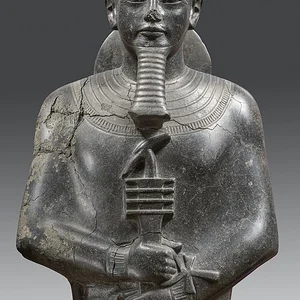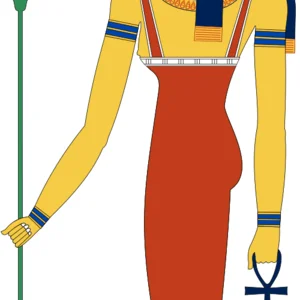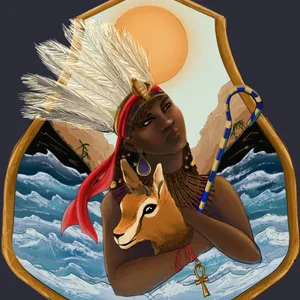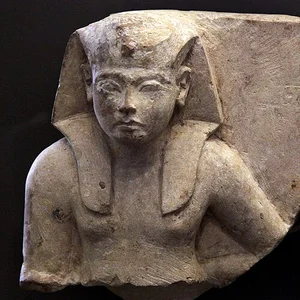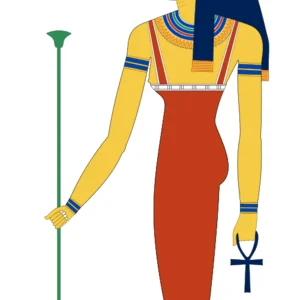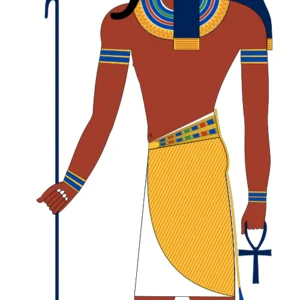

Shou is the ancient Egyptian deity personifying air and light. Son of Ra and husband of Tefnut, he supports the vault of the sky by separating Nut (the sky) from Geb (the earth). He embodies the vital space between the cosmos and the earthly world.
Shou
Shou
8 min read
Frequently asked questions
Key Facts
- Shou is one of the first deities created by Atum in the Heliopolitan cosmogony
- He is depicted lifting the sky (Nut) above the earth (Geb) with both arms outstretched
- Shou and his sister-wife Tefnut form the first divine couple of the Heliopolitan Ennead
- His name means "emptiness" or "he who lifts" in ancient Egyptian
- He is sometimes identified with the lion god Onuris in certain regional traditions
Works & Achievements
The earliest ritual formulas carved in the royal tombs of the Old Kingdom, constituting the oldest religious texts to mention Shu and establishing his birth by Atum.
A collection of magical spells designed to protect the deceased. Shu here embodies the vital breath that animates the soul in the afterlife and guides its celestial transformation.
Chapter 17 describes Shu as the spiritual image of Ra; chapter 83 allows the deceased to transform into the bennu heron by invoking his luminous power.
A mythological text carved in the tomb of Seti I, describing how Ra commanded Shu to lift Nut above the earth — the founding scene of Egyptian cosmology.
A lengthy mythological narrative in which Shu and Thoth travel to Nubia to bring back the Eye of Ra (Tefnut), who has transformed into a lioness, explaining the origin of several Egyptian religious festivals.
Anecdotes
Shu was born from a solitary act of the creator god Atum: according to the Pyramid Texts, Atum spat — or masturbated — bringing forth Shu (air) and his twin sister Tefnut (moisture). This Heliopolitan creation myth is one of the oldest in the world, passed down in royal tombs as far back as 2400 BCE.
Each day, Shu performs a titanic feat: he holds up the body of the goddess Nut (the sky) with his arms, preventing her from crashing down onto Geb (the earth). Egyptian depictions always show him in this pose — arms raised, supporting the starry vault — symbolizing the vital space that makes life possible between sky and earth.
A famous myth tells how Tefnut, furious with her father Ra, transformed into a fierce lioness and fled to Nubia. Shu was sent with the god Thoth to bring her back. They had to win her over with gentle words and music — a quest that, according to tradition, explains the origin of certain religious festivals honoring the lion goddess.
Shu ruled as a cosmic pharaoh after Ra withdrew into the sky, exhausted by the scheming of humankind. But his reign was troubled: his own son Geb rose up against him, seeking to seize power. This father-son conflict between the god of air and the god of earth illustrates the enduring tensions at the heart of the Egyptian cosmos.
In the Coffin Texts, the deceased aspires to become Shu in order to move freely through the sky. Shu's breath — literally the air — was seen as the animating force of both the living and the dead: without it, neither gods nor humans could breathe or exist.
Primary Sources
"O Atum, who spat out Shu and Tefnut, who are alone... you have put your arms around them like the arms of a ka, so that your ka may be in them."
"I am Shu, whom Atum brought forth from his creative power. There was not yet any sky, there was not yet any earth... I came between them."
"Who is he? He is Shu, the spiritual image of Ra, the guardian of sunlight, who came into being on the day that Ra himself was born."
"Then Ra said to Shu: My son, take Nut upon your neck and hold her away from Geb. Shu lifted Nut and held her above the earth."
"Shu and Thoth set out toward the land of Nubia to bring back Tefnut, the Eye of Ra. Shu took the form of a lion and walked beside her until her return."
Key Places
Great solar city of northern Egypt and the principal center of worship of the Great Ennead. It was here that Heliopolitan theology, which identifies Shu as the son of Atum, was developed and codified as early as the Old Kingdom.
City in the Nile Delta where Shu was venerated in the form of a lion, alongside Tefnut. This site was a major center of his cult during the Third Intermediate Period and the Late Period.
Political capital of the Old Kingdom, situated close to Heliopolis. Memphite theology incorporated Shu into its cosmogonic narratives, placing him among the great creative forces of the world.
Shu's own domain is the cosmic space he occupies eternally, arms raised — separating the earth (Geb) from the sky (Nut). This symbolic place is the very foundation of Egyptian cosmology.
Typical Objects

Shu always wears an ostrich feather on his head, emblem of his name and of the lightness of the air he embodies. This feather immediately distinguishes him in any Egyptian figurative representation.

Like the great gods, Shu holds the was sceptre with its stylized animal head, a symbol of divine power. Through this attribute, he asserts his cosmic authority over the atmospheric realms.

Shu is often depicted holding an ankh, the symbol of life. Since his breath is the vital air, he is directly associated with the life of all beings in the cosmos.

In cosmogonic texts, Shu erects four pillars at the four cardinal points to support the sky. These columns symbolize the spatial order he perpetually maintains.

Associated with Ra, his father, Shu is sometimes depicted wearing the solar disk, recalling his luminous nature and his role as guardian of celestial light during the sun's daily journey across the sky.

In the myth of the Distant Goddess, Shu takes the form of a lion to accompany Tefnut from Nubia. The lion skin evokes his protective strength and his warrior aspect.
School Curriculum
Vocabulary & Tags
Key Vocabulary
Tags
Daily Life
Morning
At dawn, Shou accompanies Ra's solar barque on its ascent: he parts the clouds and darkness so that light floods the earth. His presence ensures the sky remains separated from the earth, making possible the sun's daily journey from east to west.
Afternoon
In the full light of day, Shou maintains the cosmic tension between Nut and Geb, his arms eternally raised. The priests of Heliopolis recite in his name formulas that preserve the order of the cosmos (Ma'at). No movement of air, no breeze stirs without his divine consent.
Evening
At twilight, Shou watches over the sun's swallowing by Nut. He breathes the evening wind over the Nile, cooling humans exhausted by the heat of the day. In the afterlife, his breath animates the souls of the dead as they seek to cross the night sky.
Food
As a god, Shou feeds on the offerings placed in his honor in the temples of Heliopolis: bread, beer, roasted meats, fruits, and incense. He also sustains himself on the sunlight and pure air he embodies, with no need for ordinary earthly food.
Clothing
Shou wears a fine white linen kilt (shendyt), belted with gold, typical of the great male Egyptian deities. His headdress is crowned by a tall ostrich feather, sometimes accompanied by a solar disk. His skin is depicted in blue-green, the color of sky and water in Egyptian painting.
Housing
Shou does not reside in an earthly temple but in the atmospheric space itself: the vast expanse between sky and earth is his eternal palace. His main earthly place of worship was located at Heliopolis, where priests maintained his divine presence within the great complex dedicated to the Great Ennead.
Historical Timeline
Period Vocabulary
Visual Style
Homme à la peau bleue-verte portant une plume d'autruche, bras levés soutenant le ciel étoilé — palette de bleu lapis-lazuli, or sableux et turquoise dans le style pictural des tombes du Nouvel Empire.
Sound Ambience
Ambiance éolienne et céleste : vents chauds du désert, souffle cosmique, cris d'oiseaux sacrés et chants liturgiques héliopolitains baignés dans le silence de l'espace infini entre ciel et terre.
Liens externes & ressources
Références
Œuvres
Textes des Pyramides — Utterances de Shou
Vers 2400 av. J.-C.
Textes des Sarcophages — Spells 75-80
Vers 2100-1650 av. J.-C.
Livre des Morts (chapitres 17 et 83)
Vers 1550-1350 av. J.-C.
Livre de la Vache Céleste
Vers 1350 av. J.-C.
La Légende de la Déesse Lointaine
Période ptolémaïque, IIIe s. av. J.-C.