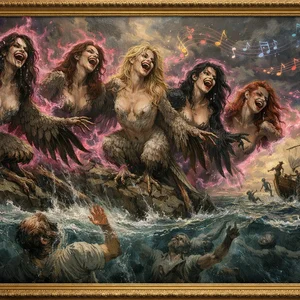

Hybrid creatures of Greek mythology — half-woman, half-bird (later half-fish in the Middle Ages) — whose bewitching song lures sailors to their deaths. Odysseus, lashed to the mast of his ship, is the only mortal ever to have heard them and survived.
The Sirens
Roussalki
9 min read
Frequently asked questions
Famous Quotes
« "Come closer, famous Odysseus — Achaea's pride and glory — moor your ship on our coast so you can hear our song!»
« (Odyssey»
« Book XII»
« trans. Robert Fagles)»
Key Facts
- Described in Homer's Odyssey (around the 8th century BCE) as half-woman, half-bird creatures living on an island strewn with bones.
- On the advice of Circe, Odysseus has himself lashed to the mast and plugs his crew's ears with beeswax to resist the Sirens' song.
- The Argonauts escape them thanks to Orpheus, whose lyre drowns out their voices.
- The transformation into half-woman, half-fish creatures gradually took hold during the Middle Ages and in Western iconography.
- Allegorical symbols of the danger of deceptive pleasures in ancient philosophy and medieval Christian tradition.
Works & Achievements
The foundational passage for the entire Siren tradition: Homer describes their encounter with Odysseus, the stratagem of the mast and the wax, and reveals the content of their song — a promise of universal knowledge rather than mere pleasure. This text shaped all subsequent representations.
Numerous Greek vases depict the scene of Odysseus and the Sirens: the hero bound to the mast, his companions with stopped ears, and the winged Sirens perched on their rocks. These works constitute the earliest attested visual representations of the myth.
In this Hellenistic epic, the Argonauts encounter the Sirens on their return voyage. Orpheus saves them by drowning out the Sirens' song with his divine music — a major variant of the myth that sets two forms of musical power against each other.
Ovid recounts the Sirens' pathetic origin: human companions of Persephone, they were granted wings so they could search for her after her abduction. This Latin text spread the myth throughout medieval and Renaissance Europe.
Siren sculptures adorning tombs have been found in many Greek cemeteries (Attica, Magna Graecia). These mourning figures playing music attest to the deep association between Sirens and the escorting of the dead.
This mythographic handbook compiles the myth of the Sirens: genealogy, winged appearance, and fate after the episode with Odysseus. A reference source for Renaissance mythologists and a major foundation of our systematic knowledge of the myth.
Anecdotes
In Homer's Odyssey, Odysseus is the only mortal to have heard the Sirens' song and survived. On the advice of the sorceress Circe, he had his companions' ears stopped with beeswax and had himself tied firmly to the mast of his ship. Bound tight, he begged his men to free him when he heard their song, but they, deaf to his cries, obeyed his prior orders and kept rowing.
Contrary to popular belief, the Sirens of ancient Greece were not fish-women but bird-women: they had the torso and face of a woman and the winged body of a bird. It was only in the Middle Ages, under the influence of medieval bestiaries and Eastern traditions, that they gradually took on the form of women with fish tails that we know today.
During the Argonauts' expedition, the Sirens tried to charm Jason and his companions. But Orpheus, the divine musician, took up his lyre and played a melody so beautiful and powerful that it completely drowned out the Sirens' song, saving the crew. Only Butes, unable to resist, threw himself into the sea and had to be rescued by the goddess Aphrodite.
According to several Greek mythographers, the Sirens were the daughters of the river god Achelous and a Muse — Terpsichore, Melpomene, or Calliope depending on the version. They were originally the companions of Persephone, and were transformed into winged creatures — either by Demeter to punish them for failing to prevent the abduction, or by Persephone herself so that they could search for her through the skies.
Tradition holds that after being outwitted by Odysseus without his dying, the Sirens, their power broken, threw themselves in despair into the sea and drowned. One of them, Parthenope, was said to have been cast by the waves onto the shore of southern Italy, and the Greek city founded on that spot was named Parthenope in her honor — before it became Naples.
Primary Sources
“You will come first to the Sirens, who bewitch every man who draws near. Whoever carelessly approaches and listens to their voice will never again see his wife and young children gathered joyfully around him at his homecoming.”
“The Sirens, daughters of Achelous, would hold passing sailors spellbound with their melodious songs and leave them to die upon their shores. Orpheus at once raised his voice and set his divine kithara ringing, drowning out their song with his music.”
“You, faithful companions of Proserpina in her games, bear the wings of birds upon the feet of young girls. Was it a deliberate choice, or did grief give you those wings so you could search for your friend across every sea?”
“The Sirens, daughters of Achelous and Melpomene, had a woman’s face but the feet and wings of a bird. They beguiled sailors with song, lyre, and flute, then devoured them.”
“The Sirens, daughters of Achelous and Calliope, after the disappearance of Proserpina, asked the gods to give them wings so they could search for her over sea and sky.”
Key Places
Ancient tradition places the Sirens' rocks in this perilous stretch of water between Sicily and the Italian peninsula, near Charybdis and Scylla. It is in this strait that the Odyssey sets the fateful encounter between Odysseus and the enchanting creatures.
Capri and the neighboring small islands are identified by Strabo and Pliny the Elder as the “Sirenusae,” the mythical dwelling of the Sirens. These sea-battered rocks matched the image of beautiful and deadly desolation described in the epics.
According to legend, the body of the Siren Parthenope, who died after her song failed to hold Odysseus, was washed ashore at the site of present-day Naples. The Greek city was thus named Parthenope in her honor before becoming Neapolis.
This promontory of the Peloponnese was considered in antiquity to be one of the entrances to the kingdom of Hades. The Sirens, by luring sailors to their deaths, play a role as guides toward the afterlife that this cape symbolizes.
According to a myth recorded by ancient scholiasts, the Sirens are said to have challenged the Muses to a singing contest on Olympus. Defeated, they were stripped of their feathers by the victorious Muses, deepening their bitterness toward mortals.