
A short-lived pharaoh of ancient Egypt's 18th Dynasty, Smenkhkare reigned briefly around 1338–1336 BC, succeeding Akhenaten. His identity remains one of the most enigmatic puzzles of ancient Egypt.
Smenkhkare(1400 av. J.-C. — 1333 av. J.-C.)
Smenkhkare
Égypte antique
8 min read
Frequently asked questions
Key Facts
- His reign is estimated between 1338 and 1336 BC, making it one of the shortest in the 18th Dynasty
- Possibly co-regent with Akhenaten, whose eldest daughter Meritaten he is thought to have married
- His identity is debated: some historians believe he may have been Nefertiti or Kiya ruling under a new name
- Contemporary with the Amarna heretical period and the exclusive worship of Aten
- His tomb has never been identified with certainty
Works & Achievements
Smenkhkare is believed to have shared power with Akhenaten in the final years of his reign, as attested by reliefs and cartouches from Amarna. This co-regency constitutes the bulk of the documented political legacy of this elusive pharaoh.
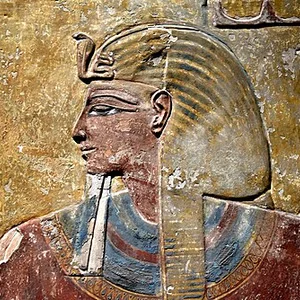
The tomb of the high priest of Aten, Meryre II, preserves one of the rare confirmed depictions of Smenkhkare, shown alongside Meritaten receiving tribute from dignitaries. This relief is a major iconographic source for identifying the pharaoh.
Some Egyptologists attribute to Smenkhkare the first gestures of reconciliation with the clergy of Amun, predating Tutankhamun's official restoration. If confirmed, this political shift would have had decisive consequences for Egypt's religious future.
Several funerary objects discovered in Tutankhamun's tomb bear inscriptions that may have been reassigned from those of Smenkhkare or Neferneferuaten, bearing witness to the recycling of royal treasures at the close of the Amarna period.
Anecdotes
Smenkhkare is one of the most enigmatic pharaohs in Egyptian history: his exact identity remains a mystery debated by Egyptologists around the world. Some believe he was a young man close to the royal family, perhaps Akhenaten's brother-in-law, while others suggest he may have been Nefertiti herself ruling under a male throne name.
Tomb KV55 in the Valley of the Kings contains a mummy whose identity has been disputed between Smenkhkare and Akhenaten. DNA analysis conducted in 2010 revealed that this individual was Tutankhamun's biological father, reigniting debate over who Smenkhkare truly was among the members of the Amarna royal family.
Smenkhkare is thought to have ruled jointly with Akhenaten as co-regent before succeeding him. Some Amarna reliefs depict two royal figures standing side by side beneath the solar disk of Aten, fueling many theories about the exact nature of their relationship — whether political, familial, or personal.
Following Akhenaten's religious revolution, which had imposed the exclusive worship of the god Aten, Smenkhkare may have quietly begun a return to the old cults, particularly that of Amun at Thebes. This symbolic gesture foreshadowed the sweeping religious restoration that would be fully carried out under Tutankhamun.
Smenkhkare's coronation name, Ankhkheperure, was also used by his successor Neferneferuaten, further complicating the identification of these figures. This overlapping of royal titles is unique in pharaonic history and reflects the dynastic turmoil that gripped Egypt at the close of the Amarna period.
Primary Sources
A scene from the tomb of the high priest Meryre II depicts Smenkhkare accompanied by Meritaten, his great royal wife. It is one of the most complete representations of the pharaoh, showing him receiving tributes beneath the radiating disk of Aten.
The Turin Royal Canon, compiled under Ramesses II, records a succession of brief reigns following Akhenaten. The gaps and partially erased names reflect a later deliberate attempt to erase the rulers of the Amarna period from official memory.
The cartouches found in tomb KV55 were deliberately hammered out and partially erased, evidence of a partial damnatio memoriae. Nevertheless, fragments of gilding and funerary equipment confirm a burial of royal rank.
The cuneiform Amarna tablets preserve correspondence between the Egyptian court and foreign rulers during this turbulent period. They illustrate the unstable geopolitical context in which Smenkhkare would briefly have held power.
Several rings and seals bearing the cartouche Ankhkheperure have been found at Amarna and in the Delta. These objects constitute direct material evidence for the existence of Smenkhkare's reign, even if their attribution is sometimes debated.
Key Places
The capital founded by Akhenaten and the heart of the Amarna court, this is where Smenkhkare is believed to have wielded power as co-regent and later as pharaoh in his own right. The ruins of this short-lived city, excavated since the 19th century, continue to yield precious clues about the identity of this mysterious ruler.
This tomb on the west bank of Thebes contains a mummy whose identity — Smenkhkare or Akhenaten — remains one of the great debates in modern Egyptology. The funerary objects were deliberately damaged and the cartouches hammered out.
The religious heart of Egypt and seat of the powerful Amun priesthood, Thebes embodied the ancient order that Akhenaten had sought to overturn. Smenkhkare may have begun the reconciliation with this sacred capital, paving the way for the return of traditional religion.
Egypt's ancient administrative capital, Memphis remained a major center of political and economic power even during the Amarna period. Governing the empire from Akhetaten required administrative relay points in this strategically located city at the heart of the Delta.
Typical Objects

The oval cartouche enclosing Smenkhkare's throne name Ankhkheperure was engraved on rings, amulets, and monuments. Several of these cartouches were found hammered out or reused, evidence of the deliberate erasure of his memory by his successors.

Symbol of unified kingship over Upper and Lower Egypt, the Pschent — combining the white and red crowns — was the pharaoh's principal attribute during major ceremonies. Smenkhkare, heir to the pharaonic tradition, wore this crown to assert his legitimacy.

The central symbol of the Amarna religion, the Aten disk whose rays ended in hands offering the ankh, adorned the temples and palaces of Akhetaten. Smenkhkare, direct heir to this theological revolution, was surrounded by this distinctive solar iconography.

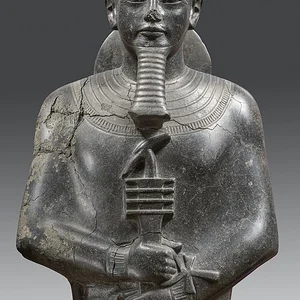
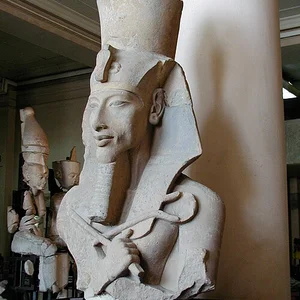
These two royal insignia — the curved heqa scepter and the ceremonial nekhekh flail — symbolized respectively the power to rule and the power to punish. Crossed over the pharaoh's chest in official representations, they affirmed the sovereign's divine authority.

Canopic jars intended to preserve the internal organs of the deceased were found in tomb KV55, sometimes attributed to Smenkhkare. These translucent alabaster vessels, adorned with sculpted lids, bear witness to the care given to funerary rites during the Amarna period.

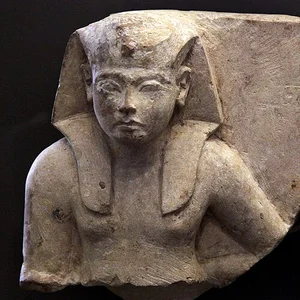
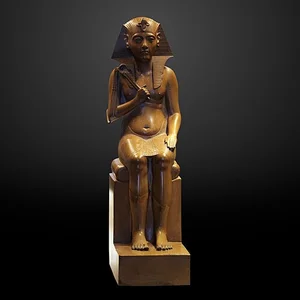
This pleated gold-and-blue linen headdress covering the head and falling in two flaps on either side of the face was one of the most recognizable signs of pharaonic kingship. Depicted wearing the nemes in the rare portraits attributed to him, Smenkhkare placed himself within the long tradition of Egyptian royalty.
School Curriculum
Vocabulary & Tags
Key Vocabulary
Tags
Daily Life
Morning
At dawn, Smenkhkarê took part in solar rituals honoring Aten at the Great Temple of Akhetaten, where ceremonies began with the first rays of sunlight before the royal family and high dignitaries. Officiating as high priest, the pharaoh recited hymns to the solar disc while incense smoke rose toward the open sky of the roofless temples.
Afternoon
Afternoons were devoted to royal audiences, receiving foreign emissaries, and managing affairs of state. Diplomatic correspondence with the Hittite, Babylonian, and Assyrian kingdoms required constant attention to maintain the alliances that ensured peace along the empire's borders.
Evening
Evenings unfolded in the gardens of the royal palace, enlivened by harp and lute music, dancers, and sumptuous banquets. The glow of oil lamps illuminated the colorful frescoes of the palatial halls, creating a lavish atmosphere yet tinged with the uncertainty that hung over the twilight years of the Amarna era.
Food
The royal table featured refined dishes: roasted beef, duck, and wild goose, dried or grilled fish from the Nile, various leavened breads, orchard fruits (figs, grapes, pomegranates, dates), and honey and pomegranate sweets. White wine from the Delta and high-quality herb-infused beer accompanied these princely meals.
Clothing
Smenkhkarê wore the traditional royal insignia: the gold-and-blue striped nemes headdress, the shendyt kilt of finely pleated white linen cinched at the waist with an embroidered belt, and the broad usekh collar in gold, carnelian, and lapis lazuli. During major ceremonies, the blue Khepresh crown or the two-toned Pschent completed the full regalia of kingship.
Housing
The Great Palace of Akhetaten, built on the eastern bank of the Nile by Akhenaten, was the ruler's primary residence. This monumental dwelling included vast audience halls decorated with scenes from Amarna life, private apartments with gardens and pools, and royal granaries supplying the court with precious provisions.
Historical Timeline
Period Vocabulary
Visual Style
Style artistique amarnien avec ses silhouettes élancées aux traits androgynes baignées de la lumière dorée d'Aton, sur fonds d'ocre chaud et de lapis-lazuli profond, entre éclat royal et mémoire effacée.
Sound Ambience
Ambiance de la cour royale d'Akhetaton entre lumière solaire et ombres de palais, mêlant chants rituels à Aton, musique de harpe et sistre, effluves d'encens et murmures des intrigues qui entourent ce pharaon aussi fugace qu'énigmatique.
Liens externes & ressources
Références
Œuvres
Co-régence avec Akhenaton
vers 1338-1336 av. J.-C.
Scène de la tombe de Méryrê II à Amarna
vers 1338 av. J.-C.
Tentative de restauration du culte d'Amon
vers 1336 av. J.-C.
Objets réemployés dans la tombe de Toutankhamon
vers 1323 av. J.-C.