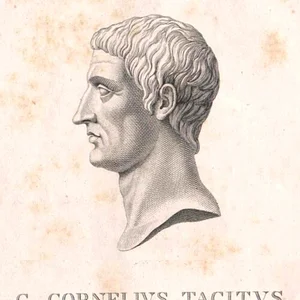

Tacitus is one of the greatest historians of ancient Rome. A senator and consul, he is the author of the Annals and the Histories, landmark works on the early Roman Empire. His incisive style and critical eye make him an irreplaceable witness to the imperial age.
Tacitus(55 — 120)
Tacitus
Rome antique
7 min read
Frequently asked questions
Famous Quotes
« Sine ira et studio. (Without anger or partiality.)»
« The crimes of the past authorize the crimes of the future.»
« The closer men are to slavery, the more they hate those who are free.»
Key Facts
- Around 55 AD: born, probably in Gallia Narbonensis or northern Italy
- 97 AD: reaches the consulship, the pinnacle of a senatorial career
- 98 AD: publishes the Life of Agricola and the Germania
- Around 109–120 AD: writes the Annals, covering the reigns of Tiberius to Nero
- Around 120 AD: presumed death, leaving behind a major historiographical body of work
Works & Achievements
A biography of his father-in-law Agricola, governor of Britain. Tacitus's first published work, it contains a veiled but scathing critique of Domitian's tyrannical rule.
An ethnographic treatise on the Germanic peoples, their customs, and their lands. A foundational text that profoundly shaped perceptions of Germanic identity well into the 20th century.
A literary dialogue exploring the decline of oratory in Rome. It examines why rhetoric lost its vitality under the imperial regime.
An account of the civil wars of 69–96 AD, from the Year of the Four Emperors to the death of Domitian. Only Books I through V have survived intact.
Tacitus's masterpiece, covering the reigns of the Julio-Claudian emperors from Tiberius to Nero (14–68 AD). A model of critical historical writing, refined in both judgment and style.
Anecdotes
Tacitus was a renowned orator before he became a historian. His friend Pliny the Younger wrote to him asking for anecdotes to include in his own works, a testament to the fame Tacitus had achieved during his lifetime in Rome.
In his Annals, Tacitus recounts the Great Fire of Rome in 64 AD and the persecution of Christians under Nero. It is one of the rare non-Christian ancient texts to mention Christ, whom he calls 'Christus', executed under Pontius Pilate.
Tacitus married the daughter of Julius Agricola, the Roman general who conquered much of Britannia (modern-day Britain). He honored him in a biography titled the 'Agricola', in which he indirectly criticized the tyranny of Emperor Domitian.
Tacitus was appointed suffect consul in 97 AD and delivered the funeral oration for Verginius Rufus, a celebrated general. He later served as governor of the province of Asia around 112–113 AD, one of the most prestigious posts in the Empire.
The phrase 'Sine ira et studio' ('without anger or bias'), which he claims as his guiding principle at the opening of the Annals, has become famous. Yet modern historians note that Tacitus was anything but neutral: his sharp, partisan view of the Julio-Claudian emperors reveals an aristocrat deeply committed to republican values.
Primary Sources
Tiberius, Caligula, Claudius, and Nero I described while they reigned, out of fear, and then out of resentment still fresh. Now, free from all attachment or hatred, I can set forth a few facts concerning Augustus.
I begin my work with the second consulship of Galba and the consulship of Titus Vinius. Of this age rich in events, I have recorded but few happy things: four emperors slain by the sword, three civil wars, and even more foreign wars.
In the fifteen years that passed — so long in the span of a man's life — he lost much to enforced inaction. Agricola himself survived, through prudence and wisdom, dangers that had swallowed so many others.
The Germans have no cities, as is commonly known; they do not even allow dwellings to be built adjoining one another. They live apart and scattered, wherever a spring, a field, or a woodland has taken their fancy.
Eloquence is not a calm and quiet virtue, as philosophy is; it requires agitation, a platform, adversaries, a city in turmoil, and a free people.
Key Places
Tacitus served as senator and consul in Rome, the political heart of the Empire. It was in the Senate that he closely observed the workings of imperial power, providing the raw material for his historical works.
Tacitus governed this prosperous province around 112–113 AD, one of the most prestigious posts in the Empire. This experience gave him firsthand insight into provincial administration.
Tacitus never went there himself, but his father-in-law Agricola led campaigns in the region, which Tacitus recounted in detail in the Agricola. This work remains the primary ancient source on the Roman conquest of Scotland.
Tacitus wrote an ethnographic treatise on the Germanic peoples, describing their customs, territory, and fierce independence. This text remains the foundational source on the ancient Germanic tribes.
In the Histories, Tacitus describes the Jewish War and the destruction of the Temple by Titus in 70 AD. His account, though colored by bias, is one of the few surviving Roman testimonies of this pivotal event.
Typical Objects

Common writing surfaces in Rome, used for drafts and correspondence. Tacitus likely jotted his earliest notes on these tablets before having his final texts copied onto papyrus.

The primary medium of ancient literature, on which Tacitus's Annals and Histories were written and circulated. A work as lengthy as the Annals required many scrolls.

A toga edged with a purple stripe, reserved for Roman magistrates. As a senator, consul, and later provincial governor, Tacitus wore this toga at official ceremonies.

The distinctive badge of equestrian and then senatorial rank. As a member of the senatorial order, Tacitus wore this ring as a mark of his elevated social status.

A curved metal scraper used to clean the skin after bathing at the public baths. Like any Roman aristocrat, Tacitus regularly visited the thermae — an essential space for socializing.

A metal or bone instrument used for writing on wax tablets. The stylus was the everyday tool of every educated Roman and the indispensable companion of a historian like Tacitus.
School Curriculum
Vocabulary & Tags
Key Vocabulary
Daily Life
Morning
Tacitus rose at dawn, as was customary for Roman aristocrats. The morning was devoted to public affairs: receiving clients who came to seek his support, then attending the Forum or Senate for political and judicial debates.
Afternoon
The afternoon was reserved for intellectual work in the tablinum, his private study. Surrounded by secretaries and papyrus scrolls, he consulted senatorial archives, the acta diurna (Rome's official daily gazette), and the memoirs of contemporaries to compose his historical works.
Evening
In the evening, Tacitus gathered with guests for the cena, the main meal taken in the late afternoon. These literary dinners were an opportunity to debate literature, rhetoric, and politics with friends such as Pliny the Younger, before a night spent in reading and reflection.
Food
Like any wealthy Roman, Tacitus ate wheat bread, vegetables (broad beans, lentils, leeks), olive oil, and wine diluted with water. On feast days, the meal included Mediterranean fish, poultry, and fresh or dried fruits.
Clothing
In everyday life, Tacitus wore a white woolen tunic (tunica) belted at the waist. In public, as a senator, he donned the white toga with a purple stripe (toga praetexta), a symbol of his rank and official duties.
Housing
Tacitus lived in a domus, a patrician townhouse on one of Rome's hills, built around an atrium and a peristyle garden. His home included a personal library and a tablinum where he received clients and correspondents.
Historical Timeline
Period Vocabulary
Visual Style
Portrait réaliste d'un sénateur romain en toge prétexte, éclairage dramatique clair-obscur, colonnes de marbre et rouleaux de papyrus, palette Pompéienne chaude et austère.
Sound Ambience
Ambiance sonore d'une domus patricienne romaine du Ier siècle, mêlant le silence studieux du cabinet de travail, les bruits de la rue et les discussions du Forum.
Liens externes & ressources
Références
Œuvres
Vie d'Agricola (De vita Iulii Agricolae)
98 apr. J.-C.
La Germanie (De origine et situ Germanorum)
98 apr. J.-C.
Dialogue des orateurs (Dialogus de oratoribus)
vers 102 apr. J.-C.
Histoires (Historiae)
vers 109 apr. J.-C.
Annales (Ab excessu divi Augusti)
vers 117 apr. J.-C.