
Queen of Georgia (1184–1213), the first woman to rule alone over this Caucasian kingdom. Her reign marks the Georgian Golden Age: territorial expansion, cultural and religious flourishing, and decisive military victories against the Seljuks.
Tamar of Georgia(1166 — 1213)
Tamar I
royaume de Géorgie
8 min read
Frequently asked questions
Key Facts
- c. 1160: born, daughter of King George III of Georgia
- 1178: associated with the throne as co-regent by her father
- 1184: assumes sole power after the death of George III, first reigning queen of Georgia
- 1195: decisive victory at the Battle of Basian against the Sultanate of Rum, cementing Georgian power
- 1204: supports the founding of the Empire of Trebizond, extending Georgian influence into Anatolia
Works & Achievements
Under Tamar, Georgia nearly tripled its territory, incorporating much of the Caucasus, Armenia, and regions of present-day Turkey and Azerbaijan. This process relied on military victories as well as skillful diplomatic alliances.
Tamar provided funding and military support to princes Alexios and David Komnenos to establish a Christian state on the Pontic coast following the fall of Constantinople. This miniature Byzantine empire survived until 1461.
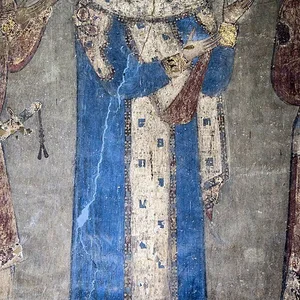
Tamar had this monumental complex of more than five hundred rock-hewn chambers completed and enriched, encompassing a church, monastic cells, and water cisterns. A fresco depicting her is still visible today.
Tamar's court attracted Georgia's greatest scholars and poets. Her patronage enabled Shota Rustaveli to compose *The Knight in the Panther's Skin*, which remains the masterwork of classical Georgian literature.
Tamar developed a state apparatus organized around the *Darbazi* (royal council), with specialized ministers. She strengthened royal justice and curbed the abuses of certain powerful nobles, contributing to internal unification and stability.
Anecdotes
Upon the death of her father King George III in 1184, Tamar inherited the throne of Georgia. Part of the nobility (the *aznauri*) refused to obey a woman and attempted to impose a regency council on her. Tamar skillfully outmaneuvered these political schemes, established herself as sovereign in her own right, and convened a grand council at Lorthkhis to consolidate her authority. Her reign would last nearly thirty years.
In 1185, under pressure from her nobles, Tamar agreed to marry the Russian prince Yuri Bogolyubsky. He quickly proved to be cruel and a drunkard; Georgian chronicles attest that he was repudiated by Tamar around 1187 and exiled from the kingdom. This divorce, extremely rare for a medieval queen, is testament to the real authority she wielded over her court.
In 1195, the Georgian army won the Battle of Shamkor against the Eldiguzids of Azerbaijan. According to the chronicles, a great quantity of spoils was brought back to Tbilisi, and Tamar distributed a large share among the monasteries and the poor, refusing to keep any for herself. This victory opened Georgia's access to the southern Caucasus.
The great Georgian poet Shota Rustaveli dedicated to Tamar his epic *The Knight in the Panther's Skin* (*Vepkhistkaosani*), a masterpiece of medieval Georgian literature. This poem, which celebrates chivalry, courtly love, and generosity, is still today considered the founding text of Georgian cultural identity.
After the fall of Constantinople during the Fourth Crusade in 1204, Tamar provided military and financial support to Alexios and David Komnenos, Byzantine princes who had taken refuge at her court, enabling them to found the Empire of Trebizond on the shores of the Black Sea. This new Christian state of the East would survive for two and a half centuries, until 1461.
Primary Sources
And Tamar, queen of queens, protector of Christians, light and glory of the Kartvelians, triumphed over her enemies by the strength of God and governed her kingdom in peace and prosperity.
May her glory spread like the sun from east to west; she is queen over kings, and her wisdom surpasses that of Solomon.
To her, like the sun, whose gaze melts the heart like wax, to Tamar the queen, this song is offered with devotion.
I, Tamar, by the grace of God queen of Abkhazia, Kartli, Ran, of the Kakhetians and Armenians, Shahanshah of Iran and non-Iran, sovereign of the East and the West…
Queen Tamar was of exemplary piety and showed great kindness toward the Armenian people who lived in her lands; she had several monasteries rebuilt and protected Christians of all nations.
Key Places
Capital of the Kingdom of Georgia since David IV, Tbilisi was the political and administrative center of Tamar's reign. It was from the royal palace that the queen received ambassadors, dispensed justice, and organized her military campaigns.
A vast cave monastery carved into the volcanic cliff of the Mtkvari (Kura) valley, developed at Tamar's initiative from work originally begun by her father. The queen occasionally retreated there to pray, and a famous contemporary fresco depicts her in this very place.
The ancient capital and holy city of Georgia, seat of the Catholicos (head of the Georgian Orthodox Church). Tamar was crowned here, and the major religious decisions of her reign were proclaimed from this city.
Founded by David IV the Builder, this monastery-academy near Kutaisi was the kingdom's foremost intellectual center. Tamar endowed it generously and sent students there; it is today inscribed on the UNESCO World Heritage List.
Site of the great military victory of 1203 against the Seljuk sultan Rukn al-Din Suleiman Shah, in present-day eastern Turkey. This battle marked the height of Georgian military power under Tamar.
A town in present-day Azerbaijan and the site of the 1195 victory against the atabeg Abu Bakr. Chronicles report that church bells rang out in Tbilisi for three days to celebrate this triumph.
Typical Objects

A gold headdress adorned with precious stones and enamelwork, worn at major ceremonies and coronations. Tamar was crowned twice (in 1178 as co-regent, in 1184 as reigning queen), and the crown symbolized her divine authority conferred by the Orthodox Church.

Tamar was renowned for her deep piety and always carried a Marian icon with her during military campaigns. According to the chronicles, she attributed her victories to divine intercession and distributed rich offerings to monasteries after each battle.

A metal matrix engraved with Tamar's arms and titles, affixed to royal charters to authenticate them. The preserved charters bear her titles in Georgian and sometimes in Arabic or Persian, reflecting the multilingual diplomacy of her court.

A symbol of royal martial office, the sword was presented to Tamar at her coronation and featured in her official representations. Although she did not fight in person, she accompanied her armies to the vicinity of the battlefield.

Tamar's court was a major center of manuscript production, particularly of religious and literary texts. She personally funded the copying and illumination of holy books intended for the monasteries of the kingdom.

Georgian queens dressed in a fashion inherited from Byzantium, in colorful silks embroidered with gold thread and adorned with pearls. Contemporary depictions of Tamar in the frescoes of Vardzia show her wearing an imperial purple mantle.
School Curriculum
Vocabulary & Tags
Key Vocabulary
Tags
Daily Life
Morning
Tamar began her day with morning office prayers according to the Georgian Orthodox rite, attended by priests of the palace chapel. She fasted regularly, and the chronicles emphasize her sincere piety — not merely ceremonial. She would then receive reports from her ministers and news from the provinces.
Afternoon
The afternoon was devoted to royal audiences: nobles, foreign ambassadors, merchants, and ordinary petitioners came before her one after another at the Darbazi, the royal council. Tamar personally presided over military deliberations during campaign preparations, surrounded by her constable (spaspet) and her generals.
Evening
In the evening, Tamar attended the vespers of the Church, then welcomed scholars, poets, and theologians to her table. According to the chronicles, she had sacred texts read aloud during meals and avoided the excess of feasting that some of her nobles were fond of.
Food
The Georgian royal table combined meats (lamb, game), Caucasian vegetables, cornbread or wheat bread, and locally prized wines. During the many Orthodox fasting periods in the Georgian calendar, Tamar abstained from meat and dairy, eating only vegetables, legumes, and fish.
Clothing
Tamar wore long gowns of silk imported from Persia or Byzantium, embroidered with gold thread and adorned with precious stones at the necklines and sleeves. On her head she wore a veil or a crown depending on the occasion; during military campaigns, she dressed in a plainer cloak, sometimes lined with fur for the harsh Caucasian winters.
Housing
The royal palace in Tbilisi, built of stone and cedarwood, comprised sumptuous audience halls adorned with frescoes and mosaics. Tamar also stayed at country palaces — notably near Vardzia during her spiritual retreats — or in fortresses when travelling on military campaigns.
Historical Timeline
Period Vocabulary
Liens externes & ressources
Références
Œuvres
Expansion territoriale du royaume de Géorgie
1184-1213
Soutien à la fondation de l'Empire de Trébizonde
1204
Aménagement et dotation du monastère rupestre de Vardzia
1185-1203
Mécénat littéraire et culturel — patronage de Roustavéli
Vers 1200-1210
Réforme administrative et judiciaire du royaume
1184-1213