
Tefnut is an Egyptian goddess with the head of a lioness, personification of moisture and dew. Daughter of Ra and sister-wife of Shu, she is part of the Ennead of Heliopolis. She embodies life-giving rain and plays a role in maintaining cosmic balance.
Tefnut
Tefnut
9 min read
Frequently asked questions
Key Facts
- Tefnut is mentioned as early as the Pyramid Texts (c. 2400 BCE), among the oldest religious texts in the world
- Together with her brother Shu, she forms a primordial pair representing air and moisture, fundamental elements of creation
- Direct daughter of the solar god Ra (or Atum in some versions), she is woven into the Heliopolitan cosmogony
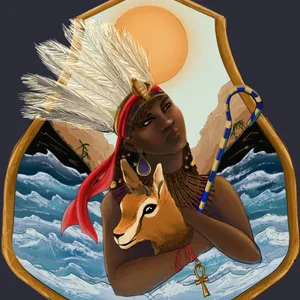
- She is often depicted as a woman with a lioness's head or as a full lioness, sometimes associated with the goddess Sekhmet
- Her cult was particularly active at Leontopolis (Tell el-Muqdam) and at Memphis
Works & Achievements
A collection of religious spells carved inside royal pyramids in which Tefnut plays an essential role as a source of vital moisture for the pharaoh's resurrection. This is the oldest attested written mention of the goddess.
Thousands of bas-reliefs, paintings, and statues depict Tefnut within the Heliopolitan Ennead, lion-headed and holding the solar disk. These works adorned the walls of temples, tombs, and funerary objects.
A lengthy narrative recounting Tefnut's exile in Nubia and her reconciliation with Ra through the intervention of Thoth. This text is the most fully developed literary account of the goddess and reveals the rich storytelling tradition of late Egyptian mythology.
A series of liturgical inscriptions carved on the columns of the temple of Esna, celebrating Tefnut as a cosmic goddess who is at once gentle and fearsome. These hymns bear witness to the vitality of Egyptian religious practice under Roman rule.
Numerous figurines in faience, bronze, or granite depict Tefnut as a woman with a lion's head. Worn as amulets or placed in tombs, they invoked her protection for both the living and the dead.
Anecdotes
According to Heliopolitan cosmogony, Tefnut was born directly from the creator god Atum-Ra, who brought her into being by spitting — or, according to some texts, through divine masturbation. She and her twin brother Shu were thus the first beings engendered by the creator, together representing the dry air and moisture necessary for all life on Earth.
The most famous myth associated with Tefnut is that of the Eye of Ra: seized by rage, the goddess abandoned Egypt for Nubia in the form of a wild lioness. Without her moisture, Egypt dried up and the cosmos fell out of balance. Thoth was sent to calm her through trickery and flattery, and her triumphant return sparked celebrations and a renewal of vegetation.
In the Pyramid Texts — the oldest written religious texts in human history, carved into the pyramids of Saqqara around 2400 BCE — Tefnut is invoked to offer the deceased pharaoh her sacred saliva, a symbol of vital moisture enabling resurrection in the afterlife. This association between divine spittle and eternal life is unique in Egyptian mythology.
Tefnut and her brother Shu formed an inseparable cosmic pair: he embodied dry air and light, while she represented moisture and clouds. Together, they separated Geb (the Earth) from Nut (the Sky), making possible the existence of the world as the Egyptians knew it. This founding couple appears in numerous temples, standing on either side of the horizon.
During the Ptolemaic period, the cult of Tefnut experienced a revival at Leontopolis (Tell el-Muqdam) in the Nile Delta. Living lionesses were kept in the temples there as earthly embodiments of the goddess; priests brought them meat and wine, and their roars were interpreted as divine messages.
Primary Sources
"Tefnut is your sister who lives, she spits her spittle on your face so that you may live." The resurrection spells invoke Tefnut as a source of vital moisture for the deceased pharaoh.
Tefnut appears here as a protector of the dead, associated with the left eye of the Sun and the celestial dew that nourishes the fields of the afterlife, the Fields of Ialu.
Tefnut is mentioned among the guardian deities who welcome the soul of the deceased. She appears in several vignettes as protector of the eastern horizon, alongside her husband Shu.
The inscriptions describe Tefnut as "Mistress of the sky, lady of the horizon, eye of the Sun, she who spits flame against the enemies of Ra." She is celebrated both as the gentle goddess of dew and as the avenging lioness.
This late text recounts Tefnut's journey to Nubia in the form of a raging lioness and Thoth's mission to bring her back. The exchange between the two deities is rich in fables and cosmological symbolism.
Key Places
The main theological center of solar worship, where the Ennead — of which Tefnut is a founding member — was developed. Here, priests codified the myth of her birth from Atum-Ra.
A Delta city dedicated to the worship of sacred lionesses, earthly incarnations of Tefnut. Living lionesses were venerated within the temple precinct, fed and cared for by specialized priests.
The mythical destination of Tefnut during her exile in the form of a raging lioness. The Nubian desert represents in the myth the place of cosmic trial: wherever the goddess withdraws, drought takes hold in Egypt.
A Ptolemaic and Roman temple where numerous inscriptions and hymns celebrate Tefnut as a cosmic goddess. The texts carved on its columns are among the richest surviving sources on her late mythology.
The ancient capital of Egypt where Heliopolitan and Memphite theological traditions intersected. Stelae and depictions of Tefnut have been found here, attesting to the spread of her cult throughout the country.
Typical Objects

A characteristic headdress of Tefnut, the solar disk adorned with a rearing cobra symbolizes her role as the Eye of the Sun — the fierce protector of Ra. She wears this attribute in the majority of her iconographic representations.

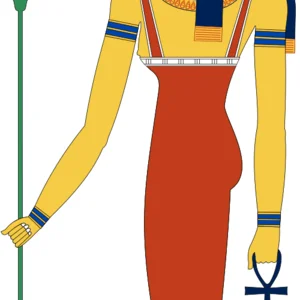
A staff topped with a stylized animal head, the was scepter is a symbol of divine power in ancient Egypt. Tefnut often holds it in her right hand, asserting her authority over the forces of moisture and nature.

The looped cross, symbol of eternal life, is frequently depicted in Tefnut's left hand. It embodies her capacity to give and renew life through the water she bestows.

Some representations show Tefnut holding a vessel containing water or sacred dew, recalling her primary function: bringing the moisture essential to the fertility of the Egyptian land.

A heavy counterweight necklace associated with lioness goddesses such as Hathor and Sekhmet. The menat has an apotropaic value; its rattling during rituals was believed to soothe fierce deities, Tefnut among them.

As a member of the Ennead, Tefnut sits on the council of the great gods. Her throne symbolizes the cosmic order (Ma'at) that she is charged with upholding alongside her brother-husband Shu.
School Curriculum
Vocabulary & Tags
Key Vocabulary
Tags
Daily Life
Morning
At dawn, Tefnut awakens with the sun, her sacred dew covering the earth in a veil of nurturing moisture. As the Eye of Ra, she takes her place on the solar barque to accompany the sun god during his ascent over the eastern horizon. The temple priests then offer her the day's first libations — fresh water, purifying natron, and bouquets of lotus flowers.
Afternoon
At the height of the day, Tefnut watches over the cosmic balance alongside her husband Shu: he holds up the vault of the sky while she maintains the moisture essential for vegetation and the flooding of the Nile. In the temples, priests recite hymns, burn myrrh incense, and place offerings of fruit and barley bread before her statue in the naos.
Evening
As the sun descends toward the western horizon, Tefnut transforms into a fierce lioness to protect Ra during his perilous journey through the Duat, the realm of the dead. She battles the forces of chaos embodied by the serpent Apophis, thus ensuring the possibility of solar rebirth the following morning.
Food
As a goddess, Tefnut receives daily food offerings brought by her priests: beef and poultry, barley flatbreads, figs, grapes, sesame oil, and beer. At Leontopolis, the living sacred lionesses who embodied her were fed raw meat and fish as a mark of divine honor.
Clothing
Tefnut is depicted wearing a long sheath dress of white or turquoise linen, fitted and pleated in the manner of the great Egyptian goddesses. Her distinctive headdress — a solar disk encircled by the uraeus — is crafted from gold and lapis lazuli. She wears a broad polychrome faience and gold collar, along with bracelets adorned with turquoise and carnelian.
Housing
Tefnut's domain is the cosmos itself: the space between Earth and Sky that she has shared with Shu since the primordial separation. Her earthly temples featured a granite naos housing her divine statue, surrounded by an open-air courtyard that allowed sunlight to flood in. The sacred enclosures of Leontopolis housed living lionesses, embodied symbols of the goddess.
Historical Timeline
Period Vocabulary
Visual Style
Style pictural égyptien classique : Tefnout à tête de lionne représentée en profil hiératique, sur fond de hiéroglyphes et de frises de lotus, dans une palette dorée, bleue et turquoise évoquant les tombes de Louxor.
Sound Ambience
Ambiance sonore de l'Égypte ancienne à l'aube : souffle du désert, murmure du Nil, rugissement lointain d'une lionne et cliquetis des instruments rituels résonnant sous les colonnes d'un temple.
Liens externes & ressources
Références
Œuvres
Textes des Pyramides de Saqqarah
Vers 2400-2300 av. J.-C.
Représentations iconographiques de l'Ennéade d'Héliopolis
De l'Ancien Empire à l'époque ptolémaïque (2700 – 30 av. J.-C.)
Mythe de l'Œil du Soleil (Papyrus de Leyde, démotique)
IIIe-Ier siècle av. J.-C.
Hymnes du Temple d'Esna
Ier siècle av. J.-C. – IIe siècle apr. J.-C.
Statuaire et amulettes léontocéphales
Du Moyen Empire à l'époque basse