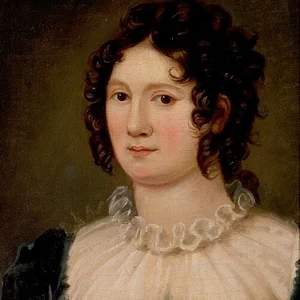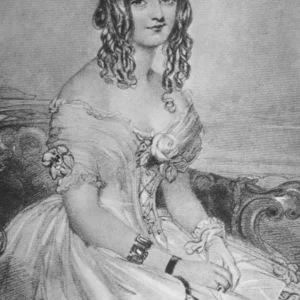

Italian countess born in 1800, Teresa Guiccioli is best known for being the last great love of Lord Byron, with whom she shared a celebrated affair from 1819 to 1823. After the poet's death, she dedicated a memorial work to him, “Lord Byron Judged by the Witnesses of His Life” (1868), a precious testament to European Romanticism.
Teresa Guiccioli(1800 — 1873)
Teresa Guiccioli
États pontificaux, royaume d'Italie
8 min read
Frequently asked questions
Key Facts
- Born on 20 March 1800 in Faenza (Italy) into the noble Gamba family
- Met Lord Byron in Venice in 1819; a lasting affair until the poet's death in 1824
- Her family circle supported the Italian nationalist movement (Risorgimento)
- Published in 1868 “Lord Byron Judged by the Witnesses of His Life”, a major biographical source on Byron
- Died on 21 March 1873 in Settimello, near Florence
Works & Achievements
A memoir published in Paris by Amyot, in which Teresa gathers her own recollections and the testimonies of those close to him to paint an intimate portrait of Byron. This work is an essential primary source on European Romanticism and on the poet's personality.
A collection of several hundred letters exchanged between Teresa and Byron, held largely at the Pierpont Morgan Library and in private archives. Partially published by Iris Origo in *The Last Attachment* (1949), they constitute an exceptional document on the emotional and intellectual life of the Romantic movement.
After Byron's death, Teresa maintained a correspondence with leading figures of French Romanticism, sharing her memories and actively keeping the Byronic legacy alive in Parisian literary circles until she settled permanently in France.
Anecdotes
In April 1819, in Venice, Teresa Guiccioli met Lord Byron at a salon hosted by Countess Benzoni. Nineteen years old and already married to the elderly Count Guiccioli, she was immediately captivated by the English poet, who was equally enchanted. This meeting would mark the beginning of one of the most celebrated love affairs of European Romanticism.
Byron settled in Ravenna to remain close to Teresa, going so far as to rent apartments in the very palace of Count Guiccioli — her own husband. This extraordinary arrangement, accepted in Italian society under the custom of the *cicisbeo*, nonetheless shocked foreign observers with its boldness and its openly displayed nature.
In 1820, Teresa obtained a legal separation from Count Guiccioli from the Holy See — a papal rescript of extreme rarity, granted in large part thanks to the liberal influence of the Gamba family. It was one of the very few separations granted by Rome at that time, a testament to both her determination and her father's political connections.
At Byron's death in Missolonghi on 19 April 1824, Teresa was devastated. She carefully preserved a lock of his hair and hundreds of his letters until her own death in 1873, these relics becoming for her the irreplaceable symbols of a love from which she never fully recovered.
After her remarriage in 1851 to the Marquis de Boissy, Teresa settled in Paris. Her second husband, far from concealing his wife's illustrious past, openly boasted in Parisian salons of having married Lord Byron's former companion — a society provocation that caused a great stir in French high society and perpetuated the poet's legend.
Primary Sources
I am not writing a life of Lord Byron here: others have done it better than I could. I am writing only what I have seen, heard, and known of him personally, letting the facts speak rather than the imagination.
You are the only woman I have loved consistently since I have known you. If I were to lose you, I would no longer know what reason keeps me in Italy or in life.
Lord Byron is dead — and with him the greatest light of modern poetry has been extinguished. Those who did not know him cannot measure what the world has lost in him.
Lord Byron left Italy with the painful feeling of leaving behind everything he cherished. His parting from Countess Guiccioli was heart-rending for both of them; he never truly recovered from it.
Key Places
Teresa's birthplace in 1800, in the fertile region of Romagna, then under papal authority. She grew up there in a noble family with liberal, anti-Austrian convictions.
It was in Venetian drawing rooms — at Countess Benzoni's in April 1819 — that Teresa first met Lord Byron. Venice was then the hub of Italian social and artistic life, frequented by Romantic exiles from northern Europe.
Teresa's main residence after her marriage, and the place where Byron came to lodge in order to be near her. It was here that most of their life together unfolded, between 1819 and 1821.
From 1821 onward, Teresa and Byron joined the Pisan Circle alongside Percy and Mary Shelley and Leigh Hunt. Pisa became a fleeting centre of European Romanticism, blending poetry, politics, and social life.
The Greek town where Byron died of fever on 19 April 1824, having joined the struggle for Greek independence. The news of his death reached Teresa as a blow from which she never fully recovered.
Typical Objects

Until her death, Teresa kept a lock of Byron's hair sealed in a locket — a symbol of her unshakeable devotion to the poet. Such romantic relics were common keepsakes used to preserve the memory of a beloved who had passed away.

Hundreds of letters exchanged between Teresa and Byron form one of the richest epistolary collections in all of Romantic literature. Teresa kept them throughout her life and drew on them extensively when writing her posthumous memoirs.

An indispensable accessory for any society woman in the 19th century, the fan was a fixture of drawing rooms and theatre boxes — the social spaces where Teresa met Byron and maintained her worldly reputation.

Teresa read and annotated Byron's works, either in English or in translation. The volumes from her personal library bearing her handwritten notes are direct witnesses to their intellectual relationship.

The defining instrument of the Romantic salon, the pianoforte accompanied evenings in which music, poetry, and conversation intertwined in the Italian palaces Teresa frequented, lending the era its distinctly sentimental atmosphere.

Journeys between Ravenna, Venice, Pisa, and various country retreats were made by carriage along Italian roads. These long crossings of the peninsula formed the backdrop for many episodes in the shared life of Teresa and Byron.
School Curriculum
Vocabulary & Tags
Key Vocabulary
Daily Life
Morning
Teresa rose late, in keeping with Italian aristocratic customs. She devoted her mornings to correspondence — the cornerstone of her relationship with Byron — and to reading poetry or political gazettes, reflecting the liberal convictions she had inherited from her family.
Afternoon
Afternoons were reserved for visits and carriage rides through the streets of Ravenna or the gardens of the palaces. Teresa also took music lessons and played an active social role, maintaining the bonds of solidarity characteristic of the Romagnole nobility.
Evening
Evenings unfolded in drawing rooms and theater boxes, the nerve centers of Italian social and political life. Byron and Teresa would meet there in public before retreating to more intimate gatherings where literature, Romanticism, and politics mingled freely.
Food
The aristocratic Romagnole table centered on fresh pasta, roasted meats, local cheeses, and full-bodied red wine. Dinners brought together family and friends, and strong coffee invariably rounded off evenings in company.
Clothing
Teresa first wore the high-waisted gowns of the Empire style, then the fuller skirts of the Romantic era with puffed sleeves and fitted bodices. Her evening gowns in silk or velvet, adorned with lace and jewels, spoke to the refinement of the Italian aristocracy.
Housing
Teresa lived in the vast Palazzo Guiccioli in Ravenna, a multi-story residence organized around an inner courtyard and furnished with paintings, libraries, and richly decorated reception rooms. Byron occupied an entire wing as a lodger, creating a singular and scandalous arrangement of cohabitation with the husband and his wife.
Historical Timeline
Period Vocabulary
Liens externes & ressources
Références
Œuvres
Lord Byron jugé par les témoins de sa vie
1868
Correspondance avec Lord Byron
1819-1823
Correspondance avec Alphonse de Lamartine et les cercles romantiques français
1832-1851