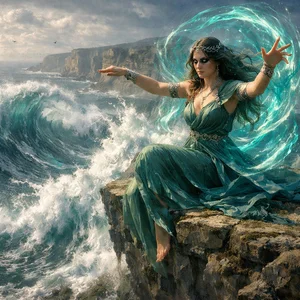

Titaness of the sea and freshwaters in Greek mythology, daughter of Gaia and Ouranos. Wife of the Titan Oceanus, she is the mother of the 3,000 Oceanids and the great river gods, personifying the nourishing waters of the world.
Tethys
Tethys
8 min read
Frequently asked questions
Key Facts
- Daughter of Gaia (the Earth) and Ouranos (the Sky), belonging to the first generation of Titans
- Wife of the Titan Oceanus, who personifies the great circular river surrounding the known world
- Mother of the 3,000 Oceanids (water nymphs) and the river gods (Acheron, Styx, Nile, etc.)
- Mentioned by Hesiod in the Theogony (c. 700 BCE) as the mother of all waters
- According to some traditions, Hera was entrusted to her care during the Titanomachy, which led to her separation from Oceanus
Works & Achievements
Tethys bore with Oceanus three thousand Oceanids, nymphs of fresh waters, clouds, and springs. These daughters became the nurses of young mortals and the guardians of aquatic life throughout Greek mythology.
Tethys is also the mother of three thousand deified rivers, among them the Nile, the Alpheus, the Asopus, and the Styx. Through this lineage, she is the origin of all flowing waters that fertilize and define the known world of the Greeks.
Tethys welcomed and raised the young Hera during the War of the Titans. This nurturing role earned her particular veneration from the queen of the gods and was counted among her most celebrated acts in the Homeric tradition.
Hesiod places Tethys and Oceanus at the origin of creation by designating them as the primordial aquatic couple who gave rise to the rivers and Oceanids, securing her place at the summit of Greek divine genealogy.
The philosopher Thales of Miletus drew on the myth of Tethys and Oceanus to theorize water as the *arché* — the first principle of the universe — marking the transition from myth to rational philosophical inquiry.
Anecdotes
Tethys raised the young Hera, future queen of the gods, during the Titanomachy. Zeus had entrusted the child to her to keep her safe from the fighting. This nurturing bond explains the tenderness that the queen of Olympus always preserved for Tethys and Oceanus, her divine foster parents.
In the Iliad, Homer presents Tethys and Oceanus as the ancestors of all the gods and the source of all things. When Hera wishes to visit them, she describes them as those who raised her — a sign of the immense prestige of the Titaness, recognized even by the Olympian gods as a primordial mother.
According to a tradition recorded by Homer, Tethys and Oceanus had long ceased to share their bed, breaking their primordial union. Some ancient commentators saw in this an explanation for the cosmic separation of the waters and the sky, with the Milky Way representing the rift between the two divine spouses.
Tethys is the mother of a prodigious number of children: three thousand Oceanids, nymphs of springs and clouds, and three thousand river gods, including the Nile, the Alpheus, and the Styx. Through her descendants, she is literally the source of all the freshwater that irrigates and fertilizes the world known to the Greeks.
Among her daughters are several major deities: Metis, goddess of wisdom and Zeus's first wife; Styx, guardian of the sacred oaths of the gods; and Doris, mother of the fifty Nereids. Tethys is thus the mythological grandmother of virtually all the marine deities of ancient Greece.
Primary Sources
"Ocean begot with Tethys the eddying rivers: the Nile, the Alpheus [...] And Tethys gave birth to the daughters called Oceanids, who raise young men together with lord Apollo and the rivers."
"I go to visit the ends of the bountiful earth, and Oceanus, father of the gods, and Tethys our mother, who reared and nurtured me in their splendid halls."
"The ancient poets tell us that Oceanus and Tethys are the parents of the generation of the gods, and that their children swore by the waters of the Styx."
"From Tethys and Oceanus were born the rivers: the Nile, the Alpheus, the Asopus, and their sisters called the Oceanids, infinite in number."
Key Places
A vast mythic river imagined by the Greeks as encircling the entire earth. It is the joint domain of Tethys and Oceanus, their dwelling at the edge of the world, where the stars rise and plunge into the primordial waters.
The Alpheus river, one of Tethys's most celebrated sons, has its source in Arcadia. This real place in Greece embodies the concrete presence of Tethys's offspring in the mortal world.
Sacred mountain and home of the Olympian gods. By raising the young Hera, Tethys maintained close ties with the future queen of Olympus, making her cosmic home a space in constant dialogue with the mountain of the gods.
The Greeks placed the dwellings of the aquatic Titanesses in the underwater depths of the eastern Mediterranean. Tethys was imagined residing in a submerged palace at the edge of the sea, connected to all the Greek islands and coastlines.
The river-god Nile is one of the sons of Tethys and Oceanus. The Greeks placed his sources at the edge of the known world, in the cosmic zone governed by Tethys, linking the Titaness to the mysteries of this great life-giving river of Egypt.
Typical Objects

A large Greek three-handled jar used for drawing and carrying water. Tethys is often depicted with a hydria, a symbol of her mastery over all freshwater and her role as the nourishing source of the world.

A plant-based headdress characteristic of Greek river and water deities. Tethys and her children the Oceanids wear reed crowns signifying their belonging to the realm of waters and rivers.

A long flowing cloth evoking the movement of waves and sea currents. In ancient iconography, water deities wear a veil swelled like a wave, a symbol of their dominion over the primordial waters.

A vessel from which the waters of the world flow, a symbol of universal aquatic fertility. This image illustrates the role of Tethys as the inexhaustible source of all rivers and springs that nourish the earth and mortals.

Common attributes of Greek maritime and water deities. Tethys, mistress of the primordial waters, is sometimes depicted surrounded by sea creatures, underlining her dominion over the depths and the riches of the aquatic world.

An attribute associated with navigation and mastery of the waters. Linked to the great marine deities, it evokes the power of Tethys over sea voyages and her role as protector of sailors in ancient Greece.
School Curriculum
Vocabulary & Tags
Key Vocabulary
Daily Life
Morning
At sunrise, Tethys presides over the welling of springs and the departure of rivers as they begin their course toward the sea. In mythological tradition, she sends her daughters the Oceanids out each morning to watch over the fresh waters of the earth and bestow their benefits upon mortals.
Afternoon
Tethys reigns over the depths of her submerged palace at the edge of the world, surrounded by her children — the river gods and nymphs — who pay her homage. She ensures that the waters of the world flow according to the established cosmic order, maintaining the vital balance among all the waters of the earth.
Evening
In the evening, Tethys receives in her watery dwelling the stars that plunge into the waters of Ocean after their journey across the sky. She thus presides over the nocturnal rest of the cosmos and the perpetual renewal of the waters, which gather in her realm before setting out once more to nourish the earth.
Food
As an immortal deity, Tethys feeds on ambrosia and drinks nectar, the divine substances that grant immortality to the gods. In mythological symbolism, she is also associated with the pure, life-giving waters that well up from springs — nourishing substances par excellence in Greek thought.
Clothing
Tethys is depicted wearing a long, flowing *chiton* in blue-green hues evoking the surface of water. She wears a veil billowing like a wave above her head and a crown of reeds or sea plants, marking her dominion over the fresh waters and rivers of the world.
Housing
The dwelling of Tethys is a mythical palace situated at the edge of Ocean, the great river that encircles the world. Homer describes this place as vast and welcoming — a refuge at the limits of the cosmos where the Titaness receives divine travelers and watches over the sources of all life.
Historical Timeline
Period Vocabulary
Liens externes & ressources
Références
Œuvres
Génération des 3 000 Océanides
Temps mythiques
Génération des 3 000 dieux-fleuves
Temps mythiques
Éducation d'Héra
Temps de la Titanomachie (mythique)
Rôle cosmogonique dans la Théogonie d'Hésiode
vers 700 av. J.-C.
Inspiration de la philosophie présocratique
VIe siècle av. J.-C.