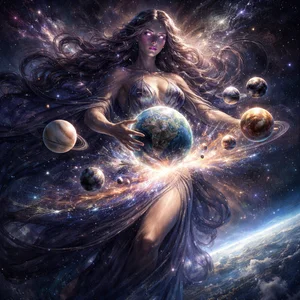

Titaness of celestial light and vision in Greek mythology. Daughter of Ouranos and Gaia, she united with her brother Hyperion and gave birth to the three great astral deities: Helios (the Sun), Selene (the Moon), and Eos (the Dawn).
Theia
Theia
7 min read
Frequently asked questions
Key Facts
- Daughter of Ouranos (the Sky) and Gaia (the Earth) according to Hesiod's Theogony (c. 700 BC)
- Wife of her brother Hyperion, Titan of celestial light
- Mother of Helios (the Sun), Selene (the Moon), and Eos (the Dawn)
- Her name means 'divine' or 'radiant' in ancient Greek
- Personification of the brightness of the clear blue sky and the light reflected by gold, gems, and eyes
Works & Achievements
The founding act of Theia: united with Hyperion, she gives birth to the three great astral deities. This creative act shapes the whole of cosmic time — day, night, and dawn — for gods and mortals throughout all eternity.
According to Pindar, Theia is the source of the brilliance and preciousness of gold, silver, and gemstones. This cosmic function makes her a goddess of visible worth and luminous splendor inscribed in matter itself.
The first written text to name Theia and establish her divine genealogy. The Theogony fixed her place in the Greek pantheon for centuries, along with her role as mother of the celestial bodies that govern the time of mortals.
Pindar invokes her as the source of all brilliance and luminous power, bearing witness to the enduring importance of Theia in the religious and poetic consciousness of classical Greece.
Anecdotes
Her name in ancient Greek, Θεία (Theia), simply means “divine” or “goddess.” This etymology reveals her primordial status: Theia is one of the original forces of the universe, far predating the Olympian gods. She embodies celestial light in its purest form — the light that existed before the sun itself.
The ancient Greeks attributed to her the power to make precious metals and sparkling gemstones gleam. Gold, silver, and gems were not mere material wealth: their radiance was seen as a visible manifestation of Theia’s divine light descended into matter. The poet Pindar invokes her in the 5th century BCE as the source of all visible splendor.
Without Theia, the Greek cosmos would be cast into permanent darkness: she is the mother of Helios (the Sun), Selene (the Moon), and Eos (the Dawn). These three children structure the daily rhythm of human life — day, night, and dawn — making Theia, by extension, the mother of cyclical time itself.
Unlike other Titans harshly punished after the Titanomachy, Theia appears to have been spared by Zeus. The myths record no punishment against her, perhaps because her children — Helios, Selene, and Eos — were too indispensable to the proper workings of the cosmos for their mother to be exiled into the darkness of Tartarus.
Primary Sources
Theia, submitting to Hyperion, bore great Helios, bright Selene, and Eos who illuminates all things — for the immortals who dwell in the wide heavens and for mortals born upon the earth.
Mother of the far-seeing Sun, many-named Theia, it is for your sake that men honor the power of gold above all else.
Sing, O Muse, of Helios, son of great Hyperion, born of divine Theia and Hyperion, who brings light to mortals and the immortal gods alike.
From the Titans were born Oceanus and Tethys, Hyperion and Theia [...] Hyperion and Theia begot Helios, Selene, and Eos.
Key Places
In Greek cosmology, the Aether is the upper, luminous layer of the sky and Theia's natural domain. It is from this primordial space that the celestial light she embodies radiates outward and is bestowed upon her children.
Home of the Greek gods and symbolic site of the Titanomachy. Theia belongs to the divine generation that preceded the Olympians; Olympus marks the boundary between the old and the new divine order.
The birthplace of Hesiod, the poet who set down the divine genealogies — including Theia — in the *Theogony*. It is from this region that the earliest surviving written mention of the Titaness comes to us.
The great Panhellenic sanctuary where cosmogonic myths were recited and preserved. Stories of the Titans and their astral descendants — the children of Theia — circulated throughout these preeminent sites of Greek religious memory.
The dark abyss beneath the Underworld where the defeated Titans were banished after the Titanomachy. Theia escapes this imprisonment, highlighting her singular place among the Titanesses in the Greek mythological tradition.
Typical Objects

An attribute of celestial light deities in Greek iconography. Theia, Titaness of ethereal brightness, is imagined wearing a halo or crown evoking the rays of the sun she gave birth to.

Pindar directly associates Theia with the brilliance of gold. In archaic Greek thought, the sheen of noble metals was seen as a manifestation of her divine light descended into earthly matter.

A symbol of light passed down through the generations. Theia transmits celestial brightness to her three children — Helios, Selene, and Eos — each carrying a different form of light across the cosmos.

In later depictions, some Titanesses wear a veil scattered with stars or astral motifs, symbolizing their connection to the primordial sky, Ouranos, of whom they are daughters.

A symbol of Helios, son of Theia, often associated with his mother by metonymy. The luminous disk is a reminder that it is through Theia that the sun received its radiance and cosmic power.
School Curriculum
Vocabulary & Tags
Key Vocabulary
Daily Life
Morning
In Greek mythological imagination, Theia awakens with the rising of her son Helios, whose solar chariot sets the eastern horizon ablaze. It is Eos, her daughter, who opens the gates of the sky each morning to let the light through — a cosmic ritual over which Theia presides as the mother of all celestial bodies.
Afternoon
Theia dwells in the Aether, the layer of pure light that lies above the sky visible to mortals. She watches over Helios's journey across the firmament, ensuring that his light remains brilliant and benevolent for the humans working in the fields and cities of Greece.
Evening
When evening comes and Helios plunges into the Ocean in the west, Selene takes over and bathes the night in her silvery radiance. Theia, mother of both celestial bodies, presides over this passage from day to night — a perpetual cycle she set in motion once and for all through her divine fertility alone.
Food
As a primordial deity, Theia feeds on ambrosia and drinks nectar, foods reserved for immortals in Greek mythology. These divine substances grant them eternal life and set them entirely apart from mortal humans, who are subject to hunger, disease, and old age.
Clothing
The Titanides are imagined dressed in peplos or chitons in the colors of light — gold, brilliant white, or celestial blue — whose drapery evokes the movement of clouds. A translucent veil, a feminine attribute of Greek goddesses, symbolizes the power concealed beneath beauty.
Housing
Theia dwells in the primordial Aether with her husband Hyperion — a palace of pure light situated beyond the clouds, where the sky meets the luminous infinite. Her children reside there between their celestial journeys: Helios parks his solar chariot there, Selene her silver barque, and Eos prepares her sails of rose and gold there each morning.
Historical Timeline
Period Vocabulary
Liens externes & ressources
Références
Œuvres
Enfantement d'Hélios, Séléné et Éos
Temps mythiques primordiaux
Don de l'éclat aux métaux et pierres précieuses
Temps mythiques
Théogonie — Hésiode (mention fondatrice de Théia)
vers 700 av. J.-C.
Isthmiques V — Pindare (invocation de Théia)
476 av. J.-C.