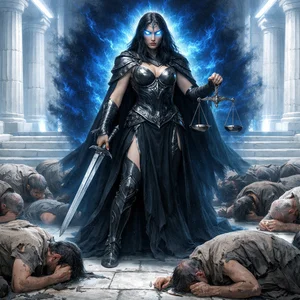

A Titaness daughter of Ouranos and Gaia, Themis personifies divine law, justice, and cosmic order in the Greek tradition. A privileged counselor of Zeus and his second divine wife, she is the mother of the Horae and the Moirai, guardians of fate and the seasons.
Themis
Themis
8 min read
Frequently asked questions
Famous Quotes
« Hesiodic tradition: Themis summons the gods to the assembly on Olympus at Zeus's command (Iliad, Book XX)»
Key Facts
- Daughter of Ouranos (Sky) and Gaia (Earth), one of the twelve Titans according to Hesiod (Theogony, c. 7th–6th century BCE)
- Zeus's second divine union, before Hera; from this union were born the Horae (Eirene, Dike, Eunomia) and the Moirai (Clotho, Lachesis, Atropos)
- First guardian of the oracle at Delphi, which she ceded to Apollo according to some traditions
- Personification of themis (θέμις): the unwritten, divine, and immutable law, distinct from nomos (human law)
- Associated with the scales of justice, an attribute later adopted by the Roman goddess Justitia, ancestor of the modern judicial symbol
Works & Achievements
Themis was the second guardian of the oracle of Delphi after Gaia, revealing the decrees of fate to mortals. This handover symbolizes the transition from Titanic order to Olympian order, and the continuity of divine prophecy.
By giving birth to the three Moirai, Themis is the source of the powers that spin, measure, and cut the thread of life for every being. Through them, she governs the fate of the entire cosmos — gods and mortals alike.
The three Horae — Peace, Justice, and Good Order — are her daughters, personifying the very values she embodies. As guardians of the gates of Olympus, they also govern the cycle of the seasons and the harmony of nature.
Themis is entrusted with summoning and presiding over the assemblies of the gods on Olympus, ensuring that divine decisions uphold the cosmic order. Her very presence reminds the Immortals that they too are subject to higher laws.
Themis reveals to the gods that Thetis's son will surpass his father in power, compelling Zeus to wed the Nereid to a mortal. This prophecy leads to the birth of Achilles and directly shapes the fate of the Trojan War.
Anecdotes
Before Apollo claimed it, it was Themis who guarded the oracle at Delphi. She delivered her prophecies from the depths of the earth, conveying divine will to mortals. This tradition is attested by Aeschylus in *the Eumenides*, where the Pythia herself recalls the sacred succession: Gaia, then Themis, then Phoebe, and finally Apollo.
Themis played a central role in the life of the Olympian gods: it was she who summoned the divine assemblies on Mount Olympus, ensuring that each god took their place according to the established order. She thus embodied not only justice, but also the sacred protocol that governed the world of the immortals.
According to Pindar, it was Themis who warned the gods of a terrible prophecy: if the Nereid Thetis bore a son to a god, that child would be more powerful than his father. To prevent the Olympian order from being overthrown, Zeus decided that Thetis would marry a mortal — Peleus — and their son would be Achilles, the greatest hero of the Trojan War.
Themis is the mother of the Moirai, the three goddesses of fate — Clotho who spins destiny, Lachesis who measures it, and Atropos who cuts it — as well as the Horae, who govern the seasons and the order of natural cycles. Through her daughters, she holds sway over the time and destiny of all beings, gods and mortals alike.
Unlike Dike, her own daughter who represents justice as rendered in human courts, Themis embodies cosmic and divine law, predating any written code. Her very name, “themis” in Greek, referred to the sacred unwritten customs and divine ordinances that structured the lives of gods and mortals long before the invention of writing.
Primary Sources
"Zeus then took as his shining wife Themis, who bore the Horai, Eirene, Dike, and flourishing Eunomia, and the Moirai to whom wise Zeus gave the greatest honor: Clotho, Lachesis, and Atropos."
"First to hold this seat of prophecy was Gaia; after her Themis sat upon this oracular throne, second, they say; then Phoebe received it as a gift, without violence or cunning."
"Themis, seated beside Zeus the Savior, holds a place of honor among all the gods; it is she who revealed to the Immortals the fate bound to the divine sea-goddess Thetis."
"My mother Themis, also called Gaia in her many forms, had foretold me many times how the future was to unfold: not by force but by cunning would the power of the Olympians one day be shaken."
"Divine Themis poured nectar and ambrosia in golden cups to all the immortal gods gathered on Olympus, while Leto bathed in the sacred river after giving birth."
Key Places
Home of the Olympian gods, where Themis sits as counselor to Zeus and summons the divine assemblies. It is in this sacred place that she fully exercises her role as guardian of cosmic order and protocol among the Immortals.
Before Apollo claimed it, Themis was the second guardian of this oracle, delivering her prophecies from the sacred vapors rising through the earth's fissure. This sanctuary, the most celebrated in the Greek world, is deeply tied to her prophetic role.
An archaeological site where a temple was dedicated jointly to Nemesis and Themis. A famous statue of Themis was discovered there — now housed in the National Museum of Athens — bearing witness to her active cult.
One of the oldest oracles in Greece, where divine will was revealed through the rustling of a sacred oak tree. Themis was honored here as a mediator between the divine world and mortals seeking guidance.
Typical Objects

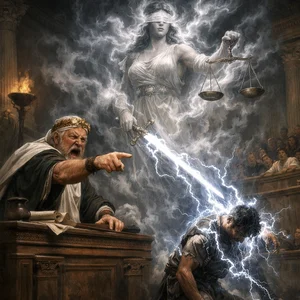
Themis's most famous symbol, the scales represent the perfect equilibrium of cosmic justice. They weigh the deeds of mortals and gods alike to determine what is right according to divine law, without favoritism or passion.

The emblem of her divine authority over the assemblies of the gods. Themis raises the scepter when summoning the gods on Olympus, signifying that her word carries the force of law, even for the immortal gods.

Before Apollo claimed it, it was upon the sacred tripod at Delphi that Themis delivered her oracles. This object symbolizes her prophetic function and her direct access to the decrees of fate.

In certain depictions, Themis holds tablets inscribed with the *thesmoi* — the unwritten laws and divine customs that predate all human legislation and govern the order of the cosmos.

Sometimes depicted holding a cornucopia, Themis embodies the prosperity that flows naturally from a just and harmonious order: when *themis* reigns, peace and fertility flourish.

Themis is often depicted partially veiled in white cloth, a symbol of the purity and impartiality of divine law — beyond the reach of the passions and self-interest that blind mortals.
School Curriculum
Vocabulary & Tags
Key Vocabulary
Tags
Daily Life
Morning
In the Greek mythological imagination, Themis begins her day on the golden heights of Olympus, watching as Helios drives the sun chariot across the sky. She consults the decrees of fate with her daughters the Moirai, ensuring that the day ahead will unfold according to the cosmic order she has embodied since the dawn of time.
Afternoon
At the heart of the divine day, Themis presides over the deliberations of the gods or lingers at the sanctuaries where mortals come to seek her guidance through the oracle. When she held the oracle of Delphi, she would sit upon the sacred tripod, allowing the vapors rising from the earth to pass through her divine being and deliver prophecies to the priestesses.
Evening
In the evenings on Olympus, Themis sits at Zeus's right hand during the divine banquets, ensuring that each god is served according to rank and that the guests honor the sacred laws of divine hospitality. Her presence reminds all that even the most powerful gods remain subject to the cosmic order she embodies.
Food
Like all Olympian gods, Themis nourishes herself on ambrosia and drinks nectar, the divine foods that confer immortality and sustain the vigor of the Immortals. These delicacies are served to her at celestial banquets, in golden cups crafted by Hephaestus, the smith god of Olympus.
Clothing
Themis is depicted draped in a long white or golden peplos, the flowing and majestic garment characteristic of the great female Greek divinities. Her attire reflects the purity and impartiality of divine law: sober and dignified, without excessive adornment — justice must not be burdened with artifice.
Housing
Themis resides in the golden palace of Olympus, within the community of Olympian gods to whom she allied herself after the Titanomachy. Some accounts also grant her access to the depths of the earth at Delphi, a crossroads between the chthonic world and the world of men, and the source of all prophecy.
Historical Timeline
Period Vocabulary
Liens externes & ressources
Références
Œuvres
Gardiennat de l'oracle de Delphes
Temps mythique primordial
Maternité des Moires (Clotho, Lachésis, Atropos)
Temps mythique
Maternité des Heures (Eirènè, Dikè, Eunomie)
Temps mythique
Présidence des assemblées divines
Temps mythique olympien
Prophétie sur Thétis et la destinée d'Achille
Avant la guerre de Troie (temps mythique)