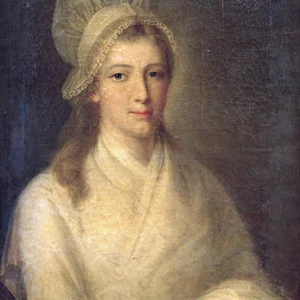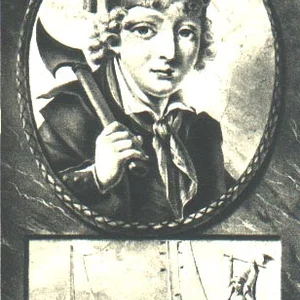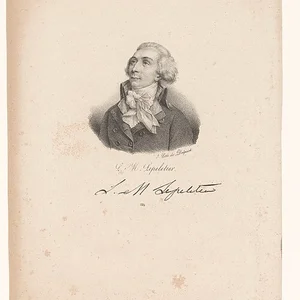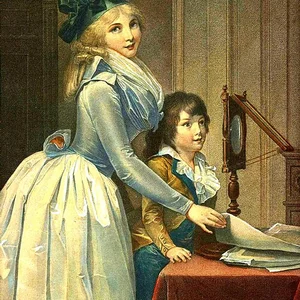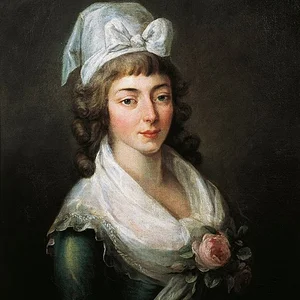

A Belgian revolutionary activist (1762–1817), Théroigne de Méricourt played an active role in the French Revolution, most notably during the Women's March on Versailles (1789). A fierce champion of women's political rights, she was one of the first revolutionary feminists before being committed to the Salpêtrière asylum, where she remained until her death.
Théroigne de Méricourt
Théroigne de Méricourt
8 min read
Frequently asked questions
Key Facts
- 1762: born in Marcourt in the Austrian Netherlands (present-day Belgium)
- October 1789: took part in the Women's March on Versailles
- 1791: arrested by the Austrians and imprisoned at Kufstein Castle
- May 1793: publicly flogged by Jacobin women, marking her break with the Revolution
- 1794–1817: committed to the Salpêtrière hospice until her death
Works & Achievements
Théroigne founded in Paris one of the first exclusively female political clubs, aimed at educating women in citizenship and debating public affairs. This pioneering initiative foreshadowed the feminist struggles of the following century.
In this celebrated speech, Théroigne called on women to take up arms and form battalions to defend the Republic. In it, she articulated one of the earliest explicit demands for full political equality between the sexes.
Théroigne drafted and circulated a petition demanding that women be allowed to join the National Guard on equal terms with men. This text reflects her conviction that citizenship cannot be incomplete.
An iconic collective action in which Théroigne played an active role by mobilizing and rallying the crowds. This event forced Louis XVI to return to Paris and became a symbol of women's entry into revolutionary politics.
Théroigne fought during the insurrectionary day that overthrew the monarchy, bearing arms alongside the sans-culottes. Her armed presence that day made her a controversial icon of the Revolution.
Anecdotes
Théroigne de Méricourt was not her real name: she was actually born Anne-Josèphe Terwagne, in a small village in the Belgian Ardennes. She adopted the name "Théroigne de Méricourt" to sound more French and establish herself in Parisian revolutionary circles, where foreign origins could be viewed with suspicion.
On 5 October 1789, Théroigne took part in the famous Women's March on Versailles. Thousands of Parisian women, furious over the price of bread, marched to the royal palace to force Louis XVI to return to Paris. Théroigne played a key role in rallying and mobilizing the crowd, becoming one of the Revolution's most recognized female figures.
Théroigne wore a striking outfit that made her instantly recognizable: a red Amazon-style coat, a feathered hat, and a sword at her belt. This attire symbolized her demand for full equality between men and women, including the right to bear arms in defense of the Republic.
In May 1793, Théroigne was publicly flogged by a group of Jacobin women on the Terrasse des Feuillants, near the National Assembly. Accused of Girondin sympathies, she was humiliated before the crowd. This brutal trauma, combined with years of exhausting political engagement, hastened her descent into madness.
Arrested in 1791 by Austrian authorities while traveling in her homeland, Théroigne was transferred to Vienna and personally interrogated on the orders of Emperor Leopold II, who wanted to understand how French revolutionary networks operated. She refused to betray her comrades and was eventually released following protests from the National Assembly.
Primary Sources
Women must at last emerge from the shameful lethargy into which men's ignorance and arrogance have plunged them for too long. We must unite our strength to reclaim the rights that nature has granted us and that tyranny has stolen away.
She declared that she had frequented the public galleries of the National Assembly, had forged ties with several patriot deputies, and had taken part in various revolutionary journées which she described with evident exaltation. She denied any involvement in plots against foreign sovereigns.
Among the most ardent could be spotted a beautiful woman from Liège, known by the name of Théroigne, whose courage and beauty excited general admiration. She was dressed as an Amazon and never set aside her sabre.
The patient, formerly known as citizeness Théroigne, has presented a fixed melancholic state for several years. She incessantly repeats fragments of revolutionary speeches and appears to relive the events of 1793 with unconcealed terror.
Key Places
Théroigne's birthplace, then part of the Austrian Netherlands. Born to a peasant family, she spent a difficult childhood there before leaving the region to seek her fortune in Paris.
Théroigne took part in the Women's March on Versailles on 5 October 1789, which forced Louis XVI to leave Versailles and move to Paris. This landmark event of the Revolution was one of her first major acts of militancy.
Théroigne took part in the storming of the Tuileries on 10 August 1792, the insurrectionary day that overthrew the monarchy and proclaimed the Republic. She appeared there dressed as an Amazon, sword at her side.
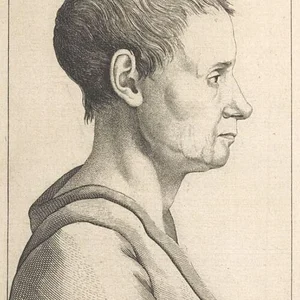
Théroigne was committed here in 1794 following her mental breakdown and died here in 1817 after twenty-three years of confinement. The psychiatrist Esquirol studied her there, making her an unwitting figure in the history of psychiatry.
Arrested in 1791 during a stay in her home region, Théroigne was taken to Vienna and interrogated by the Emperor's agents about French revolutionary networks. She was held there for several months before being released.
Typical Objects

Théroigne wore a long red coat inspired by equestrian dress, a symbol of her refusal of traditional feminine roles. This militant garment earned her the nickname “amazon of Liberty.”

She conspicuously wore a saber at her belt to assert that women had as much right as men to defend the Republic by force of arms. This symbolic gesture shocked and inspired her contemporaries in equal measure.

Like all patriots, Théroigne wore the blue-white-red cockade as a mark of belonging to the revolutionary cause. She campaigned to make wearing the cockade compulsory for women as well as men.

Théroigne read and distributed militant newspapers such as *Les Révolutions de France*, which helped spread new ideas. She also wrote her own petitions and speeches to demand women's political rights.

Her feather-adorned hat completed her amazon costume and made her immediately recognizable in processions and in the public galleries of the Assembly. This striking headwear was a deliberate part of her political self-presentation.

Théroigne drafted several petitions addressed to the National Assembly demanding the right to vote and the right to bear arms for women. These handwritten documents were copied and circulated among the patriotic clubs.
School Curriculum
Vocabulary & Tags
Key Vocabulary
Daily Life
Morning
Théroigne rose early in her Parisian apartment in the Cordeliers district. She read revolutionary newspapers such as *Les Révolutions de France* or *L'Ami du peuple* to follow political debates, then drafted letters and petitions intended for clubs or deputies.
Afternoon
She would make her way to the galleries of the National Assembly or the Jacobin Club to listen to debates, often dressed in her red riding habit that made her instantly recognizable. She also took part in meetings at her own club and walked the popular sections of Paris to address the citizens.
Evening
Evenings were devoted to political discussions in cafés and patriot salons, where she rubbed shoulders with deputies and revolutionary journalists. She prepared her upcoming speeches and maintained her network of activists sympathetic to women's rights.
Food
Like the majority of revolutionary Parisians, Théroigne lived simply: soup, dark bread, vegetables, and occasionally meat on good days. The food shortages that roiled Paris — notably the high price of bread — were a daily reality that, in her eyes, justified women's political engagement.
Clothing
Her signature costume — the red Amazon-style riding habit, the plumed hat, and the saber — was a genuine political manifesto worn on her person. Day to day, she might wear more understated attire, but the tricolor cockade was always present, an unmistakable mark of belonging to the patriot camp.
Housing
Théroigne occupied a modest apartment in Paris, in the neighborhoods frequented by revolutionary activists. Unlike the great ladies of the Ancien Régime, she lived without servants, in conditions close to those of the artisans and petty bourgeois who formed the heart of the sans-culottes.
Historical Timeline
Period Vocabulary
Liens externes & ressources
Références
Œuvres
Fondation du Club des Amies de la Loi
1790
Discours à la Société fraternelle des minimes
25 mars 1792
Pétition pour le droit des femmes à porter les armes
1792
Participation à la marche des femmes sur Versailles
5-6 octobre 1789
Participation à la prise des Tuileries
10 août 1792