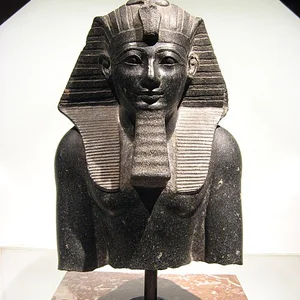

Pharaoh of the 18th Egyptian Dynasty (c. 1479–1425 BCE), Thutmose III is considered the greatest conqueror of ancient Egypt. He led seventeen military campaigns and brought the Egyptian empire to its greatest territorial extent.
Thutmose III(1480 av. J.-C. — 1424 av. J.-C.)
Thutmose III
Égypte antique
8 min read
Frequently asked questions
Key Facts
- c. 1479 BCE: accession to the throne, initially under the co-regency of Hatshepsut
- c. 1457 BCE: victory at the Battle of Megiddo, the first battle recorded in detail in history
- Led 17 military campaigns in the Levant, Nubia, and Syria
- Extended the Egyptian empire from the Euphrates in the north to the Fourth Cataract in the south
- c. 1425 BCE: death after a reign of more than fifty years
Works & Achievements
A festival hall built at Karnak to celebrate the royal jubilee (Sed festival). It houses the room known as the 'botanical garden', decorated with bas-reliefs depicting exotic plants and animals brought back from Syria — a unique naturalistic document in Egyptian art.
Texts engraved on the walls of the Karnak temple by the royal scribe Thjaneni, describing the pharaoh's seventeen military campaigns. The first detailed military chronicle in history, they are a primary source for Egyptology.
Thutmose III erected at least seven obelisks, more than any other pharaoh. Several were moved in antiquity: one stands in Rome (the Lateran), one in Istanbul, and two in the United States and Great Britain, testifying to the global reach of his reign.
A commemorative stele erected in Nubia, recounting Thutmose III's conquests from the Euphrates to the heart of Africa. It marks the borders of the empire at its height and proclaims the pharaoh's universal sovereignty.
A tomb remarkable for its innovative architectural layout and walls covered with the complete text of the Amduat in a distinctive linear style, like a giant papyrus unrolled onto stone — a model for subsequent royal tombs.
Thutmose III had a temple built overlooking Hatshepsut's at Deir el-Bahari, integrating this sanctuary into a larger architectural complex dedicated to Amun and to royal memory.
Anecdotes
During his first major campaign in 1457 BC, Thutmose III faced a strategic dilemma outside Megiddo: take a wide, safe route or push through the narrow and risky pass of Aruna to catch the enemy off guard. His generals strongly advised against the dangerous passage, but the pharaoh led his troops through it himself. His victory was total, and Megiddo fell after a seven-month siege.
After his campaigns in the Levant, Thutmose III brought back to Egypt not only prisoners and plunder, but also exotic plants and animals. He had precise depictions of these species carved into what is known as the 'botanical garden' room in the temple of Karnak: ibises, gazelles, Syrian lotuses. It is one of the earliest illustrated herbariums in history.
Thutmose III began his reign as co-regent under his stepmother Hatshepsut, who assumed full pharaonic titles and kept him in the background for over twenty years. After Hatshepsut's death, he erased her cartouches and monuments only much later — an act of political calculation rather than personal revenge, according to modern Egyptologists.
During his eighth campaign, Thutmose III reached the Euphrates, pushing the empire's borders further than any pharaoh before him. This expedition included an elephant hunt near Niya in Syria, during which his officer Amenemhab saved him from a charging elephant — a feat recorded in the soldier's own autobiography, carved into the walls of his tomb.
Thutmose III is the earliest ruler in history whose military campaigns were recorded in the form of detailed official annals, written by his scribe Tjaneni. These texts, carved on the walls of the temple of Karnak, constitute the oldest document of military strategy from the ancient world and allow historians to reconstruct with precision seventeen campaigns over twenty years.
Primary Sources
"His Majesty passed through the pass of Aruna. [...] His Majesty rode on his electrum chariot, adorned with his weapons of war, like Horus the strong-armed, lord of action."
"I fought at Megiddo [...] I seized a severed hand. It was handed over to the royal scribe to be recorded to the account of valor."
"Foreign peoples came to him with their tribute on their backs, their children before them, begging that the breath of life be granted to them."
"I have come to make you crush the chiefs of Asia; I have hurled them beneath your sandals."
The stele records the early military campaigns of Thutmose III and celebrates his victories over the chiefs of Asia. It corroborates the chronological data from the Karnak Annals for the earliest campaigns.
Key Places
Site of Thutmose III's first great victory in 1457 BC against the Syro-Canaanite coalition. The battle is the earliest military action in history to be documented with precise tactical detail.
Grand sanctuary of Amun where Thutmose III had his military annals inscribed and built the Akh-menu. It is the primary site commemorating his reign and his conquests.
Burial place of Thutmose III, discovered in 1898 by Victor Loret. Its walls are covered with the complete Amduat, painted in a distinctive linear style, as though a giant papyrus scroll had been unrolled across the surfaces.
Southern frontier of Thutmose III's empire, where he erected a commemorative stele. This region, regarded as the throne of Amun, would later become the heartland of the Kingdom of Kush.
A strategic city in the Levant captured by Thutmose III during his Syrian campaigns. Kadesh would remain a major geopolitical flashpoint for later pharaohs, most notably Ramesses II, who fought his famous battle there against the Hittites.
Sacred city of the god Ra where Thutmose III erected several obelisks celebrating his victories. Two of them, known as Cleopatra's Needles, stand today in London and New York.
Typical Objects

A military headdress made of blue leather or fabric, decorated with golden discs, worn by Thutmose III during his campaigns. It symbolizes the pharaoh's warrior power and appears in nearly all depictions of his victories at Karnak.

A curved-blade sword of Asian origin, adopted by Egyptian armies during the New Kingdom. Thutmose III presented it to defeated chiefs as a sign of submission and royal recognition.

A light two-wheeled vehicle introduced to Egypt by the Hyksos and mastered during the New Kingdom. Thutmose III deployed it extensively at Megiddo, personally driving his chariot at the head of his troops.

Thutmose III erected more obelisks than any other pharaoh. These pink granite monoliths covered in hieroglyphs commemorated his victories and piety — several stand today in Rome, Istanbul, London, and New York.

The crook and flail, pharaonic insignia representing royal authority and justice. Thutmose III holds them in all his official representations as guarantor of Ma'at across the land and in conquered territories.

Funerary figurines made of faience, intended to substitute for the deceased in the labor duties of the afterlife. The burial goods of tomb KV34 include shabtis among the earliest to bear complete magical spells from the Book of the Dead.
School Curriculum
Vocabulary & Tags
Key Vocabulary
Tags
Daily Life
Morning
The pharaoh wakes before dawn in his palace at Thebes or in his military camp. Priests perform purification rites: a ritual bath, anointings with scented oils, and ceremonial dressing. Thutmose III begins the day with an offering to the god Amun in the royal chapel, before receiving reports from his generals and scribes.
Afternoon
On campaign, the pharaoh presides over war councils, reviews reconnaissance reports, and issues tactical orders from his chariot. In peacetime, he oversees construction at Karnak, receives ambassadors from vassal peoples bringing their tributes, and presides over judicial hearings. The afternoon may include archery practice or chariot training.
Evening
In the evening, Thutmose III attends royal banquets accompanied by musicians and dancers. Scribes read him stewardship reports on the granaries and livestock. The day closes with religious rites at sunset, during which the pharaoh — as mediator between men and gods — performs the gestures that ensure the sun's return the following day.
Food
The royal diet is abundant: breads of several qualities, barley beer, meats (beef, goose, duck), fish from the Nile, legumes (lentils, chickpeas), vegetables (onions, garlic, cucumbers), and fruits (dates, figs, pomegranates). Wine is reserved for the elite. On campaign, military rations are more frugal, consisting mainly of bread, beer, and dried legumes.
Clothing
Thutmose III wears the shendyt, a pleated white linen kilt with a golden belt. For ceremonies, he dons fine translucent linen robes, pectorals of gold, lapis lazuli, and carnelian, along with bracelets and broad usekh collars. On the battlefield, he wears the blue khepresh crown and reinforced leather armor. A gilded false beard is attached to his chin during official ceremonies.
Housing
The royal palace at Thebes is a vast complex of whitewashed mud brick, featuring hypostyle halls with painted columns, interior gardens with reflecting pools, and private apartments ventilated by tall north-facing windows. On campaign, Thutmose III resides in a large royal linen tent, surrounded by his personal guard and senior officers.
Historical Timeline
Period Vocabulary
Visual Style
Art officiel égyptien du Nouvel Empire : bas-reliefs peints sur grès et granite dans les tons ocre, or, bleu lapis et vert Nil, représentant en registres superposés les triomphes militaires et les offrandes rituelles du pharaon.
Sound Ambience
Ambiance de camp militaire égyptien au lever du jour, mêlant rites religieux à Amon, préparatifs guerriers et tumulte de la bataille, suivis du retour triomphal et des travaux de commémoration à Karnak.
Liens externes & ressources
Références
Œuvres
Akh-menu (salle des fêtes de Karnak)
v. 1440 av. J.-C.
Annales de Thoutmôsis III (Karnak)
v. 1457-1425 av. J.-C.
Obélisques de Thoutmôsis III
v. 1450-1425 av. J.-C.
Stèle de Gebel Barkal
v. 1432 av. J.-C.
Tombe KV34 (Vallée des Rois)
v. 1424 av. J.-C.
Temple de Deir el-Bahari (agrandissements)
v. 1450 av. J.-C.
Rechercher
See also
Related Characters
Ay
1400 av. J.-C. — 1400 av. J.-C.
Narmer
3200 av. J.-C. — 3124 av. J.-C.
Ptah
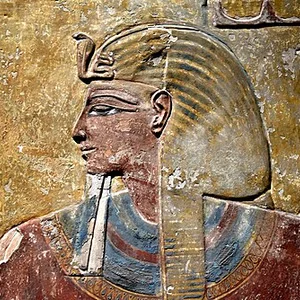
Seti I
1322 av. J.-C. — 1278 av. J.-C.
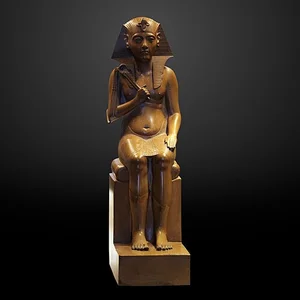
Smenkhkare
1400 av. J.-C. — 1333 av. J.-C.
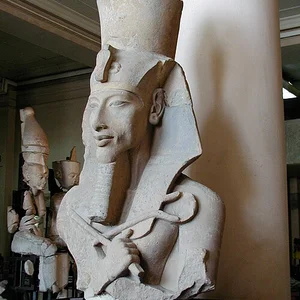
Akhenaten
1400 av. J.-C. — 1335 av. J.-C.