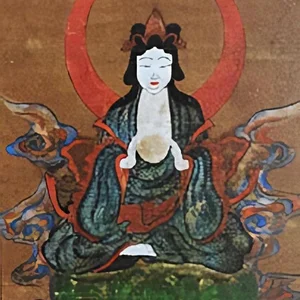

Tsukuyomi is the god of the Moon in Japanese Shintō mythology. Born from the right eye of Izanagi during the primordial purification, he reigns over the night. His quarrel with the sun goddess Amaterasu explains the separation of day and night.
Tsukuyomi
Tsukuyomi
8 min read
Frequently asked questions
Key Facts
- Born from the right eye of Izanagi during his purification after his descent to the land of the dead (according to the Kojiki)
- He kills the food goddess Uke Mochi, provoking Amaterasu's wrath
- Following this murder, Amaterasu refuses to look at him, thus creating the alternation of day and night
- Mentioned in the Kojiki (712 CE), the oldest Japanese chronicle
- His name roughly means “one who reads the moon” or “master of the month”
Works & Achievements
Izanagi entrusts Tsukuyomi with sovereignty over the night sky. His cosmic mission is to preside over the dark hours, ensure the lunar cycles, and maintain temporal balance in alternation with Amaterasu.
The episode of Tsukuyomi and Uke Mochi constitutes the central etiological narrative explaining why the Sun and Moon never see each other in the sky. This myth, preserved in the Nihon Shoki, is fundamental to Shintō cosmology.
The lunar cycles presided over by Tsukuyomi structured the Japanese calendar for centuries. Religious festivals, sowing seasons, harvests, and court ceremonies were all organized according to its 29.5-day lunar months.
The autumnal full moon festival, a direct heir to the cult of Tsukuyomi, still brings Japanese people together today to contemplate the moon, offer mochi and pampas grass, perpetuating a thousand-year-old religious tradition.
The moon associated with Tsukuyomi is omnipresent in lacquerware painting, ukiyo-e woodblock prints, haiku poetry, and Nō theater. Poets such as Matsuo Bashō made it a symbol of the transient and the divine.
Anecdotes
Tsukuyomi is born from Izanagi's right eye when the creator god purifies himself in a river after his harrowing journey to Yomi, the realm of the dead. At that same moment, the left eye gives birth to Amaterasu, goddess of the Sun, and the nose brings forth Susanoo, god of storms. This triple birth marks the great separation of the fundamental cosmic forces.
According to the Nihon Shoki, Tsukuyomi is sent by Amaterasu to visit Uke Mochi, the goddess of food. But when he sees her preparing a banquet by drawing food from her mouth, nose, and bowels, he kills her in a fit of disgust. Amaterasu, horrified by this act, vows never to look upon her brother again — and so the Sun and Moon are condemned never to meet in the sky.
Unlike Amaterasu and Susanoo, whose mythological adventures fill many pages of the Kojiki and the Nihon Shoki, Tsukuyomi remains a mysterious and nearly absent figure in the tales. Some historians of religion believe his myths were deliberately erased or never fully developed, making him one of the most enigmatic deities in the Shinto pantheon.
In Japanese, the name Tsukuyomi (月読) literally means 'moon reading' or 'moon counting.' This name reflects the moon deity's concrete role in ancient Japan: the moon served as a natural clock for organizing planting, harvests, and religious ceremonies according to a precise lunar calendar known as taiinreki.
Shinto shrines dedicated to Tsukuyomi still exist in Japan today, notably near the Grand Shrine of Ise in Mie Prefecture and in Kyoto near the Matsunoo Shrine. These places of worship, more than a thousand years old, show that despite his mythological silence, the moon god has always held a genuine place in Japanese popular devotion.
Primary Sources
When Izanagi-no-Mikoto washed his right eye, a deity was born called Tsukuyomi-no-Mikoto. When he washed his left eye, a deity was born called Amaterasu-Ōmikami. These two deities were charged with governing the heavens.
Tsukuyomi-no-Mikoto slew Uke Mochi no Kami. When Amaterasu-Ōmikami learned of this, she grew angry and said: “You are an evil and wicked being. I no longer wish to look upon you.” From that time on, the deity of the Sun and the deity of the Moon were separated into day and night, never to meet again.
Izanagi-no-Mikoto held a white mirror in his left hand, and a deity was born called Amaterasu-Ōmikami, lord of the Heavens. He then held a white mirror in his right hand, and a deity was born called Tsukuyomi-no-Mikoto, whose reign was set over the night.
The norito addressed to Tsukuyomi-no-Mikoto describe him as the guardian of nocturnal cycles, the deity who presides over lunar phases and watches over the purification rites performed in darkness.
Key Places
Mythic celestial realm where the great Shintō deities reside. It is here that the eternal separation of Tsukuyomi and Amaterasu takes place after the murder of Uke Mochi, establishing the cosmic alternation of day and night.
One of the oldest shrines dedicated to Tsukuyomi, located in the sacred region of Ise. It is part of the network of secondary shrines (sessha) affiliated with the Grand Shrine of Ise, dedicated to Amaterasu.
A Shintō shrine dedicated to Tsukuyomi located in the Matsunoo district of Kyoto. A site of nocturnal purification rites and lunar ceremonies, it has been frequented since the Heian period.
The most sacred shrine in Japan, primarily dedicated to Amaterasu. Tsukuyomi is honored there as the brother of the great goddess, in an auxiliary shrine that recalls their original bond and their mythic separation.
The subterranean underworld of Japanese mythology, from which Izanagi returns defiled before purifying himself and giving birth to Tsukuyomi. This mythical place is the symbolic point of origin of the lunar deity and the cycle of life-death-rebirth.
Typical Objects

The mirror is Tsukuyomi's fundamental attribute in certain variants of the Nihon Shoki, where he is born from a mirror held in Izanagi's hand. It symbolizes the moon's ability to reflect sunlight without being its own source.

The shape of the crescent moon evokes the farmer's sickle, an essential tool in ancient Japan. Tsukuyomi is associated with agricultural rhythms, as the lunar calendar guided planting, harvesting, and fertility rituals.

These round, white cakes mimic the shape of the full moon and are offered during the Tsukimi festival in honor of Tsukuyomi. Their whiteness evokes the purity and cold brilliance of moonlight.

A wooden wand adorned with white or silver paper streamers, used in Shinto purification rituals. Its color evokes the lunar glow and the purity that Tsukuyomi is believed to bestow upon nocturnal ceremonies.

Lanterns placed in Shinto shrines to guide worshippers through the darkness, symbolizing Tsukuyomi's moonlight. They have illuminated nocturnal processions and ceremonies since the Heian period.

Shinto priests used engraved tablets to track the phases of the moon and plan ritual ceremonies. Tsukuyomi, master of the nocturnal realm, symbolically presided over these divinatory and calendrical practices.
School Curriculum
Vocabulary & Tags
Key Vocabulary
Daily Life
Morning
At the break of dawn, Tsukuyomi leaves the sky and yields his place to Amaterasu. In accordance with the cosmic oath that separates them forever, their passage is imperceptible — one fades as the other brightens, in a celestial ballet that governs the life of all creatures.
Afternoon
During the daylight hours, Tsukuyomi governs in shadow the nocturnal forces taking shape. His invisible influence rules the tides, natural cycles, and dreams. Shintō priests prepare in his honor the offerings that will be presented at nightfall.
Evening
At dusk, Tsukuyomi emerges to illuminate the darkness. In the sanctuaries, stone lanterns are lit, norito are recited, and offerings of white rice, mochi, and sake are placed to seek his protection over the coming night and the smooth progression of agricultural cycles.
Food
The ritual offerings destined for Tsukuyomi include polished white rice, a symbol of lunar purity; fermented sake prepared on full-moon nights; and round, white mochi rice cakes evoking the shape and radiance of the moon. These white foods are the sacred foods par excellence of nocturnal Shintō.
Clothing
In artistic representations and liturgical texts, Tsukuyomi is associated with white and silver hues recalling the cold light of the moon. Priests officiating at nocturnal ceremonies in his name wore white ritual robes (white hakama), the color of absolute purity in Shintō.
Housing
Tsukuyomi resides in Takamagahara, but separated from Amaterasu's dwelling since their eternal quarrel. His earthly residences are the sanctuaries dedicated to him, built in hinoki cypress according to traditional Shintō architecture — sober, unpainted, in communion with the forest and the night.
Historical Timeline
Period Vocabulary
Liens externes & ressources
Références
Œuvres
Gouvernance du royaume de la nuit
Temps mythologique
Mythe fondateur de la séparation jour/nuit
Temps mythologique (consigné en 720 apr. J.-C.)
Organisation du calendrier lunaire japonais (太陰暦, taiinreki)
Antiquité — 1872 apr. J.-C.
Fête Tsukimi (月見, contemplation de la lune)
Période Heian (~794 apr. J.-C.) — aujourd'hui
Motif lunaire dans l'art et la poésie japonaise
VIIIe siècle apr. J.-C. — aujourd'hui