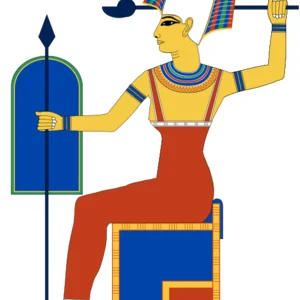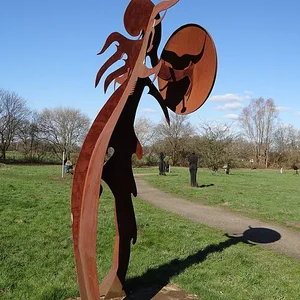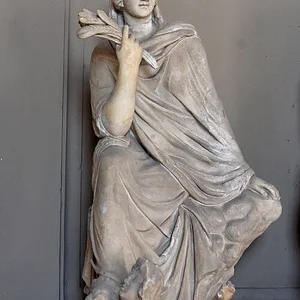

Tyche is the Greek goddess of fortune, chance, and destiny. Daughter of Oceanus and Tethys, she personifies the whims of fate that govern the lives of mortals and the destinies of cities. Her cult spread throughout the Hellenistic world.
Tyche
Tyche
9 min read
Frequently asked questions
Key Facts
- Tyche is mentioned as early as Hesiod (7th century BC) among the Oceanids in the Theogony
- Her Roman equivalent is Fortuna, whose cult was extremely popular in Rome
- She is often depicted with a cornucopia and a rudder symbolizing destiny
- In the Hellenistic period, every major city had its own tutelary Tyche (e.g., the Tyche of Antioch)
- The statue of the Tyche of Antioch, created around 300 BC by Eutychides, is one of the most celebrated works of Hellenistic sculpture
Works & Achievements
Masterpiece of Hellenistic sculpture commissioned by Seleucus I for the new capital of his empire. This bronze statue (known through marble copies) depicts Tyche seated on a rock, symbolizing the solid foundation of Antioch, with the river god Orontes at her feet — an innovative composition that was copied throughout the Greek world.
Lyric ode composed in honor of Ergoteles of Himera, winner of the stadion race. Pindar invokes Tyche Eleuthereia (the Liberating Fortune) as a daughter of Zeus, crediting her with power over the sea, warfare, and human deliberations — the first major literary work devoted entirely to her glory.
The Greek historian Polybius devotes long passages of his monumental work (40 books) to analyzing the role of Tyche in the rise of Rome. He portrays her as a power guided almost providentially toward a goal, transforming the goddess of chance into a quasi-rational historical concept.
A remarkable mosaic discovered at Zeugma (in modern-day Turkey) depicting Tyche with her traditional attributes. It attests to the vitality of her cult in the eastern regions of the Seleucid empire and stands as one of the best-preserved iconographic records of the goddess.
The first Greek text to name Tyche, placing her within the divine genealogy as an Oceanid, daughter of Oceanus and Tethys. This brief mention in Hesiod's great cosmogonic poem grants her an ancient divine origin, predating her Hellenistic cultic prominence.
Anecdotes
Around 300 BCE, the sculptor Eutychides of Sicyon created for the new city of Antioch a statue of Tyche that would become one of the most celebrated of Antiquity. The goddess is depicted seated on a rock, wearing a crown in the shape of city walls, while at her feet swims the river-god Orontes. This image would be copied hundreds of times throughout the Hellenistic world.
In 476 BCE, the poet Pindar composed an entire ode in honor of Tyche Eleuthereia — the Liberating Fortune — to celebrate Ergoteles' victory at the Olympic Games. It is one of the oldest literary testimonies attesting to a cult of Tyche as an autonomous divine power, distinct from the Moirai or blind fate.
In the Hellenistic world, every major city had its own tutelary Tyche, depicted wearing the mural crown symbolizing the city's walls. Alexandria, Antioch, Smyrna, and Ephesus competed in splendor to honor their poliad Tyche, regarded as the mystical guardian of their prosperity and survival.
The historian Polybius, in the 2nd century BCE, used Tyche as a philosophical concept to explain the unpredictable reversals of history, particularly the rise of Rome. For him, Fortune was not a whim but an almost rational force that redirected the course of human events toward a goal — Roman domination over the Mediterranean world.
The Wheel of Fortune, one of Tyche's most celebrated attributes, perfectly embodies the idea that fate raises the lowly and brings down the mighty. Stoic and Epicurean philosophers endlessly debated how much room was left to Tyche alongside virtue or destiny — a debate that would run throughout all of Antiquity and resurface in the Middle Ages under the name of the Wheel of Fortune (*rota fortunae*).
Primary Sources
"And Tethys bore to Oceanus the swirling Oceanids [...] Tyche and Metis and Eurynome of the white arms."
"I beseech you, daughter of Zeus the Liberator, guardian Tyche, mighty Fortune! On the vast sea the swift ships are in your hands, on land the counsels of war and the assemblies of men."
"Fortune (Tyche), having turned almost all the affairs of the world in a single direction and compelled them to tend toward one and the same goal, is what drove us to undertake this history."
"The Messenians also possess a sanctuary of Tyche. The marble statue is the work of Scopas; the goddess holds in one hand the cornucopia and in the other the winged Eros."
"Mortals have need of benevolent Fortune; knowledge counts for less than Tyche when it comes to the outcome of battles."
Key Places
The Seleucid capital where Eutychides sculpted the Tyche of Antioch around 300 BC — an iconic statue depicting the goddess wearing a mural crown, seated on the city's rocky terrain. This masterpiece became the iconographic model for all Hellenistic civic Tyches.
The great Panhellenic sanctuary where Tyche was honored alongside the other Olympian deities. Pausanias mentions a statue of Tyche holding Plutus (god of wealth) in her arms, signifying that she alone distributes riches to mortals.
The great Hellenistic metropolis founded by Alexander the Great, where Tyche was venerated as the city's tutelary goddess alongside Serapis. Her cult there symbolized the extraordinary fortune of a city destined to dominate Mediterranean trade.
At the heart of the democratic city, a statue of Tyche stood in the Agora — the center of all political and commercial life. Her presence reminded citizens that even the wisest decisions remained subject to the whims of Fortune.
A major city of Asia Minor that proudly proclaimed itself to be under the protection of Tyche. Coins minted at Smyrna during the Hellenistic period regularly bear the image of a crowned Tyche, attesting to the depth of her cult there.
Typical Objects

Tyché's most common attribute, the cornucopia overflowing with fruits and riches symbolizes the prosperity she can bestow upon individuals and cities alike. It serves as a reminder that Fortune can be just as generous as she is cruel.

The wheel that Tyché spins represents the fickleness of fate: those at the top may find themselves at the bottom, and vice versa. This symbol perfectly captures the Greek idea that no human happiness is ever permanent.

The ship's rudder held by Tyché signifies that she steers the course of human life just as a helmsman guides his vessel. It is a reminder that humans sail upon the unpredictable sea of destiny, never fully in command of its storms.

Tyché Polias — protector of cities — is often depicted wearing a crown shaped like battlemented walls. This architectural diadem symbolizes her role as the mystical guardian of city fortifications and urban prosperity.

Sometimes depicted standing atop a sphere or globe, Tyché embodies the fundamental instability of fortune: a sphere rolls at the slightest breath, and happiness can tip over at any moment.

In certain later depictions influenced by the Roman Fortuna, Tyché is shown blindfolded, emphasizing that chance makes no distinction between the just and the unjust, the rich and the poor.
School Curriculum
Vocabulary & Tags
Key Vocabulary
Daily Life
Morning
At dawn, Tyché travels through the ether from Olympus to observe mortals as they wake and begins her daily distribution of lots. At this hour, the faithful would leave offerings at her sanctuaries — flowers, libations of milk and honey — hoping to incline her toward benevolence before the day began.
Afternoon
In broad daylight, Tyché spins her mystic wheel, raising some and lowering others with no one able to foresee which way it will turn. She guides the rudder of merchant ships at sea, takes her seat in city assemblies to sway the votes of men, and accompanies generals on the battlefield, deciding the outcome at the very last moment.
Evening
At twilight, Tyché gathers the fates of the day and places into her cornucopia what she holds in store for the morrow. It was at the hour of sunset that Greek philosophers meditated on her caprices, seeking in wisdom (sophia) or virtue (areté) the only possible bulwark against the reversals of fortune.
Food
As a goddess, Tyché feeds on ambrosia and nectar, the divine foods that grant immortality to the gods of Olympus. Her devotees offered her honey cakes (melitoutta), fruits of the cornucopia — figs, pomegranates, grapes — and sometimes libations of pure wine to honor her generosity.
Clothing
Tyché is depicted draped in a chiton (tunic) and a himation (large cloak) with flowing folds, garments typical of Greek goddesses. Her crenellated mural crown is her most immediately recognizable distinctive feature, sometimes complemented by a billowing veil symbolizing the unpredictability of the wind of fate.
Housing
Tyché has no fixed residence on Olympus like Zeus or Hera — her very nature as a wandering Fortune implies perpetual movement between the heavens and the world of men. In the cities that devoted a cult to her, Tychaia were built — small sanctuaries at the heart of the agora — to symbolically anchor her to the fortune of the city and prevent her from carrying it elsewhere.
Historical Timeline
Period Vocabulary
Liens externes & ressources
Références
Œuvres
Tyché d'Antioche — sculpture d'Eutychidès
vers 300 av. J.-C.
Olympique XII — Pindare
476 av. J.-C.
Histoires — Polybe (traitement philosophique de Tyché)
vers 167–118 av. J.-C.
Mosaïque de Tyché de Zeugma
IIe siècle av. J.-C.
Théogonie — Hésiode (mention des Océanides)
vers 700 av. J.-C.