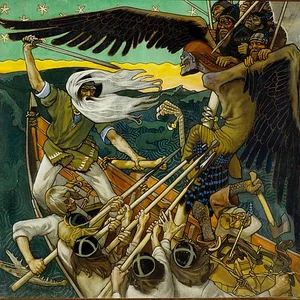

Väinämöinen is the central hero of the Kalevala, Finland's national epic. A primordial sage and shamanic bard, he embodies wisdom, magic, and music in Finnic mythology. His kantele casts spells over men, animals, and nature alike.
Väinämöinen
Väinämöinen
9 min read
Frequently asked questions
Key Facts
- Son of the primordial goddess Ilmatar, Väinämöinen is born from the sea after a gestation of 700 years
- Master of magical song (runo) and inventor of the kantele, a stringed zither capable of enchanting all of nature
- The Kalevala, Finland's national epic compiled by Elias Lönnrot (1835–1849), places him as the central hero across 50 cantos
- He takes part in the creation of the world and leads the quest for the Sampo, a magical object that brings infinite prosperity
- At the end of the Kalevala, he leaves Finland on a copper boat, promising to return in a new age
Works & Achievements
Väinämöinen creates the first kantele by carving a zither from the jawbone of a great pike. This founding act makes him the father of music and poetry throughout the Finnic tradition.
Through his primordial runes, Väinämöinen takes part in the ordering of the cosmos by singing the trees, stones, and waters into their places, acting as a demiurge whose word is deed.
Väinämöinen organizes and leads the perilous expedition to Pohjola to seize the Sampo; this episode forms the narrative heart of the Kalevala and illustrates his role as spiritual guide and culture hero.
A journey of initiation into the underworld to steal secret magical formulas. This shamanic episode is one of the oldest motifs in Finnic mythology and aligns Väinämöinen with the great figures of shaman-healers.
A collection of 50 cantos and 22,795 verses recounting the adventures of Väinämöinen and the heroes of Kalevala. It became a symbol of Finnish national identity and has profoundly inspired Tolkien, Sibelius, and countless artists around the world.
Anecdotes
Väinämöinen was born after floating for seven hundred years in the womb of his mother Ilmatar, herself born of the primordial waters. When he finally touched land, he was already a wise, bearded old man, carrying all the memory of the world. This extraordinary birth symbolizes the antiquity of shamanic wisdom in Finnic culture.
During a magical singing duel against the young Joukahainen, Väinämöinen sang so powerfully that his rival gradually sank into a swamp up to his shoulders. Joukahainen, terrified, had to promise his sister Aino in marriage to be freed. This duel illustrates how, in the Finnic tradition, the sung word holds real power over the physical world.
Väinämöinen crafted the first kantele — Finland's emblematic stringed instrument — from the jawbones of an enormous pike he had caught. The strings were made of horsehair and the pegs of fish teeth. When he played, not only did men stop to listen, but animals, trees, and even stones were enchanted by the melody.
To obtain secret magical formulas, Väinämöinen descended alive into the kingdom of the dead, Tuonela. He was received with suspicion by the daughters of Tuoni, goddess of the dead, who nonetheless offered him beer laced with frogs and worms. He managed to escape by transforming into a water snake — a rare feat, since no one normally returns from Tuonela.
At the end of the Kalevala, having lost the contest against Marjatta and watched the newborn baptized as king of Karelia in his place, Väinämöinen stepped into his copper boat and sailed toward the horizon, never to return. He promised, however, to come back one day if his people had need of him again, leaving behind his kantele and his songs as an eternal legacy.
Primary Sources
Old Väinämöinen, the eternal singer, was born of the waters and carried within him the runes of the beginning. He sang the earth, the trees, and the stones into their places, and his word was deed.
Väinämöinen took up his kantele with its horsehair strings, laid his fingers on the bone pegs, and began to play. Bears left their dens, eagles soared low, and the waves grew still to listen.
These songs I sing, these words I speak, I received from the evening wind, stolen from the forest, gathered from the branches of bushes, collected from the grasses of the pathways.
Väinämöinen, old and wise, knew the runes of the origins. Through his songs he could freeze rivers, move hills, and call the dead back to the threshold of the world of the living.
Key Places
The mythical land from which the heroes of the epic originate, associated with Karelia in the Finnish imagination. It is the home of Väinämöinen, from which he sets out on his expeditions and to which he returns after his adventures.
A dark and hostile land of the Far North, ruled by the witch Louhi. Väinämöinen travels there several times in pursuit of the Sampo and must overcome tricks and enchantments along the way.
The underground realm of the dead in Finnic cosmology, separated from the world of the living by a black river of silent waters. Väinämöinen descends there alive to steal secret runes — a feat unique in the epic.
A village in southern Finland where Elias Lönnrot, the compiler of the Kalevala, was born. Without his collecting journeys starting from this point, the runes of Väinämöinen might have vanished forever.
The border region between Finland and Russia, the living cradle of the Finnic runic tradition. It was here that Lönnrot collected most of the epic songs from the last *runonlaulajat* in the nineteenth century.
Typical Objects

A Finnish string instrument that Väinämöinen crafts himself from the jawbones of a giant pike. His playing is so powerful that it enchants all of creation — men, animals, trees, and stones freeze in place to listen.

A magical artifact forged by the smith Ilmarinen at the command of Louhi, mistress of Pohjola. This mysterious mill produces endless abundance — flour, salt, and gold; its conquest is the central stake of the epic and the symbol of prosperity.

A magical vessel aboard which Väinämöinen sails toward the horizon at the end of the *Kalevala*. It symbolizes his departure into an undefined beyond and his promise to return should his people ever need him.

Sung incantations that Väinämöinen masters better than anyone. These magical chants allow him to act upon nature, heal the sick, vanquish his enemies, or descend into the underworld.

The tool with which Väinämöinen clears and sows the primordial land, laying the foundations of agricultural civilization in the Finnic mythical world.

A drink offered to him by the daughters of Tuoni during his descent into the underworld; Väinämöinen refuses to drink it all, sensing a trap: the beer is filled with frogs and worms, a death offering reserved for the dead.
School Curriculum
Vocabulary & Tags
Key Vocabulary
Daily Life
Morning
Väinämöinen begins his day at the water's edge, in the pale light of a Finnish morning. He listens carefully to the sounds of the forest and the lakes, for every natural sound carries secret runes to his ears. His immemorial age grants him absolute serenity: he never rushes, and he observes the world with the patience of a being born before time itself.
Afternoon
In the afternoon, he plays the kantele or sings his runes, his melodies spreading across the waters and through the undergrowth. He also performs healing rites, reciting incantations to mend broken tools or protect a village from evil spells, for his runic knowledge covers every domain of daily life and the invisible world.
Evening
As evening falls, Väinämöinen retires to his dwelling by the lake, sometimes surrounded by young apprentices to whom he passes on his songs, thus perpetuating the oral chain of Finnic wisdom. At night, he may undertake spirit journeys to other worlds, communing with the forces of nature and the ancestors.
Food
In the Finnic tradition, heroes subsist on fish — pike, perch, and vendace from the Karelian lakes — along with forest game and rye bread. Barley ale (*olut*) is the ritual drink of feasts and rites; Väinämöinen, an expert fisherman since his aquatic origins, favors the produce of fresh waters.
Clothing
Väinämöinen is described as an old man with a long white beard, dressed in hand-tanned animal skins and rough hand-spun wool, typical of the peoples of the Finnic north. His dark cloak and grave bearing evoke the shaman-*tietäjä*: at once an ordinary man and an intermediary between worlds.
Housing
He lives in a wooden dwelling by a lake, of the *pirtti* type (the traditional Finnish smoke-house): a main room heated by a large stone stove, with an earthen floor, sleeping benches along the walls, and a roof of thatch or birch bark. Dense forest and silent waters surround him on all sides, forming a threshold space between the world of the living and the invisible.
Historical Timeline
Period Vocabulary
Liens externes & ressources
Références
Œuvres
Invention du kantele
Temps mythiques
Chants de création du monde
Temps mythiques
Expédition pour le Sampo
Temps mythiques
Descente à Tuonela
Temps mythiques
Le Kalevala (épopée nationale, compilée par Elias Lönnrot)
1835 ; édition définitive 1849