Valentina Tereshkova(1937 — ?)
Valentina Tereshkova
Russie, Union soviétique
8 min read
Soviet cosmonaut born in 1937, she became on June 16, 1963, the first woman to travel in space aboard Vostok 6. A textile worker turned pilot, she embodied Soviet propaganda and the conquest of space. She later pursued a political career within the Communist Party.
Famous Quotes
« Seagull calling Earth — everything is fine! »
Key Facts
- Born on March 6, 1937, in Maslennikovo, USSR
- First woman in space on June 16, 1963, aboard Vostok 6
- She completed 48 orbits around the Earth in 70 hours and 50 minutes
- Selected from 400 civilian candidates, she was an amateur parachutist
- Named Hero of the Soviet Union after her mission
Works & Achievements
The first spaceflight by a woman in history: 71 hours in orbit, 48 revolutions around the Earth. This mission remains one of the most iconic of the Soviet space program and an enduring symbol for women's rights.
Tereshkova chaired this official organization representing Soviet women on the international stage, participating in numerous UN conferences on women's rights and world peace.
As an official representative of the USSR, she spoke at numerous UN forums, carrying the Soviet message on gender equality, disarmament, and international space cooperation.
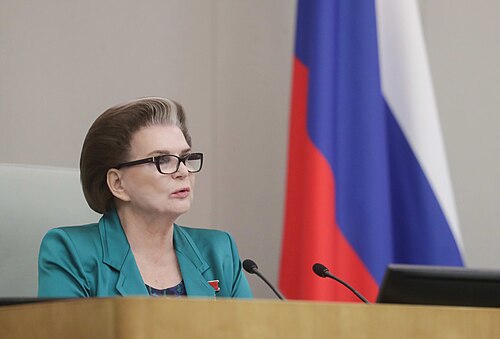
Elected on the United Russia ticket, Tereshkova has served in the Duma since 2011. In 2020, she supported the constitutional amendment allowing Vladimir Putin to seek re-election to the presidency beyond 2024.
Tereshkova was among the founding signatories of this international association bringing together astronauts and cosmonauts from around the world, dedicated to the peaceful promotion of space exploration.
Anecdotes
Before becoming a cosmonaut, Valentina Tereshkova worked as a textile worker at a cotton mill in Yaroslavl. It was her passion for skydiving — which she had practiced as an amateur since 1959, logging more than 90 jumps — that caught the attention of Soviet selectors: the Vostok capsules were designed so that the cosmonaut would eject at high altitude and land separately by parachute.
On June 16, 1963, as she lifted off aboard Vostok 6, her radio callsign was “Chaika” (the Seagull). During her 71-hour flight, she completed 48 orbits of the Earth, logging more hours in space than all American astronauts combined up to that point.
Nikita Khrushchev used Tereshkova’s flight as a powerful propaganda tool: the daughter of a collective farm peasant turned space heroine proved, in his view, the superiority of the Soviet system and the equality between men and women in the USSR — even as female astronauts would remain absent from the American space program until 1983, with Sally Ride.
In November 1963, Tereshkova married cosmonaut Andrian Nikolayev in an official ceremony attended by Khrushchev himself. Their daughter Yelena, born in 1964, was the first child whose two parents had both traveled to space, sparking worldwide scientific interest in the effects of weightlessness on human reproduction.
In 2015, during the commemorations of the 70th anniversary of the Soviet victory, Valentina Tereshkova — then a member of the State Duma — publicly declared that she would be ready to travel to Mars, even on a one-way trip. This statement, widely picked up by the international media, reflects the enduring depth of her commitment to space exploration, more than fifty years after her historic flight.
Primary Sources
“Seagull calling Earth. I feel fine. The flight is proceeding normally.” These words, spoken during the first radio contact with the Soviet ground station on June 16, 1963, were broadcast live on Soviet radio and picked up by news agencies around the world.
“Our Valentina has accomplished what no woman in the world had ever achieved before. She has proved that in our socialist country, women are the equals of men in every field, including the exploration of space.”
“A Soviet woman in space! Cosmonaut Valentina Tereshkova, aboard Vostok 6, successfully completes her orbital flight around the Earth — a brilliant new demonstration of the power of Soviet science and technology in the service of humanity.”
The medical examination conducted after the landing of Vostok 6 indicates that cosmonaut Tereshkova is in satisfactory health. Symptoms of motion sickness were observed during the initial phase of the flight, with no impact on the conduct of the mission.
“Space belongs to all of humanity. The flight of Vostok 6 demonstrates that women can contribute as equals to space exploration and to the scientific progress of our shared civilisation.”
Key Places
Valentina Tereshkova's birthplace, where she was born on **March 6, 1937**. Her father, a collective farm worker, died on the Soviet front during the Second World War; her mother raised her three children alone in this rural village deep in Russia.
The textile factory where Tereshkova worked as a mill hand from **1955** to **1962**. It was in this industrial city that she joined the Aeroclub parachuting club — the first step on her remarkable path to space.
The Soviet launch site from which *Vostok 6* lifted off on **June 16, 1963**. All Soviet and later Russian crewed spaceflights departed from this desert facility in Kazakhstan, which remains in use by Soyuz missions today.
The Soviet cosmonaut training center located 40 km northeast of Moscow, where Tereshkova spent 18 months preparing for her flight. She lived and worked there for most of her career in spaceflight.
Tereshkova landed on **June 19, 1963** on the Kazakh steppe after ejecting from the capsule at high altitude. The parachute landing in strong winds left visible marks on her face, noted by the recovery teams.