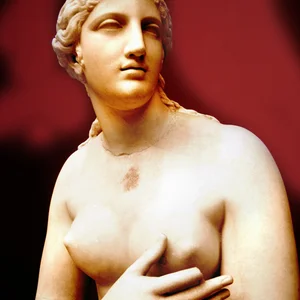

Venus is the Roman goddess of love, beauty, and fertility, equivalent to the Greek Aphrodite. Daughter of Jupiter according to some traditions, she plays a central role in Roman mythology and has inspired countless works of art throughout the centuries.
Venus
Venus
9 min read
Frequently asked questions
Key Facts
- Venus is the Roman equivalent of Aphrodite, the Greek goddess of love and beauty
- She is considered the mother of Aeneas, the legendary ancestor of the Romans, as described by Virgil in the Aeneid
- Julius Caesar claimed descent from Venus through the lineage of Aeneas, granting him divine legitimacy
- The cult of Venus was officially introduced to Rome around the 3rd century BC
- She inspired major Renaissance masterpieces such as Botticelli's The Birth of Venus (c. 1484)
Works & Achievements
Oil on canvas commissioned by the Medici family, housed in the Uffizi Gallery in Florence. This iconic Renaissance masterpiece depicts the goddess emerging from the sea on a shell, blending the ancient ideal of beauty with Neoplatonic philosophy.
Marble statue discovered in 1820 on the island of Milos, now housed in the Louvre Museum. Regarded as one of the finest examples of ancient sculpture, it has embodied the Western canon of feminine beauty for two centuries.
Oil on canvas housed in the Uffizi Gallery in Florence. This sensual depiction of a reclining nude Venus redefined the female nude in European art and would inspire Manet's Olympia three centuries later.
Oil on canvas housed at the National Gallery in London. The only known female nude by the Spanish master, it depicts Venus from behind gazing at her reflection — the sole example of a mythological nude in Spanish Golden Age painting.
A Latin philosophical poem whose opening invocation to Venus as a cosmic and creative force ranks among the most beautiful passages in Latin literature; Venus here represents the vital principle governing all life.
Rome's national epic in twelve books, in which Venus is the divine mother of the hero Aeneas, protecting him throughout his adventures as a benevolent intermediary between mortals and the destiny of Rome.
A Mannerist oil on canvas commissioned by Cosimo I de' Medici for Francis I of France, housed at the National Gallery in London. A complex allegorical painting illustrating the dangers and pleasures of Venusian love.
Anecdotes
According to Roman tradition inherited from Hesiod, Venus was born from the sea foam after Saturn mutilated Uranus: the god's body fell into the waves, and from this miraculous contact the goddess of love emerged, carried on a giant shell. This mysterious, oceanic origin explains why the scallop shell and the waves are her oldest symbols.
During the famous Judgment of Paris, three goddesses — Juno, Minerva, and Venus — competed for a golden apple inscribed "to the fairest." Venus won the prize by promising the Trojan prince the hand of Helen, the most beautiful mortal in the world. This fateful choice triggered the Trojan War, one of the most celebrated conflicts in all of mythology.
Venus was passionately in love with Adonis, an exceptionally handsome young hunter. Despite the goddess's warnings, he was killed by a wild boar. From the young man's blood sprang red anemones, and the Romans commemorated this loss every year during the Adonia festival, where women and men wept together over the death of the beautiful hunter.
Although married to Vulcan — the ugly, lame god of the forge — Venus carried on a notorious affair with Mars, the god of war. The Sun, who sees all, reported the news to Vulcan, who stretched an invisible net around the marriage bed and caught the two lovers in the act before all the gods of Olympus, to widespread shame and laughter.
The Romans venerated Venus as the divine ancestor of their entire people. According to Virgil in the Aeneid, she was the mother of the Trojan hero Aeneas, ancestor of Romulus, the founder of Rome. Julius Caesar himself claimed this divine lineage, declaring himself a member of the gens Iulia, descended from Iulus, son of Aeneas and grandson of Venus.
Primary Sources
Ænéadum genetrix, hominum divumque voluptas, alma Venus, caeli subter labentia signa quae mare navigerum, quae terras frugiferentis concelebras… ("Mother of the Aeneads, delight of men and gods, nurturing Venus, you who fill the navigable seas and the fertile lands…")
Cui mater media sese tulit obvia silva, virginis os habitumque gerens et virginis arma Spartanae… ("His mother came to meet him in the middle of the forest, bearing the face and bearing of a Spartan maiden…")
At Venus… videt exstinctum, videt et sua vulnera videt. In sinus ponit trepidumque amplectitur artus… ("Venus saw Adonis lying dead. She bent over his lifeless body and held his trembling limbs in her arms.")
Μοῦσά μοι ἔννεπε ἔργα πολυχρύσου Ἀφροδίτης, Κύπριδος, ἥ τε θεοῖσιν ἐπὶ γλυκὺν ἵμερον ὦρσε… ("Tell me, Muse, of the works of golden Aphrodite the Cyprian, who stirs sweet desire in the gods…")
'En,' inquit Venus, 'haec est filia mea, nurusque mea futura, si modo paria mea meruerit auxilia…' ("Then Venus said: Here is my daughter, and my future daughter-in-law, if only she proves worthy of my help…")
Key Places
According to legend, it was on the shores of Cyprus that Venus emerged from the sea; the island was home to her most celebrated sanctuary in antiquity, drawing pilgrims from across the Mediterranean world.
Home of the Greco-Roman gods, Olympus is the divine dwelling place of Venus, where she joins the celestial banquets, schemes among the immortals, and exerts her influence over mortals.
Julius Caesar had the Temple of Venus Genetrix built here in 46 BC, proclaiming the divine ancestry of his family; this site symbolizes the fusion of the Venusian myth and Roman political power.
A Greek island that was home to an important sanctuary of Aphrodite/Venus, where the goddess was said to have first set foot after her birth; the term "Cytherean" was used in antiquity to refer to anything connected with love.
Built by Hadrian in AD 135, this was the largest temple in Rome, dedicated jointly to Venus and Roma, reflecting the central role of the goddess in the city's identity and its mythical founding.
Typical Objects

An emblematic attribute of Venus since her birth from the sea foam, the scallop shell symbolizes her aquatic origins and the beauty that emerges from the chaos of the primordial waters.

A magical belt embroidered with golden threads that Venus wore, granting her an irresistible power of seduction; even Juno borrowed it from her to better charm Jupiter.

The sacred bird of Venus, a symbol of gentleness and love; doves drew her celestial chariot and filled her temples, where they lived in freedom.

The quintessential sacred flower of Venus, the red rose is said to have sprung from the blood of Adonis — or from the goddess herself, wounded by thorns as she rushed toward her dying lover.

A frequent attribute of Venus in Roman art, the mirror symbolizes awareness of one's own beauty and divine self-contemplation — the ultimate instrument of seduction.

At the Judgment of Paris, Venus was awarded the golden apple inscribed "to the fairest"; it symbolizes the supremacy of love and beauty over power and wisdom.

An evergreen shrub sacred to Venus, it adorned her temples and the crowns of brides; it symbolizes lasting love, eternal youth, and fertility.

A symbol of the fire of love that Venus kindles in the hearts of mortals and gods alike, the torch represents the burning passion and irresistible desire she inspires in every living being.
School Curriculum
Vocabulary & Tags
Key Vocabulary
Daily Life
Morning
Venus awakens in her marble palace on Olympus, attended by the three Graces who style her golden hair and dress her in diaphanous veils. She receives the first prayers of mortals seeking love or beauty, responding through dreams or omens sent down to earth.
Afternoon
The goddess strolls through her gardens fragrant with roses and myrtle, accompanied by her son Cupid, who shoots his golden arrows at mortals below. She watches over the love affairs of men and gods alike, intervening to help or hinder romances according to her moods and divine alliances.
Evening
Venus presides over the divine banquets of Olympus, enchanting the immortals with her beauty and grace. She devotes herself to Mars, her secret lover, or receives the homage of the poets she inspires; at night, she watches over the mortal couples placed under her divine protection.
Food
Like all Olympian deities, Venus feeds on ambrosia and drinks nectar — the divine foods that grant immortality and preserve the eternal beauty of the gods. She sometimes shares these banquets with favored heroes, thereby granting them a share of immortality.
Clothing
Venus wears peplos or chitons of finely woven silk and linen, typically white, ivory, or rose-colored, often embroidered with golden thread at the hem. She always wears her magic girdle (the cestus), which heightens her power of seduction, along with golden jewelry and garlands of roses and myrtle woven through her hair.
Housing
The goddess resides in a palace of white marble and gold on Olympus, its columns adorned with carved roses and its halls perfumed with incense and fresh flowers. On earth, her temples — notably at Paphos in Cyprus and in Rome — serve as her earthly dwellings where she receives the offerings and prayers of her devotees.
Historical Timeline
Period Vocabulary
Visual Style
Un style visuel d'une douceur lumineuse inspiré de la peinture de la Renaissance italienne et de la statuaire antique : tons ivoire, dorés et rosés, drapés flottants sur marbre blanc, jardins méditerranéens baignés d'une lumière chaude et dorée.
Sound Ambience
Une atmosphère sensuelle et apaisante mêlant le doux murmure de la mer méditerranéenne, les roucoulements de colombes, la musique délicate de la lyre et le parfum imaginaire des roses et du myrte dans un temple baigné de lumière dorée.
Liens externes & ressources
Références
Œuvres
La Naissance de Vénus — Sandro Botticelli
1484-1486
Vénus d'Urbino — Titien
1538
De rerum natura — Lucrèce
vers 55 av. J.-C.
L'Énéide — Virgile
29-19 av. J.-C.