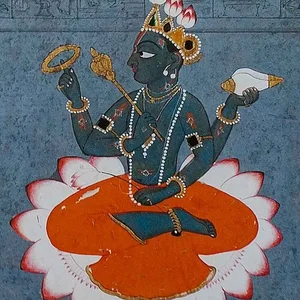

Vishnu is one of the three principal deities of Hinduism, forming the Trimurti alongside Brahma and Shiva. God of protection and preservation of the universe, he manifests in multiple avatars including Krishna and Rama, central figures in Indian mythology.
Vishnu
Vishnu
10 min read
Frequently asked questions
Key Facts
- Mentioned in the Rigveda (c. 1500–1200 BCE) as a minor solar deity, he eventually became one of the major gods of Hinduism
- He is the 'Preserver' within the Trimurti, alongside Brahma the Creator and Shiva the Destroyer
- He manifests in ten principal avatars (Dashavatara), including the seventh (Rama) and the eighth (Krishna)
- The Mahabharata and the Ramayana, two major epics of Indian literature, feature his avatars as central figures
- The Bhagavad Gita, a foundational philosophical and spiritual text, consists of teachings delivered by Krishna (an avatar of Vishnu)
Works & Achievements
Vishnu descends to Earth in ten successive forms (Matsya, Kurma, Varaha, Narasimha, Vamana, Parashurama, Rama, Krishna, Buddha, and the yet-to-come Kalki) to restore cosmic order. Some modern scholars have interpreted this doctrine as a mythological representation of the evolution of living beings.
Revealed by Krishna (an avatar of Vishnu) to the warrior Arjuna on the battlefield of Kurukshetra, the Bhagavad Gita is one of the most influential philosophical and spiritual texts in the world, addressing duty, selfless action, and spiritual liberation.
One of the eighteen major Puranas, this foundational text recounts Vaishnava cosmogony, the genealogy of gods and heroes, and the cycle of avatars; it codifies Vaishnava theology and remains a central reference in the tradition.
Composed of twelve books, this Purana is the pre-eminent sacred text of Vaishnavism; it recounts with great lyricism the deeds of all the avatars — particularly Krishna — and inspired the entire Bhakti devotional movement.
This masterpiece of Khmer architecture symbolically represents Mount Meru, the abode of Vishnu, at the center of the cosmic ocean. Its galleries lined with Vaishnava bas-reliefs stretching over 800 meters constitute the largest narrative sculptural surface in the world.
The twelve Tamil poet-saints known as the Alvars composed 4,000 verses of devotion to Vishnu, founding texts of the Vaishnava bhakti tradition in South India, still recited in temples as a sacred equivalent of the Vedas.
Anecdotes
During the great churning of the cosmic ocean (Samudra Manthan), gods and demons unite to extract the nectar of immortality, using Mount Mandara as a churning rod and the serpent Vasuki as a rope. Vishnu then transforms into a giant turtle (the Kurma avatar) to act as a pivot for the mountain, preventing the world from sinking into primordial chaos.
Vishnu has ten principal avatars, the Dashavatara, through which he descends to Earth whenever cosmic order (dharma) is threatened. Among them are the fish Matsya, who saved the Vedas from a great flood; the dwarf Vamana, who humbled the demon Bali's pride with three enormous strides covering the earth, the sky, and the entire universe; and Krishna and Rama, heroes celebrated in the Bhagavad Gita and the Ramayana.
The young Prahlada, son of the demon Hiranyakashipu, remains devoted to Vishnu despite persecution by his own father. When the demon challenges Vishnu to hide inside a stone pillar, the god bursts forth in the terrifying form of Narasimha — half-man, half-lion — and slays the tyrant at twilight, the hour when neither day nor night holds sway, thus outwitting the demon's curse of invulnerability.
Vishnu rests eternally upon the cosmic serpent Ananta Shesha, floating on the primordial ocean of milk. In this state of divine sleep (Yoganidra), he dreams the entire universe: each dream is a cycle of creation, and from his navel grows a golden lotus upon which Brahma sits to create the world. When Vishnu awakens, the universe is reabsorbed into him before a new cycle begins.
The temple of Angkor Wat, built in the 12th century in Cambodia by King Suryavarman II, is dedicated to Vishnu and symbolically represents Mount Meru, the abode of the gods. Its famous bas-reliefs, carved across more than 800 meters of gallery walls, depict the great Vaishnavite epics — the Samudra Manthan, the exploits of Krishna — making it the largest religious monument in the world and a testament to the spread of Hinduism across Southeast Asia.
Primary Sources
"I will now sing the heroic deeds of Vishnu, who measured out the earthly spaces, who supported the highest dwelling, who strode three paces into far distant abodes."
"Whenever righteousness wanes and unrighteousness increases, I send myself forth. For the protection of the good, for the destruction of the wicked, and for the establishment of righteousness, I come into being age after age."
"Vishnu is the soul of all that exists, the lord of the universe. He is the creator, the preserver, and the destroyer. In him all things are contained, from him all things arise, and into him all things return."
"Lord Vishnu, in the form of a tortoise, plunged into the ocean of milk and supported Mount Mandara on his shell. The devas and asuras churned the ocean for a thousand divine years before the treasures of the world emerged."
"It is Vishnu himself who, wishing to bring good to all the worlds, descends to Earth in the form of Rama, son of King Dasharatha of Ayodhya, to put an end to the tyranny of Ravana and restore the divine order."
Key Places
Vaikuntha is Vishnu's eternal paradise, beyond the three ordinary worlds, where the god rests upon the serpent Ananta Shesha surrounded by lotuses and his consort Lakshmi. A mythical realm of absolute peace, purified souls reach it after death and are no longer subject to the cycle of reincarnation.
The Venkateswara Temple at Tirupati is the most visited Hindu pilgrimage site in the world, welcoming tens of thousands of Vaishnavite devotees every day. Venkateswara is a form of Vishnu venerated since at least the 2nd century BCE.
Mathura is the birthplace of Krishna (avatar of Vishnu) and Vrindavan the setting of his divine youth, where he performed his first feats and danced with the gopis. These two cities form the heart of the Krishnaite pilgrimage circuit and remain thriving Vaishnavite religious centers.
Ayodhya is the legendary kingdom of Rama, avatar of Vishnu, and one of the seven sacred cities of Hinduism. It is the heart of the Rama cult as recounted in the Ramayana and a major pilgrimage site for millions of Vaishnavite faithful.
Built in the 12th century by King Suryavarman II, Angkor Wat is the largest temple dedicated to Vishnu in the world and a testament to the spread of Hinduism across Southeast Asia. Its bas-reliefs depicting the Samudra Manthan and the exploits of Krishna stretching over 800 meters make it a masterpiece of sacred art.
The Srirangam temple is the largest functioning temple complex in the world, entirely dedicated to Vishnu in his reclining form as Ranganatha resting upon the serpent Shesha. First among the 108 sacred Vaishnavite sites (Divya Desam), it is the living center of the Vaishnava tradition in South India.
Typical Objects

Vishnu's rotating weapon, symbolizing the wheel of time and cosmic justice. The Sudarshana is used to sever evil and restore order; it is depicted on the index finger of his upper right hand.

Vishnu's conch emits the primordial sound Om and heralds the victory of good over evil. Its breath represents the creation of the universe through sound vibration; it is held in his upper left hand.

A golden club symbolizing Vishnu's power over the material universe and the force that destroys ignorance. It is held in one of his lower hands and represents the supreme authority of the Preserver.

The lotus held by Vishnu symbolizes purity, creation, and spiritual beauty. Just as the lotus grows from mud without being tainted, Vishnu remains pure throughout all of material creation; it also evokes the emergence of Brahma from his navel.

Garuda is a mythical eagle that is half-man, half-bird, enemy of serpents and symbol of speed and absolute devotion. He carries Vishnu across the three worlds in an instant and represents the soul rising toward the divine.

A unique precious stone worn on Vishnu's chest, drawn from the ocean of milk during the cosmic churning. It symbolizes the pure soul and the divine consciousness that radiates through every creature in the universe.

A garland of five types of flowers worn by Vishnu, representing the five elements (space, air, fire, water, earth) and the god's absolute dominion over the entirety of the sentient creation.
School Curriculum
Vocabulary & Tags
Key Vocabulary
Tags
Daily Life
Morning
At the cosmic dawn, Vishnu rests in his divine slumber (Yoganidra) upon the coils of Ananta Shesha, floating on the primordial ocean of milk. Upon his awakening, Brahma is born from his navel on a golden lotus to begin a new cycle of world creation. In temples dedicated to him, priests celebrate the awakening ceremony (Suprabhatam) by chanting hymns to 'rouse' the deity to the sound of conch shells.
Afternoon
Vishnu watches over the cosmos from Vaikuntha, safeguarding the balance of dharma across the three worlds. Whenever a threat looms over this order — a usurping demon, an impious king — he deliberates with Lakshmi and the gods to decide in which avatar form to intervene. In the epics, his incarnations perform heroic deeds: cosmic wars, philosophical dialogues, and protective miracles.
Evening
Evening at Vaikuntha resonates with celestial music: the Gandharvas play the vina and flutes, the Apsaras dance, and liberated souls (muktas) meditate in the god's soothing light. Vishnu, accompanied by Lakshmi, receives the homage of the divine assembly and bestows his grace upon souls who have distinguished themselves through sincere devotion.
Food
As a deity, Vishnu does not consume ordinary food; ritual offerings (naivedya) include milk, clarified butter (ghee), tropical fruits, sweet rice pudding (payasam), and lotus flowers. These pure, vegetarian foods reflect the principle of non-violence (ahimsa) that is central to Vaishnavism.
Clothing
Vishnu is always depicted wearing a bright yellow silk dhoti (pitambara, meaning 'golden garment'), a solar color symbolizing divine light and prosperity. He wears a golden conical crown (kirita-mukuta), ornate bracelets, a garland of fresh flowers (Vaijayanti), makara-shaped earrings, and the sacred tilak mark on his forehead.
Housing
Vishnu's abode is Vaikuntha, a transcendent realm located beyond the fourteen universes, bathed in perpetual divine light and surrounded by oceans of milk and gardens of immortal flowers (parijata). His central throne is formed by the coils of Ananta Shesha, the walls are of pure gold and precious gems, and no sorrow, death, or sin ever enters.
Historical Timeline
Period Vocabulary
Visual Style
Vishnou est représenté en bleu cobalt profond avec quatre bras dorés tenant ses attributs sacrés, vêtu d'une soie jaune safran, dans un style mêlant la statuaire Chola du Tamil Nadu et les miniatures de l'école Pahari du XVIIIe siècle.
Sound Ambience
Ambiance sonore des grands temples vishnoïtes à l'aube, mêlant conques sacrées, cloches rituelles, chants védiques en sanskrit et musique dévotionnelle du culte bhakti.
Liens externes & ressources
Références
Œuvres
Les Dashavatara — les dix avatars de Vishnou
tradition codifiée vers IXe-Xe siècle apr. J.-C. (Bhâgavata Purâna)
Bhagavad-Gita (Chant du Seigneur)
vers 200 av. J.-C. – 200 apr. J.-C.
Vishnou Purâna
vers IVe-Ve siècle apr. J.-C.
Bhâgavata Purâna (Srimad Bhagavatam)
vers IXe-Xe siècle apr. J.-C.
Temple d'Angkor Vat
1116-1150 apr. J.-C.
Œuvres des poètes Âlvârs — Divya Prabandham
VIe-IXe siècle apr. J.-C.