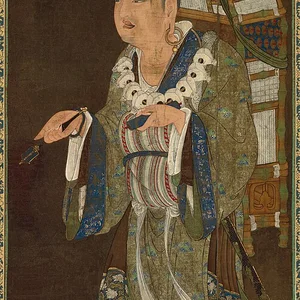

A 7th-century Chinese Buddhist monk, he undertook a seventeen-year journey to India to collect sacred texts. He translated hundreds of sutras into Chinese and played a major role in the spread of Buddhism in China.
Xuanzang(602 — 664)
Xuanzang
dynastie Sui, dynastie Tang
10 min read
Frequently asked questions
Key Facts
- Born around 602 in China, he entered Buddhist monastic life at a very young age
- In 629, he left China without imperial authorization to travel to India
- He spent seventeen years in India, including a long stay at the University of Nalanda
- In 645, he returned with more than 650 Buddhist texts written in Sanskrit
- He translated 74 works into Chinese, including the famous Heart Sutra
Works & Achievements
A geographical, ethnographic, and religious account in twelve volumes covering 128 kingdoms visited, written at the request of Emperor Tang Taizong. An unparalleled primary source on 7th-century Central Asia and India, still used by archaeologists today to locate lost Buddhist sites.
A 260-character Chinese version of the shortest and most recited text in Mahāyāna Buddhism. Xuanzang's translation, celebrated for its precision and beauty, remains to this day the canonical version chanted in temples across China, Japan, Korea, and Vietnam.
A monumental Buddhist philosophical encyclopedia in 200 fascicles, foundational text of the Sarvāstivāda school. This translation represented several years of intensive work and was instrumental in transmitting Abhidharma philosophy throughout East Asia.
A hagiography in ten volumes tracing Xuanzang's life from childhood to death. The first account to blend historical events with miraculous episodes, it laid the foundations for the legend that would eventually give rise to Journey to the West.
A classic novel in one hundred chapters in which Xuanzang (Tang Sanzang) is the pilgrim monk protected by Sun Wukong the Monkey King, Zhu Bajie, and Sha Wujing. One of the Four Great Classical Novels of Chinese literature, it has inspired thousands of adaptations to this day.
Anecdotes
In the tradition of the novel 'Journey to the West', Xuanzang is not a simple monk but the reincarnation of the Golden Cicada, a disciple of the Buddha in a previous life. Banished from the Western Paradise for showing disrespect during a sermon, he was destined to be reborn ten times on Earth before earning the right to return — a cosmic fate that explains why demons are so relentlessly determined to devour his immortal flesh.
According to legend, the Bodhisattva Guanyin was tasked with finding protective disciples for the monk. And so Sun Wukong the Monkey King, imprisoned beneath a mountain for five hundred years, was freed to escort the holy pilgrim in exchange for his redemption — a pact sealed by placing a golden headband on the monkey's head, which the monk could tighten painfully with a spell whenever the monkey disobeyed.
Historically, the real Xuanzang left Chang'an in 629 in secret, as Emperor Tang Taizong had refused to grant him permission to travel. He crossed the Gobi Desert alone, nearly died of thirst, and pressed forward guided only by the stars and the bones of travelers who had come before him. Upon his return in 645, the impressed Emperor welcomed him with a triumphant escort and asked him to write an account of his journey.
The legend of the Flaming Mountains illustrates the supernatural trials of the pilgrimage: an eternal blaze — sparked by an ember that fell from the Taoist Old Sage's furnace while the rebellious monkey was being cooked inside — blocked the road to the West. Only the Banana Leaf Fan, held by the Iron Fan Princess, could extinguish the flames. In Buddhist tradition, this ordeal symbolizes the burning passions that every practitioner must learn to master.
Upon his return to Chang'an, Xuanzang brought back 657 sacred texts, 150 relics, and several statues. He spent the last nineteen years of his life at the Giant Wild Goose Pagoda translating these texts alongside a team of several dozen monks. His translation of the Heart Sūtra — rendered in just 260 Chinese characters — is still recited daily in Buddhist temples around the world.
Primary Sources
"To the north of the Shifting Sands, the road winds through mountains covered in eternal snow. Travelers who venture there perish from the cold or are devoured by dragons."
"The Master of the Law, burning with the desire to seek the authentic scriptures in India, endured heat and cold, crossed mountains and rivers, and directed his steps westward for seventeen years."
"The Buddha said: 'I have three baskets of sūtras that I wish to send to the Land of the East. Who will carry them?' The Bodhisattva Guanyin bowed: 'Your disciple will travel to the Land of Tang to find a pilgrim worthy of this mission.'"
"The Bodhisattva Avalokiteśvara, while practicing the profound Prajñāpāramitā, clearly perceived that the five aggregates are all empty, and was thus freed from all suffering and affliction."
"Xuanzang returned in the fourteenth month of the nineteenth year of the Zhenguan era. He had traveled through one hundred and twenty-eight kingdoms and brought back six hundred and fifty-seven volumes of sūtras."
Key Places
A cosmopolitan metropolis of two million inhabitants and a crossroads of the Silk Road, where Xuanzang began and completed his journey. He spent his final years at the Wild Goose Pagoda, translating the texts he had brought back from India.
The greatest center of Buddhist learning in the ancient world, housing up to ten thousand monks; Xuanzang spent several years there and debated with the foremost masters of Indian philosophy.
In reality, the red-ochre hills of Turpan reach ground temperatures of 70°C in summer. In the legendary novel, they form a supernatural wall of fire — a formidable ordeal symbolizing the passions that must be extinguished in order to advance.
A sacred hill in Bihar from which the Buddha Shakyamuni preached many sūtras, and the ultimate destination of the pilgrimage. In the legendary novel, it is the Western Paradise, a celestial realm where the pilgrims receive the sacred scriptures.
A vast arid expanse of 337,000 km² whose name means 'he who enters does not come out.' Xuanzang crossed it alone, guided by the stars and the bones of previous caravans; in legendary tradition, the desert is inhabited by demons and supernatural creatures.
A seven-story Buddhist tower built at Xuanzang's initiative to preserve the texts and relics he brought from India. Still standing in Xi'an today, it is a UNESCO World Heritage Site and a symbol of Buddhist influence under the Tang dynasty.
Liens externes & ressources
Références
Œuvres
Grande Relation sur les Contrées d'Occident de la Grande Tang (大唐西域記)
646
Traduction du Sūtra du Cœur (般若波羅蜜多心經)
649
Traduction du Mahāvibhāṣā Śāstra (阿毘達磨大毘婆沙論)
656-659
Biographie du Maître des Trois Corbeilles (大唐大慈恩寺三藏法師傳) — rédigée par Huili et Yancong
688
Le Voyage en Occident (西遊記, Xīyóujì) — Wu Cheng'en
vers 1592