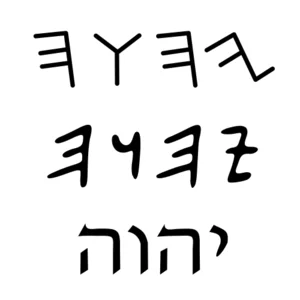

YHWH is the divine name in the Hebrew religion, composed of four letters (yod, he, vav, he). It designates the one God of Israel, at the heart of the Abrahamic monotheistic tradition.
YHWH
YHWH
9 min read
Frequently asked questions
Key Facts
- The name YHWH appears more than 6,800 times in the Hebrew Bible
- Revealed to Moses according to Exodus (around the 13th century BCE) as 'I am that I am' (Ehyeh asher ehyeh)
- The exact pronunciation of the Tetragrammaton is unknown, as it was considered too sacred to be spoken aloud
- The exclusive worship of YHWH gradually took hold in Israel between the 9th and 6th centuries BCE
- YHWH is the source of the monotheism shared by the three Abrahamic religions: Judaism, Christianity, and Islam
Works & Achievements
The first five books of the Hebrew Bible recount the creation of the world by YHWH, the covenant with Abraham, the Exodus, and the revelation of the Law at Sinai. The founding text of Judaism, Christianity, and Islam.
A collection of 150 poems and prayers addressed to YHWH, partly attributed to King David. These texts express the full range of human relationships with the divine: praise, lament, supplication, and thanksgiving.
A dramatic poem exploring the suffering of the righteous before YHWH. YHWH's speech "from the whirlwind" on the wonders of creation stands as one of the great masterpieces of world literature.
A prophetic collection proclaiming the absolute holiness of YHWH Sabaoth and announcing the restoration of Israel. One of the most frequently quoted Old Testament texts in the New Testament.
The founding pact between YHWH and the people of Israel, formalized through the Ten Commandments. This mutual contract — YHWH will be their God, Israel will be his people — underpins the whole of biblical theology.
Biblical manuscripts discovered at Qumran in 1947, containing the oldest known texts of the Hebrew Bible. They attest to the diversity of traditions surrounding YHWH during the Second Temple period.
Anecdotes
In the book of Exodus, YHWH appears to Moses in a burning bush that blazes without being consumed. He reveals his name — a tetragrammaton made up of four Hebrew letters (יהוה) — and entrusts Moses with the mission of freeing the Hebrew people from Egypt. This episode, known as the Sinai theophany, marks the first explicit revelation of the divine name in the biblical tradition.
The name YHWH is so sacred in Jewish tradition that it is never pronounced aloud when reading sacred texts. In its place, readers say "Adonai" (my Lord) or simply "HaShem" (the Name). This practice, called the perpetual qere, dates back to the Second Temple period and remains in use in Jewish communities around the world.
In the book of Job, YHWH accepts a challenge from Satan: Job, a righteous man, will be put to the test to prove his faith. After a series of misfortunes strikes Job, YHWH speaks "out of the whirlwind" in a breathtaking speech (Job 38–41) that emphasizes the vastness of creation against the smallness of humankind — one of the most powerful poetic passages in the Hebrew Bible.
Archaeologists discovered at Kuntillet Ajrud, in the Sinai, inscriptions from the 9th–8th century BCE mentioning "YHWH and his Asherah." These texts suggest that in early times, some worshippers associated YHWH with a female consort, before strict monotheism gradually took hold — evidence that the Hebrew religion evolved over time.
Around 850 BCE, the prophet Elijah challenged the 450 priests of Baal on Mount Carmel: which god would answer with fire? The priests of Baal called on their god for hours, to no avail. Elijah prayed to YHWH, who immediately sent fire down upon the altar. This dramatic episode, told in the First Book of Kings, is one of the key turning points in the rise of Yahwism over the Canaanite cults.
Primary Sources
God said to Moses: "I am who I am." He said further, "Thus you shall say to the Israelites: I am has sent me to you."
O YHWH our Lord, how majestic is your name in all the earth! You have set your glory above the heavens.
"I bless you by YHWH of Samaria and by his Asherah." Text inscribed on a ceramic jar, attesting to the worship of YHWH in the Sinai during the period of the Divided Kingdom.
As I looked, a stormy wind came out of the north: a great cloud with fire flashing forth continually, and a bright light all around it, and in the midst of the fire, something like gleaming amber.
For I am YHWH your God who takes hold of your right hand and says to you: Do not fear, I will help you.
Key Places
Sacred desert mountain where YHWH reveals himself to Moses in the burning bush, then delivers the Tablets of the Law. The site of the great theophany that founded the Hebrew religion and Abrahamic monotheism.
The earthly dwelling of YHWH according to biblical tradition. The First and then Second Temple housed the Holy of Holies, a sacred inner sanctum accessible only to the High Priest once a year, on Yom Kippur.
The mythical place where YHWH creates humanity and gives it a home, according to Genesis. He walks there "in the cool of the evening" and speaks directly with Adam and Eve before their expulsion — the defining rupture between the divine and the human.
Site of the legendary confrontation between the prophet Elijah and the priests of Baal, where YHWH demonstrates his power through fire. A symbol of the victory of Yahwistic monotheism over the polytheistic Canaanite cults.
The arid region where the Hebrew people wander for forty years after the Exodus, guided by YHWH through a pillar of cloud. It is in this stark, stripped-down landscape that the religious identity of Israel and its covenant with YHWH are forged.
Typical Objects

A chest of acacia wood covered in gold, believed to contain the Tablets of the Law given by YHWH to Moses. It represents the divine presence among the people of Israel as they journeyed through the desert.

Two stone tablets inscribed by YHWH himself according to the Book of Exodus, bearing the Ten Commandments. They symbolize the founding covenant (berith) between YHWH and the Hebrew people.

A seven-branched golden candelabrum that adorned the Tabernacle and later the Temple in Jerusalem. Its perpetual light evokes the continuous presence of YHWH at the heart of the sanctuary.

The four Hebrew letters yod, heh, vav, heh that form the proper name of YHWH. Considered so sacred that they cannot be erased once written, they stand at the core of Jewish theology and mysticism.

A wind instrument carved from a ram's horn, used during major festivals and the Jubilee. According to the account of Sinai, its powerful blast accompanied the revelation of YHWH to Moses on the mountain.

A vessel used by priests to burn incense in the Tabernacle and the Temple. The rising smoke symbolized prayer ascending to YHWH and purified the sacred space.

The visible manifestation of YHWH guiding the Hebrew people through the desert according to Exodus: a cloud by day, a pillar of fire by night. It represents divine guidance and the constant protection of the chosen people.
School Curriculum
Vocabulary & Tags
Key Vocabulary
Tags
Daily Life
Morning
In biblical cosmology, YHWH is portrayed as watching over his creation from the break of dawn. The priests of the Temple lit the altar fire each morning and offered the perpetual sacrifice (tamid) at sunrise — a daily renewal of the covenant between YHWH and his people.
Afternoon
In biblical texts, midday evokes the time of divine judgment and decision: it is at noon that Elijah confronts the priests of Baal on Mount Carmel. The prophets describe YHWH as actively at work in the history of nations, directing battles, droughts, and harvests according to his justice.
Evening
In the Hebrew calendar, evening marks the beginning of a new day. The Sabbath tradition — a rest sanctified by YHWH since the very origins of creation — begins at sunset. It is a time for prayer, reading sacred texts, and family gathering around ritual.
Food
YHWH does not eat, but the sacrifices offered to him at the Temple include animals (oxen, sheep, doves) and plant offerings (unleavened bread, olive oil, wine). The dietary laws (kashrut) he prescribes to Israel govern his people's entire relationship with food and the natural world.
Clothing
YHWH is never depicted wearing garments in the strict Hebrew tradition — his manifestations take the form of light, fire, or cloud. The priests who serve him at the Temple, however, wear specific attire: white linen, a breastplate set with twelve stones, a ritual turban, and sandals.
Housing
YHWH's earthly dwelling is first the Tabernacle (mishkan), a portable tent carried through the Sinai desert. Then it becomes Solomon's Temple in Jerusalem, with its innermost Holy of Holies, closed off to all but the high priest. In poetic texts, YHWH is also said to 'dwell' in the heavens and in the collective prayers of his people.
Historical Timeline
Period Vocabulary
Visual Style
Un style visuel inspiré de l'art sacré du Proche-Orient ancien : lumière divine dorée, déserts minéraux, Temple en pierre ocre de Jérusalem et lettres hébraïques du Tétragramme flottant dans des nuées lumineuses.
Sound Ambience
Une atmosphère de silence désertique ponctué du souffle du shofar, de prières murmuées en hébreu et du crépitement d'un feu sacré — l'ambiance sonore des révélations du Sinaï et du culte du Temple de Jérusalem.
Liens externes & ressources
Références
Œuvres
La Torah (Pentateuque)
Xe-Ve siècle av. J.-C. (rédaction)
Le Livre des Psaumes (Tehilim)
Xe-Ve siècle av. J.-C.
Le Livre de Job
VIe-Ve siècle av. J.-C.
Le Livre d'Ésaïe
VIIIe-VIe siècle av. J.-C.
L'Alliance (Berith) du Sinaï
Récit situé vers le XIIIe siècle av. J.-C.
Les Rouleaux de la mer Morte
IIIe siècle av. J.-C. — Ier siècle ap. J.-C.