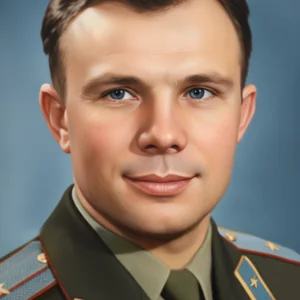

A Soviet cosmonaut, Yuri Gagarin became the first human to travel into space on 12 April 1961 aboard Vostok 1. His flight made him a worldwide hero and a symbol of Soviet space achievement at the height of the Cold War.
Yuri Gagarin(1934 — 1968)
Yuri Gagarin
Union soviétique
6 min read
Frequently asked questions
Famous Quotes
« Let's go!»
« The Earth is blue... like an orange — no, simply blue.»
Key Facts
- Born on 9 March 1934 in a village near Gzhatsk (Soviet Russia)
- 12 April 1961: the first man in space aboard Vostok 1, completing one full orbit in 108 minutes
- Became a Hero of the Soviet Union and a global icon after his flight
- His feat accelerated the Space Race and pushed the United States toward the Apollo program and the Moon
- Died on 27 March 1968 in a training plane crash
Works & Achievements
The first crewed spaceflight in history: Gagarin completed a full orbit of the Earth in 108 minutes. A major feat of the space race.
After his flight, Gagarin traveled to dozens of countries as a symbol of Soviet achievement. He met with leaders and enthusiastic crowds all over the world.
Gagarin's autobiographical account of his childhood, his training, and his historic flight. A work of both propaganda and personal testimony.
Gagarin served as backup to Vladimir Komarov for the first Soyuz mission, which ended in Komarov's death. He afterward campaigned for greater safety.
Having become a leading figure at Star City, Gagarin oversaw the training of the new Soviet cosmonauts.
Anecdotes
On 12 April 1961, just before Vostok 1 lifted off, Gagarin is said to have cried out a joyful “Poyekhali!” (“Let's go!”). The exclamation became famous throughout the USSR and remains a symbol of the dawn of the crewed space age.
Since no one knew how a human would react in space, the controls of Vostok 1 were locked: Gagarin had to enter a secret code to fly manually in an emergency. The code, tucked inside an envelope on board, was 1-2-5.
Gagarin did not land inside his capsule: as planned, he ejected at around 7,000 metres and finished his descent by parachute, separately from the cabin. The USSR long concealed this detail in order to have the record certified by the International Aeronautical Federation.
Standing about 1.57 m tall, Gagarin was partly chosen for his small stature, ideal for Vostok's cramped cabin. His broad smile and his humble origins as a peasant's son made him a perfect hero for Soviet propaganda.
Landing near the Volga, Gagarin—still in his orange suit and helmet—frightened a peasant woman and her granddaughter. He had to reassure them by shouting that he was a Soviet who had come from space and that he needed a telephone.
Primary Sources
“Poyekhali!” (“Let's go!”), spoken at the moment the engines ignited.
He describes the view of the Earth: the continents, the islands, the rivers and the thin bluish layer of the atmosphere seen from space.
The Soviet Union announces the placing into orbit of the world's first crewed spacecraft, the Vostok, piloted by the Soviet citizen Yuri Alekseyevich Gagarin.
Asked what he had observed, he said he had seen how beautiful our planet is, urging people to preserve it rather than destroy it.
Key Places
Gagarin's native village, where he grew up in a family of kolkhoz workers. The nearby town of Gzhatsk was renamed Gagarin in his honor.
Soviet launch base from which Vostok 1 lifted off on April 12, 1961. The first and main cosmodrome of the USSR.
Cosmonaut training center near Moscow, where Gagarin trained and worked. An emblematic site of the Soviet space program.
Fields by the banks of the Volga where Gagarin landed by parachute after his orbital flight. A monument now marks the spot.
The place near which Gagarin met his death on March 27, 1968 in the crash of his MiG-15. A memorial has been erected there.
The symbolic heart of the USSR where Gagarin was welcomed as a hero and received official honors after his flight. His ashes rest in the necropolis of the Kremlin Wall.
Typical Objects

Soviet spherical spacecraft aboard which Gagarin made the first crewed orbital flight. The cabin was too small for the cosmonaut to land inside it, which is why he was ejected.

Pressurized orange suit designed for Vostok, fitted with a white helmet and a life-support system. It protected the cosmonaut in the event of depressurization.

White helmet bearing the letters “CCCP” (USSR) painted in red, added shortly before the flight. It completed the cosmonaut's airtight suit.

Soviet launch vehicle derived from the R-7 ballistic missile, which propelled the capsule into orbit. Designed under the direction of engineer Sergei Korolev.

Two-seat jet fighter used to train pilots. Gagarin was killed during a training flight aboard this aircraft in 1968.

The highest Soviet honorific distinction, awarded to Gagarin after his flight. It came together with the Gold Star and the Order of Lenin.
School Curriculum
Vocabulary & Tags
Key Vocabulary
Daily Life
Morning
At Star City, a cosmonaut's day began early with an intensive workout session: running, gymnastics and weight training. This was followed by a medical examination and a breakfast monitored by the doctors.
Afternoon
The afternoon was devoted to study: classes in space mechanics, astronomy and onboard systems, plus centrifuge training to withstand acceleration. Gagarin also spent hours in simulators of the Vostok capsule.
Evening
In the evening, after dinner, came time to relax: reading, films, games of chess or billiards among the cosmonauts. Gagarin, sociable and well-liked, enjoyed the company of his comrades.
Food
His diet was strictly monitored and balanced to keep him in peak physical condition. For the flight, the food was packed in tubes: meat and chocolate purées to be swallowed in weightlessness.
Clothing
Day to day, Gagarin wore the uniform of a Soviet Air Force officer. For flights and training he put on a pilot's flight suit and helmet, and, for space, the orange SK-1 spacesuit.
Housing
He lived with his wife Valentina and their two daughters in an apartment in Star City, a residential complex reserved for cosmonauts and their families. The site combined housing, schools and training facilities.
Historical Timeline
Period Vocabulary
Liens externes & ressources
Références
Œuvres
Vol orbital de Vostok 1
12 avril 1961
Tournée mondiale d'ambassadeur de l'espace
1961-1962
Mémoires « La Route vers les étoiles »
1961
Commandant suppléant de la mission Soyouz 1
1967
Direction de la formation des cosmonautes
1963-1968