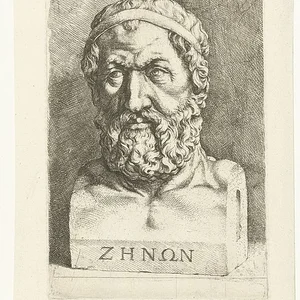

Pre-Socratic Greek philosopher and disciple of Parmenides, born around 489 BCE in Elea (Magna Graecia). He is famous for his paradoxes demonstrating the impossibility of motion and plurality, laying the groundwork for dialectic as a method of argumentation.
Zeno of Elea(489 av. J.-C. — 424 av. J.-C.)
Zeno of Elea
7 min read
Frequently asked questions
Key Facts
- Born around 489 BCE in Elea, a Greek colony in southern Italy
- Devoted disciple of Parmenides, whose thesis of the unity of being he defended
- Author of the famous paradoxes of motion, including 'Achilles and the Tortoise' (around 460 BCE)
- Considered by Aristotle to be the inventor of dialectic
- Died around 424 BCE, according to tradition as a result of his resistance to a tyrant
Works & Achievements
A lost work mentioned by Plato in the dialogue 'Parmenides'. It contained the famous paradoxes against motion and plurality, written in defense of Parmenides' philosophy.
A set of arguments, the most famous of which are 'Achilles and the Tortoise', 'The Dichotomy', 'The Arrow', and 'The Stadium'. These reasonings show that motion leads to insurmountable logical contradictions.
Arguments aimed at demonstrating that the existence of multiple distinct beings is contradictory, since any magnitude would be both finite and infinite, both large and small. They complement the defense of Parmenides' concept of the One Being.
In the 'Physics' and the 'Metaphysics', Aristotle reconstructs and discusses Zeno's reasoning, which constitutes the first systematic application of the method of reductio ad absurdum in the history of philosophy.
Anecdotes
Zeno is said to have been arrested and tortured by the tyrant Nearchus (or Demylus, depending on the source) for taking part in a plot against him. Refusing to reveal the names of his fellow conspirators, he reportedly bit off the tyrant's tongue — or, in other versions, that of one of his guards — and spat it in his torturer's face. Diogenes Laërtius records this act of defiance as an exemplary display of philosophical courage.
Aristotle credits Zeno with inventing dialectic — the art of refuting an opponent by starting from their own premises and leading them to a contradiction. This method, which shows that a thesis leads to absurd consequences, is known as 'reductio ad absurdum' and remains a fundamental tool in logic and mathematics to this day.
The paradox of Achilles and the Tortoise is one of Zeno's most famous: if the tortoise is given a head start, Achilles can never catch up, because every time he reaches the tortoise's previous position, the tortoise has moved a little further ahead. This paradox captivated generations of mathematicians and philosophers, until modern work on convergent infinite series finally shed light on it.
Zeno was Parmenides' favorite pupil and likely his life companion. In Plato's dialogue 'Parmenides', Zeno is depicted accompanying his teacher to Athens at around the age of forty, where they are said to have met the young Socrates. There, Zeno explains that his paradoxes were intended to defend Parmenides' thesis that Being is one and motionless.
Primary Sources
Zeno and Parmenides came one day to Athens for the great Panathenaea. Parmenides was very old, with hair completely white, and of noble appearance. Zeno was then approaching forty; he was tall and handsome.
It is Zeno's argument that creates the difficulty: if everything that moves always occupies a space equal to itself, then the moving arrow is motionless.
Zeno of Elea, disciple of Parmenides. Heraclides states in his Epitome that he was also a pupil of Xenophanes. He wrote dialogues. Timon says of him that he had a double tongue, meaning that he possessed great power of speech.
Aristotle credits Zeno of Elea with the invention of dialectic, in that he was the first to examine arguments by using contradiction as an instrument of demonstration.
Zeno wished to show that if the many exists, it must be both large and small: infinitely large, because each part can always be divided further; infinitely small, because each part tends toward zero.
Key Places
Zeno's birthplace, a Phocaean colony founded around 540 BCE on the Tyrrhenian coast of southern Italy. It was the cradle of the Eleatic school, founded by Parmenides and made famous by Zeno.
Zeno is said to have traveled here with Parmenides around 450 BCE, where he met the young Socrates, according to Plato's dialogue 'Parmenides'. This journey symbolizes the exchange between different Greek schools of thought.
The public square at the heart of the city where Zeno taught and debated. It was here, according to ancient sources, that he confronted a tyrant and suffered his martyrdom.
A Greek city neighboring Elea in Magna Graecia, and an intellectual hub of Pythagoreanism. Its theories on number and plurality were precisely the ideas Zeno sought to refute through his paradoxes.
Typical Objects

The most common writing surface in ancient Greece, used by philosophers to record their arguments. Zeno is said to have composed his arguments in writing before presenting them orally.

Philosophical writings of the era were copied onto papyrus scrolls. Zeno's work, mentioned by Plato, was most likely transmitted in this form.

An instrument used in Greek city-states for arithmetic calculations — the very kind of reasoning that Zeno's paradoxes challenge when it comes to infinity and division.

A time-measuring instrument used in Greek assemblies and courts. The notion of continuous time lies at the heart of Zeno's arrow paradox.

Greek philosophers taught while walking or seated, wearing simple sandals. The very act of walking is what Zeno's paradoxes claim to show as an illusion.

Geometric tools used by Greek scholars of the period. Zeno's paradoxes about the infinite divisibility of a line directly influenced debates among Greek mathematicians.
School Curriculum
Vocabulary & Tags
Key Vocabulary
Daily Life
Morning
Zeno rose at dawn in his home in Elea, a modest but well-built peristyle house. He devoted the first part of the morning to solitary reflection, walking through the city's narrow streets to organize his thoughts before meeting with his disciples.
Afternoon
In the afternoon, he gathered his students in a public space or a shaded portico to present and debate his paradoxes. His method consisted of asking questions, pushing his interlocutor to develop their thesis, then demonstrating that the thesis leads to a contradiction — an exercise that would later be called dialectics.
Evening
In the evenings, Zeno took part in communal meals (syssitia) or received visitors at symposia, where philosophical conversation continued over wine diluted with water. He was known for his intellectual rigor and his contempt for flattery.
Food
Like any Greek citizen of a city in Magna Graecia, Zeno subsisted mainly on barley or wheat bread, olives, legumes, goat cheese, and fresh fish from the Tyrrhenian Sea. Meat was scarce, reserved for festivals and sacrifices.
Clothing
Zeno wore the chiton, a tunic of linen or wool, and over it the himation, a large draped cloak, in white or natural undyed cloth. Like most philosophers, he favored plain attire, reflecting his detachment from outward appearances.
Housing
He lived in a typical Greek house with a central courtyard (oikos), with rooms arranged around a peristyle planted with a fig or olive tree. Whitewashed rammed-earth walls, packed-dirt or rough mosaic floors, and a library of papyrus scrolls made up his everyday living environment.
Historical Timeline
Period Vocabulary
Visual Style
Style visuel inspiré de la céramique grecque rouge et noir, tonalités de terre cuite et de calcaire blanc, formes géométriques évoquant les paradoxes du mouvement et de l'immobilité.
Sound Ambience
Atmosphère sonore méditerranéenne d'une cité grecque de Grande-Grèce : mer, vent dans les oliviers, rumeur de l'agora et débats philosophiques sous le soleil du Ve siècle avant J.-C.
Liens externes & ressources
Références
Œuvres
Traité sur la nature (Peri phuseôs) — attribué
vers 460-450 av. J.-C.
Paradoxes contre le mouvement
vers 450 av. J.-C.
Paradoxes contre la pluralité
vers 450 av. J.-C.
Arguments dialectiques (reconstitués par Aristote)
IVe siècle av. J.-C. (reconstitution)
See also
Related Characters
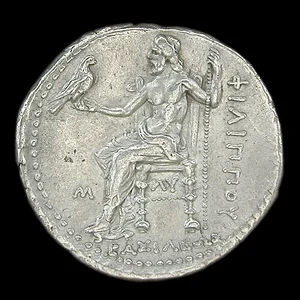
Alexander II of Macedon
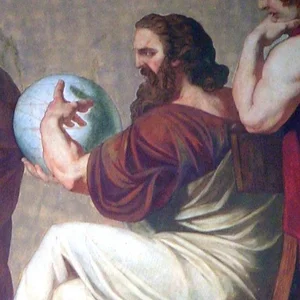
Anaxagoras of Clazomenae
499 av. J.-C. — 427 av. J.-C.
Anaximander
609 av. J.-C. — 545 av. J.-C.
Eratosthenes
275 av. J.-C. — 193 av. J.-C.
Heraclitus
534 av. J.-C. — 470 av. J.-C.
Phidias
499 av. J.-C. — 429 av. J.-C.