Kids interview Đinh Bộ Lĩnh
by Charactorium · Đinh Bộ Lĩnh (924 — 979) · Politics · Military · 5 min read

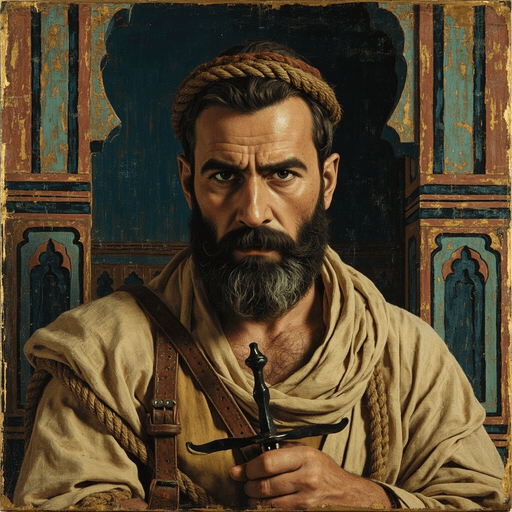
Two twelve-year-old visitors cross the fortified valley of Hoa Lư, between the limestone peaks. An old man awaits them, sitting on a stone. It is Đinh Bộ Lĩnh, the first emperor of free Vietnam. He smiles at them and invites them to sit beside him.
—What was it like when you were little? What games did you play with your friends?
Ah, you take me far back, my child. I was a little buffalo boy, right here in Hoa Lư. I led the buffaloes to the fields, feet in the mud. But in my head, I was already a chief! With the other boys, we played at being emperor. They would cross their arms to carry me, like a real palanquin. And you know what we waved instead of imperial flags? Reeds, the cờ lau. They grew everywhere by the water. Imagine an army of children with white stems dancing in the wind. We laughed loudly. But deep down, I was already playing seriously.
I had only a buffalo and reeds, but in my head I was already king.
—What became of your playmates afterward? Did you see each other again?
Yes! And that is the most beautiful part. Those boys who carried me on their arms never left me. Đinh Điền, Nguyễn Bặc, Lưu Cơ, Trịnh Tú... we had run through the same mud. As men, they took up arms at my side. You see, my child: you do not betray a friend with whom you have herded buffaloes. Loyalty cannot be bought. It is cultivated early, like rice. When I needed reliable warriors to reunite the country, I did not look far. My most faithful comrades in arms were my playmates.
Loyalty cannot be bought; it is cultivated early, like rice.
—People tell strange stories about you, with dragons. Is that true?
Ha! You heard that? Listen, I will be honest with you. They say that one day, as a child, I secretly killed my uncle's pig to feast my friends. Angry, he chased me to a river. I fell in the mud, and then two golden dragons came out to protect me. Nice story, isn't it? But it was the court scholars who added it, much later, to make me a being apart. In my time, when a man becomes emperor, they invent a destiny for him. The truth? I was a stubborn, greedy boy who was lucky to run fast.
When a man becomes emperor, dragons are invented for him.
—And the dream of the seal before your birth? Did you believe in it?
They say that my mother, before my birth, dreamed of a man holding an imperial seal, the ấn vua, who came to become her son. An omen, it seems. You know, a seal is the stamp of power: without it, no order has value. The chroniclers loved these stories. They wanted to prove I was born to rule. But I tell you frankly: I did not rule because of a dream. I ruled because I fought, walked in the mud, lost friends. Omens, my child, are invented after victory, never before.
Omens are invented after victory, never before.
—Is that terrible story true, that you had them shoot at your own son?
Yes. And it is the hardest thing in my life. Around 951, I refused to submit to the Ngô kings. So I had sent my son Đinh Liễn as a hostage to show my good faith. But one day, the enemies hung him from the end of a pole. They shouted: “Submit or we kill him!” My heart broke. Yet I ordered my archers to draw their crossbows, the nỏ, and shoot. Do you understand? If I gave in for a son, I would sell the whole country. Stupefied by my firmness, they finally spared Liễn. I was lucky. But that day, I wept in silence.
If I gave in for a son, I would sell a whole country.

—What did the War of the Twelve Warlords mean? Were there twelve kings?
Almost, my child! After the death of the last Ngô king, around 966, our country shattered into pieces. Twelve chiefs, the sứ quân, divided the land. Each held his region like a little king, and they fought each other constantly. Imagine a house where twelve brothers quarrel over every room, sword in hand. The peasants no longer knew whom to obey. So, with my men, I fought them one by one. Two long years, from 966 to 968. I did not want twelve little masters. I wanted one house, standing strong.
I did not want twelve little masters, but one house standing.
—They called you “the king of ten thousand victories.” Did you ever lose?
That nickname, Vạn Thắng Vương, “the king of ten thousand victories,” sounds impressive, huh? The truth is, I sometimes lost, like everyone. But I always got back up. After the death of my protector Trần Minh Công at Bố Hải Khẩu, I took over his troops and returned here, to Hoa Lư. I gathered the most feared warriors in the region. You see, a victory is not never falling. It is getting up one more time than the enemy. They called me undefeated, but mainly because I refused to stay down.
Being undefeated is not never falling: it is getting up one more time.
—Why did you call yourself “emperor”? Wasn't that too dangerous vis-à-vis China?
Excellent question, you have a sharp eye! For a thousand years, China had dominated our land, the period of the Bắc thuộc. In 968, when I reunited the country, I could have called myself simply king. But no. I took the supreme title: hoàng đế, emperor. It was a weighty word. In China, they thought only one man in the world deserved that title: their emperor. By taking it, I said: “We too are a great country, the equal of any other.” Yes, it was bold. But a free people must dare to speak their name aloud.
A free people must dare to speak their name aloud.
—Why did you choose this place, Hoa Lư, for your capital?
Look around you, my child. These stone mountains, tall and sharp... They form walls that no one built. Nature herself protected me! I grew up here, I knew every path, every cave. In 968, I made this valley the capital of my new state, Đại Cồ Việt, the “Great Việt.” An open plain is easy to attack. But Hoa Lư, surrounded by cliffs, was a fortress offered by the earth. The heart of a kingdom, you see, must be a place you love and can defend. Mine beat here, among these reeds and rocks.
Nature had given me walls that no one had to build.
—If you are remembered a thousand years later, what would you like to be remembered for?
You touch me by asking that question. Truly. I was not born a prince. I was a buffalo boy in the mud, with reeds for flags. And yet, I reunited a broken country and made it stand, free, with its own name: Đại Cồ Việt. If you remember one thing about me, remember this: wherever you come from, even from the smallest village, you can build something great. You do not need dragons or magical dreams. You need courage, faithful friends, and the refusal to lie down. The rest, the land will give back to you.
Even a buffalo boy in the mud can build a standing kingdom.

This imaginary interview was generated by artificial intelligence from sources documented in Đinh Bộ Lĩnh's profile. It dramatises what the figure might have said based on what we know about them, but does not constitute attested historical testimony. For primary sources and factual documentation, refer to the full profile.