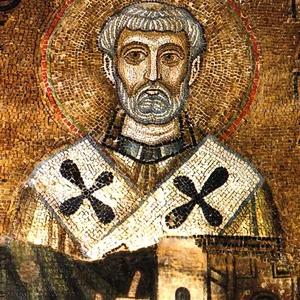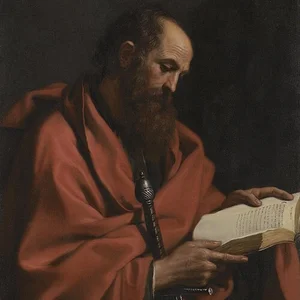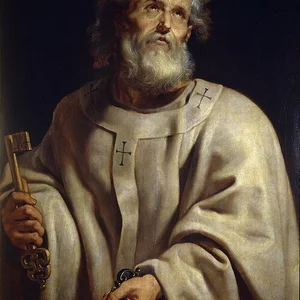

A fisherman from Galilee who became one of the twelve apostles of Jesus Christ, Peter is considered the first pope of the Catholic Church. He was martyred in Rome around 64–68 AD.
Peter(0 — 65)
Peter
7 min read
Frequently asked questions
Famous Quotes
« You are the Christ, the Son of the living God.»
« Lord, you know all things; you know that I love you.»
Key Facts
- Born around 1 AD in Bethsaida in Galilee, a fisherman by trade
- Chosen by Jesus as one of the twelve apostles, he was given the name Peter (meaning 'rock')
- Denied Jesus three times during his arrest, before repenting
- Was among the first witnesses of the Resurrection
- Martyred in Rome around 64–68 AD, crucified upside down according to tradition
Works & Achievements
A letter addressed to Christians scattered across Asia Minor, written to encourage them in the face of persecution. It is one of the earliest New Testament texts to develop a theology of Christian suffering as participation in the sufferings of Christ.
A letter warning against false prophets and asserting Peter's apostolic authority. Historians debate its authenticity, but it was ultimately included in the New Testament canon.
Catholic tradition attributes to Peter the founding and leadership of the first Christian community in Rome. This mission forms the historical basis for the legitimacy of the Roman papacy to this day.
The first major Christian sermon delivered publicly in Jerusalem. Peter proclaims the resurrection of Jesus and calls the crowd to conversion — a founding act of the Church's evangelizing mission.
Peter baptizes Cornelius, a non-Jewish Roman centurion, officially opening Christianity to the Gentiles (non-Jews). This act marks a decisive turning point in the universalization of the Christian message.
Anecdotes
Peter was originally named Simon, son of Jonah, and was a fisherman on the Sea of Galilee. It was Jesus himself who gave him the name Peter (from the Greek Petros, meaning 'rock'), declaring that he would build his Church upon this 'rock.' This change of name symbolized the extraordinary mission entrusted to him.
During the arrest of Jesus in the Garden of Gethsemane, Peter denied his master three times before the cock crowed, exactly as Jesus had predicted. This episode, recorded in all four Gospels, is one of the most human and dramatic moments in the founding texts of Christianity.
According to the Acts of the Apostles, Peter delivered the first great Christian missionary sermon on the day of Pentecost in Jerusalem, before a crowd of pilgrims gathered from across the Mediterranean world. This speech is said to have led to the baptism of nearly three thousand people in a single day.
Tradition holds that Peter was condemned to be crucified in Rome under Nero. He reportedly asked to be crucified upside down, considering himself unworthy to die in the same manner as Jesus. His tomb on the Vatican hill is today covered by St. Peter's Basilica.
Peter was the first apostle to enter the empty tomb of Jesus after the Resurrection, according to the Gospel of John. This symbolic act established his authority within the early Christian community and, for the Catholic Church, justifies his primacy over the other apostles.
Primary Sources
Simon, whom he named Peter… He said to them: 'Follow me, and I will make you fishers of men.'
Peter, standing with the Eleven, raised his voice and addressed them: 'Men of Judea and all who dwell in Jerusalem, let this be known to you...'
Peter, an apostle of Jesus Christ, to those who are elect exiles of the Dispersion in Pontus, Galatia, Cappadocia, Asia, and Bithynia.
I went up to Jerusalem to visit Cephas [Peter], and remained with him fifteen days.
To suppress this rumor, Nero fabricated scapegoats and inflicted the most exquisite punishments on a group hated for their abominations, whom the crowd called Christians.
Key Places
Peter's hometown, on the shores of the Sea of Galilee. It was here that he lived as a fisherman before meeting Jesus and becoming his disciple.
A freshwater lake in Israel where Peter worked as a fisherman. It was on its shores that Jesus called him, and where several Gospel miracles are set.
The nerve center of early Christianity's first decades. Peter led the apostolic community there, delivered the Pentecost sermon, and took part in the Council of AD 49.
A great cosmopolitan city where one of the first Christian churches was founded. Peter stayed there and exercised his apostolic authority; it was here that the followers of Jesus were first called 'Christians.'
The site of Peter's martyrdom and burial according to Christian tradition. St. Peter's Basilica, built over his presumed tomb, is the center of the worldwide Catholic Church.
Typical Objects

Before following Jesus, Peter was a fisherman on the Sea of Galilee. The net was his everyday tool, a symbol of his humble origins and his life before his apostolic calling.

Jesus symbolically entrusted Peter with the 'keys of the Kingdom of Heaven' (Gospel of Matthew 16:19). This object has become the symbol of papal authority and still appears in the coat of arms of the Vatican.

The boat on the Sea of Galilee is the setting for several foundational episodes: the miraculous catch of fish, the walking on water, and the calling of the disciples. It symbolizes the Church on its journey, according to Christian tradition.

The crowing of the rooster is closely tied to Peter's denial: it announced the betrayal foretold by Jesus. The rooster became a Christian symbol of vigilance and repentance, and is often placed atop church steeples.

During the arrest of Jesus, Peter cut off the ear of a servant of the high priest. This impulsive act, recorded in all four Gospels, illustrates his fiery temperament before his spiritual transformation.

Two letters bear Peter's name in the New Testament. They bear witness to his role as a spiritual guide for Christian communities scattered throughout the Roman Empire.
School Curriculum
Vocabulary & Tags
Key Vocabulary
Tags
Daily Life
Morning
Before his calling, Peter would rise before dawn to prepare his nets and set out on the Sea of Galilee with his brother Andrew. Night fishing was the most productive; at sunrise, he would return to shore to sell his catch at the local market in Capernaum.
Afternoon
As a traveling apostle, Peter walked the roads of Galilee and Judea with Jesus, stopping at synagogues and public squares to listen, question, and bear witness. He shared communal meals with the other disciples, often hosted by local believers.
Evening
Evenings were devoted to prayer, theological discussion, and shared meals. After the death of Jesus, Peter gathered the earliest Christian communities in private homes — the so-called 'house churches' — to pray, read the Scriptures, and break bread together.
Food
Peter followed Jewish dietary laws (kashrut): fish, bread, legumes, figs, and olives made up the bulk of his diet. The vision recounted in Acts (10:9–16), in which God commands him to eat ritually impure animals, marks his shift toward a more universal religious practice.
Clothing
Peter wore the typical dress of a 1st-century Galilean Jew: a linen tunic (kutonet) cinched at the waist with a leather belt, a woolen cloak (tallith) for warmth, and sandals. His clothes were handmade, plain, and worn from work at sea.
Housing
Peter lived in a house built from the basalt stone typical of Capernaum, most likely shared by several families under one roof. Archaeological excavations have uncovered what is identified as Peter's house in Capernaum — a modest dwelling with rooms grouped around a central courtyard.
Historical Timeline
Period Vocabulary
Visual Style
Style visuel ancré dans le Ier siècle ap. J.-C., mêlant la lumière dorée de la Méditerranée orientale aux tonalités sombres de la Rome impériale, avec des influences des premières fresques paléochrétiennes et de la mosaïque byzantine.
Sound Ambience
Ambiance sonore passant du lac de Tibériade à l'aube aux rues animées de Jérusalem et de Rome antique, évoquant le parcours de Pierre du monde de la pêche au monde de la mission apostolique.
Liens externes & ressources
Références
Œuvres
Première Épître de Pierre
vers 60-64 ap. J.-C.
Deuxième Épître de Pierre
vers fin Ier ou début IIe siècle ap. J.-C.
Fondation de l'Église de Rome
vers 42-64 ap. J.-C.
Discours de la Pentecôte (Actes 2)
vers 30 ap. J.-C.
Baptême de Corneille (Actes 10)
vers 37-40 ap. J.-C.