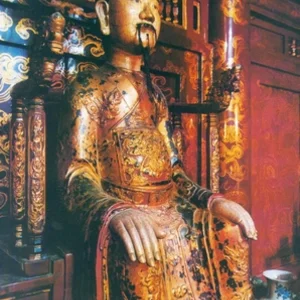

Born in 924 in Đại Hoàng (present-day Ninh Bình), Đinh Bộ Lĩnh ended the War of the Twelve Warlords (loạn 12 sứ quân) and unified the country in 968 [1]. He founded the state of Đại Cồ Việt and became the first emperor of independent Vietnam after the period of Chinese domination (Bắc thuộc) [1].
Đinh Bộ Lĩnh(924 — 979)
Đinh Bộ Lĩnh
Dai Co Viet
7 min read
Frequently asked questions
Key Facts
- 22 March 924: born in Kim Lư, Đại Hữu, Đại Hoàng (present-day Ninh Bình) [1]
- Around 951: refused to submit to Hậu Ngô Vương, sent his son Đinh Liễn as a hostage [1]
- 966–967: fought the Twelve Warlords (loạn 12 sứ quân) who were vying for power after the death of Ngô Xương Văn [1]
- 968 (according to tradition): unified the country, founded the state of Đại Cồ Việt and established his capital at Hoa Lư, took the title of emperor (Đại Thắng Minh Hoàng đế), having earlier been styled Vạn Thắng Vương [1]
- October 979: death of Đinh Tiên Hoàng [1]
Works & Achievements
Đinh Bộ Lĩnh subdues the twelve rival warlords one after another, putting an end to years of political fragmentation [1].
Creation of the first independent Vietnamese imperial state after a thousand years of Chinese domination [1].
Choice of the fortified valley of Hoa Lư as the seat of power, marking the beginning of a centralized monarchical regime [1].
Đinh Bộ Lĩnh becomes the first Vietnamese ruler to officially claim the imperial title, asserting the country's independence from China [1].
Anecdotes
As a child, Đinh Bộ Lĩnh played with other boys from his village at imitating an imperial procession: he had himself carried on crossed arms as a makeshift palanquin, while his companions waved reed flowers (bông lau) like banners. His playmates — Đinh Điền, Nguyễn Bặc, Lưu Cơ, and Trịnh Tú — would later become his loyal companions-in-arms [1].
According to ancient chronicles, young Đinh Bộ Lĩnh once secretly killed the family's pig to offer a feast to his friends, before fleeing his uncle's wrath. Pursued to the edge of a river, he is said to have fallen into the mud, where two golden dragons supposedly appeared to protect him — a marvelous episode added by court historians several centuries later, symbolically foreshadowing his destiny as a future sovereign (status: SEMI-LEGENDARY) [1].
Around 951, refusing to submit to the Ngô kings, Đinh Bộ Lĩnh sent his own son Đinh Liễn as a hostage. When the enemies hung Liễn from the end of a pole and threatened to kill him, Đinh Bộ Lĩnh ordered his archers to shoot at his own son rather than surrender — a gesture so radical that the stunned Ngô kings ultimately abandoned their plan to execute the hostage [1].
After the death of his protector Trần Minh Công at Bố Hải Khẩu, Đinh Bộ Lĩnh took command of his troops and returned to the fortified region of Hoa Lư, where he gathered around him the most feared warriors of the region, later nicknamed the “seven heroes of Giao Châu” [1].
In 968, after defeating the twelve rival lords who had been fighting over the country since the death of the Ngô king, Đinh Bộ Lĩnh proclaimed the birth of a new state, Đại Cồ Việt, and became the first Vietnamese ruler to take the title of emperor (hoàng đế) after a thousand years of Chinese domination [1].
Primary Sources
Vua mồ côi cha từ bé... Phàm khi chơi đùa, thường bắt bọn chúng chéo tay làm kiệu khiêng và cầm hoa lau đi hai bên để rước như nghi trượng thiên tử (“Orphaned of his father from a young age... during play, he would have his companions cross their arms to form a kiệu to carry him, and have them carry reed flowers on either side as an imperial escort”).
Đinh Tiên Hoàng is referred to here by the honorific titles “Đinh Tiên Vương” and “Tiên Vương,” reserved for a deceased sovereign.
Đinh Bộ Lĩnh, người động Hoa Lư, Giao Châu. Cha là Công Trứ, làm nha-tướng của Dương Đình Nghệ (“Đinh Bộ Lĩnh, native of the stronghold of Hoa Lư, in Giao Châu. His father, Công Trứ, was a subordinate officer of Dương Đình Nghệ”).
Bà mẹ vua nằm mộng thấy có một người lớn tay cầm cái ấn vua đến xin làm con, bèn có mang mà sinh ra vua (“The king's mother dreamed that a man holding the imperial seal came to ask to be recognized as her son; she then became pregnant and gave birth to the king”).
Bộ Lĩnh cùng với con là Liễn sang ở với Sứ-quân Trần Minh-công ở Bố-hải khẩu, chống hai vua Hậu Ngô Vương và các sứ quân khác (“Bộ Lĩnh, together with his son Liễn, went to take refuge with the warlord Trần Minh Công at Bố Hải Khẩu, in order to oppose the two kings of the Later Ngô dynasty and the other warlords”).
Key Places
Birthplace of Đinh Bộ Lĩnh in 924, in what is now northern Vietnam.
Fortified valley where Đinh Bộ Lĩnh grew up, gathered his followers, and later established the capital of the Đại Cồ Việt empire.
River port where Đinh Bộ Lĩnh entered the service of lord Trần Minh Công before taking command of his troops after the latter's death.
Site of a collapsed bridge where, according to legend, the young Đinh Bộ Lĩnh fell into the mud while fleeing his uncle and was protected by two golden dragons.
Liens externes & ressources
Références
Œuvres
Unification du Vietnam et fin de la guerre des Douze Seigneurs
966-968
Fondation de l'État Đại Cồ Việt
968
Établissement de la capitale impériale à Hoa Lư
968
Adoption du titre d'empereur (hoàng đế)
968