Imaginary interview with Erna Schneider Hoover
by Charactorium · Erna Schneider Hoover (1926 — ?) · Technology · Sciences · 5 min read
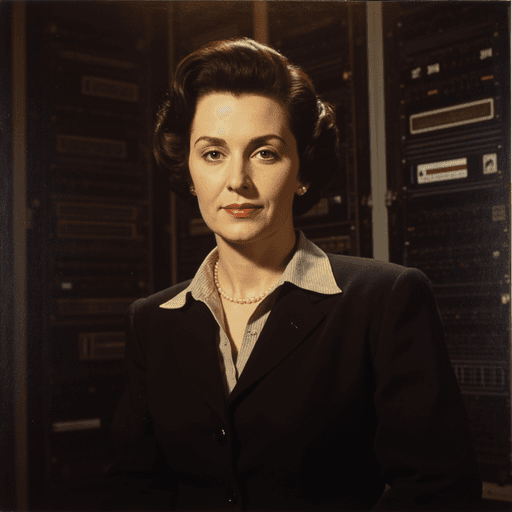
Late 1980s, somewhere in a house in Summit, New Jersey, a few miles from the Murray Hill labs. Coffee cools on the coffee table, a notepad still lies near the phone. Erna Schneider Hoover, retired from Bell Labs, agrees to look back on a career that began in logic and ended in the electronic silence of large central offices.
—Where, very concretely, was the idea that would make you famous born?
In a hospital bed, which is hardly glorious. I had just given birth to one of my daughters, and the doctors prescribed rest — that word I never quite knew how to conjugate. I had a notepad on my lap and, instead of sleeping, I thought about the telephone central offices that collapsed during peak hours. Too many calls arrived at once, the machine panicked, everything jammed. I scribbled there, between two nurse visits, the principle of a system that would monitor its own traffic. People imagine invention as a flash of lightning. For me it was a stubborn doodle, wrested from a room where I was ordered to think of nothing.
Rest — that word I never quite knew how to conjugate.
—How did you feel mixing family life and an engineering problem like that?
There was no airtight boundary, that's the truth. In the morning, I made breakfast for my daughters, then I drove to Murray Hill; in the evening, I came back to the New Jersey suburbs and sometimes kept unfolding my logic diagrams long after I'd taken off my suit. A working mother in the 1960s learned to think intermittently, between two tasks, and that discipline, curiously, resembles that of a central office: never handle everything at once, regulate, prioritize. I often thought that my home taught me as much about overload as my machines did.
—How would you explain, in simple terms, what your invention does?
Imagine a switchboard overwhelmed. Before, we replaced heavy electromechanical devices with other devices — always more cables, always more clattering relays. My idea was to entrust regulation to a stored-program computer: the machine continuously samples the rate of incoming calls, and when it senses the central office approaching overload, it slows down the acceptance of new requests. That's what's called feedback — a system that measures its own results to adjust itself. My 1971 patent, U.S. 3,623,007, describes exactly that monitor. Instead of adding matter, I added judgment.
Instead of adding matter, I added judgment.
—Why were you so insistent that a program, not a wired circuit, control the central office?
Because a wired circuit is a fixed conviction. You solder a decision into metal, and to change it you have to undo everything. Stored-program control, on the other hand, keeps its instructions in memory: you can correct them without touching the hardware. It was this flexibility that made large electronic central offices like the 1ESS, put into service in Succasunna in 1965, reliable. A central office must live for decades, absorb storms of calls on a disaster night and doze at dawn. Only modifiable logic could keep up. I always preferred ideas that can be rewritten to objects that must be replaced.
—You were first a philosopher and logician. How did that serve you?
It decided everything, really. At Yale, in 1951, I defended a thesis on the foundations of mathematics — pure logic, philosophy of reasoning, nothing that smelled of a soldering iron. Then I taught at Swarthmore. Yet a telephone central office is not primarily an electricity problem: it's a problem of chained decisions, of 'if this, then that,' exactly what a logician studies. When I drew a logic flowchart, those boxes and arrows, I was simply transporting to Bell the rigor I learned at Yale. It was the foundations of mathematics, far more than electronics, that allowed me to imagine a machine steered by thought.
A central office is not an electricity problem, but of chained decisions.
—What connection do you see between an algorithm and the work of a logician?
They are two faces of the same gesture. An algorithm is a precise sequence of steps and decisions to solve a problem; logical reasoning is a precise sequence of steps to establish a truth. I spent my student years dismantling proofs to see where they held, where they gave way. At Bell Labs, I did the same thing, except my proofs had to handle millions of calls a day without failing. People thought I was an engineer; I was mostly someone who refused to let a reasoning contain a hole. The transistor, invented at Bell in 1947, gave me the material; logic gave me the grammar.
—What did the world of Bell Labs in the 1960s represent for a woman?
A world of men, politely. I arrived in a suit, a modest skirt, low-heeled shoes — that discreet elegance that contrasted with the lab coats and bundles of cables around me. I had entered Bell in 1954 as a senior researcher, and it took time before people stopped being surprised that a mother discussed call traffic on equal terms with engineers. In the 1970s, I became the first woman to head a technical department there. I never saw it as a trophy: simply proof that a good idea eventually imposes its origin, even when that origin wears a skirt.
A good idea eventually imposes its origin, even when that origin wears a skirt.
—How did you hold your own among so many male colleagues?
By speaking the only language that knows no prejudice: that of a solved problem. In the afternoon, alongside engineers and machines, I drew my flowcharts, discussed peak-hour blockages, tested my ideas on new electronic systems. No one can long ignore a solution that prevents their central office from collapsing. I wasn't trying to stand out; I was trying to be right, and at Bell, being right always showed eventually. The rest — the looks, the astonishment — I let slide like a call I didn't accept.
—Do you remember what the idea of patenting a program meant at the time?
It was almost incongruous. We filed the patent in 1967, got it in 1971, and all that time people weren't quite sure what I was protecting. An object? A machine? No: an idea, an intelligent way to run a program. The patent document described a process, a logic, not an assembly of parts. It was one of the very first software patents ever granted. At a time when people thought in terms of machines and cables, I had to convince the Patent Office that a way of reasoning also deserved to be defended. I take a small stubborn pride in that.
I wasn't protecting a machine, but an intelligent way to run a program.
—If you could imagine how you'll be remembered in a century, what would you say?
That's a perilous game, but let's play it. In 2008, I was inducted into the National Inventors Hall of Fame, alongside inventors whose names I admired in my student books — I found that dizzying. If I'm still read in a hundred years, I hope people will remember not just a woman and a machine, but the idea that a system can learn to monitor its own limits. The feedback principles I put into a telephone central office, I believe are universal enough to outlive telephony itself. The rest — the dates, the suit, the hospital notepad — are just the scenery of an idea that doesn't age.
This imaginary interview was generated by artificial intelligence from sources documented in Erna Schneider Hoover's profile. It dramatises what the figure might have said based on what we know about them, but does not constitute attested historical testimony. For primary sources and factual documentation, refer to the full profile.