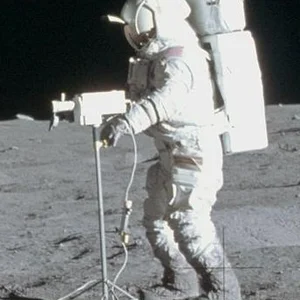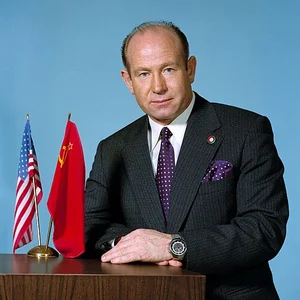

Soviet cosmonaut Alexei Leonov was the first person to perform a spacewalk on March 18, 1965, during the Voskhod 2 mission. A trained military pilot, he embodies the boldness of the Soviet space program.
Alexei Leonov(1934 — 2019)
Alexei Leonov
Russie
8 min read
Frequently asked questions
Famous Quotes
« The Earth was perfectly round. I thought I knew what that meant, but seeing it from space, I knew it with absolute certainty.»
Key Facts
- March 18, 1965: first extravehicular activity (EVA) in history, lasting 12 minutes, during the Voskhod 2 mission
- The spacewalk nearly ended in disaster: his suit inflated in the vacuum of space, preventing him from re-entering the airlock
- 1975: took part in the Apollo-Soyuz mission, the first joint American-Soviet spaceflight
- Trained as a fighter pilot before being selected for the first Soviet cosmonaut corps in 1960
- Died on October 11, 2019, in Moscow at the age of 85
Works & Achievements
Leonov spent 12 minutes in the vacuum of space, tethered by a 5.35-metre cable. This historic feat paved the way for future orbital repairs, space station assembly, and all human activity conducted outside spacecraft.
The first joint Soviet-American spaceflight, a symbol of Cold War détente. Leonov commanded the Soviet spacecraft and shook hands with Thomas Stafford during the historic docking of the two capsules.
Leonov produced hundreds of paintings depicting space, Earth as seen from orbit, and life as a cosmonaut, exhibited across the USSR, Russia, and internationally. He is recognized as the first artist-cosmonaut in history.
Intertwined memoirs of a Soviet cosmonaut and an American astronaut, offering a unique perspective on the space race told from both sides of the Iron Curtain. Translated into several languages, it is a landmark work in the history of the space age.
Following his spaceflights, Leonov became deputy director of Star City, overseeing the training of the next generation of cosmonauts. His firsthand experience of extreme emergency situations made him an exceptional instructor.
Anecdotes
During his spacewalk on March 18, 1965, Alexei Leonov's spacesuit inflated under internal pressure to the point where he could no longer bend his fingers or re-enter the airlock. To survive, he made a risky decision: manually depressurizing his suit, exposing himself to the risk of gas embolism. He managed to crawl back into the airlock head-first, utterly exhausted, in violation of the planned protocol.
A passionate artist since childhood, Leonov brought colored pencils aboard Voskhod 2. He created the very first drawing ever made in space, depicting the Earth's horizon as seen from orbit — an artistic as much as a scientific feat, reflecting a remarkable personality among the pioneers of space exploration.
After the spacewalk, Voskhod 2's automatic re-entry system failed. Leonov and his commander Pavel Belyayev had to pilot the capsule manually, landing 386 km from the intended zone in the snow-covered forests of the Urals. They spent a night inside the capsule surrounded by wolves in −30 °C temperatures, waiting for rescuers who could only reach them by sled the following day.
In 1975, Leonov commanded the Soyuz spacecraft during the Apollo-Soyuz mission, the first joint Soviet-American spaceflight at the height of the Cold War. He shook hands with astronaut Thomas Stafford in space during the docking of the two vessels — a symbolic gesture of international détente broadcast live on television around the world.
Leonov was an accomplished painter who exhibited his works throughout his life. He co-wrote with American astronaut David Scott the book *Two Sides of the Moon*, published in 2004, offering a rare dual perspective on the Space Race told simultaneously from both sides of the Iron Curtain.
Primary Sources
Transcripts of the exchanges between Leonov and the control center during his spacewalk on March 18, 1965, capture the tension felt by the ground teams as the cosmonaut struggled unexpectedly to re-enter the airlock.
"I found I was unable to get back into the airlock. My suit had inflated like a balloon. I had to bleed off pressure from inside, knowing I risked getting the bends. It was my only chance of survival."
The medical analysis of the spacewalk concluded that Leonov had undergone extreme physical and cardiac exertion while re-entering the airlock, and recommended a complete overhaul of suit design and emergency procedures.
"This flight proves that nations can cooperate in space even when they are at odds on Earth. We hope this handshake in space will stand as a lasting symbol of peace between our two peoples."
Key Places
Siberian village where Alexei Leonov was born on May 30, 1934, the eighth child of a modest family. His youth in this remote region of the USSR shaped his pioneering spirit and his drive to push beyond his limits.
Soviet launch site from which Voskhod 2 lifted off on March 18, 1965, for Leonov's historic mission. It was from this same cosmodrome that Gagarin had launched in 1961; it remains Russia's primary space launch facility to this day.
Soviet cosmonaut training center located near Moscow, where Leonov trained for years before his missions. After his flights, he became deputy director there, overseeing the training of the next generation of cosmonauts.
Unplanned landing zone for Voskhod 2 after the automatic re-entry system failed. Leonov and Belyayev survived a night in the snow at -30 °C, surrounded by wolves, before being rescued the following day by sled.
Capital city where Leonov spent most of his life after his space missions, holding leadership roles within the Soviet and later Russian space program, and exhibiting his paintings. He died there on October 11, 2019.
Typical Objects

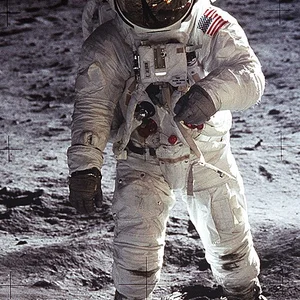
Pressurized suit worn by Leonov during his spacewalk, designed to withstand the vacuum and extreme temperatures of space. It was precisely the uncontrolled inflation of this suit due to internal pressure that nearly cost him his life on March 18, 1965.

Soviet two-person capsule fitted with a specially designed inflatable airlock to enable the first extravehicular activity in history. Leonov spent twelve minutes in space before struggling to re-enter the airlock.

Leonov brought colored pencils aboard Voskhod 2 and produced the first drawings ever made in space. Painting remained his lifelong passion, making him the world's first recognized cosmonaut-artist.

A 5.35-meter cable tethering Leonov to Voskhod 2 during his spacewalk, serving as both a lifeline and an oxygen supply cord. Without this cable, the cosmonaut would have drifted into the void with no way back.

A Soviet camera mounted on Leonov's suit to film the first EVA in history. The footage was broadcast on Soviet television and stands as a unique historical record of the early days of space exploration.

A bilingual embroidered patch (Russian and English) worn by Leonov during the joint 1975 mission, symbolizing space cooperation between the USSR and the United States. It has become an iconic artifact of the Cold War's international détente.
School Curriculum
Vocabulary & Tags
Key Vocabulary
Daily Life
Morning
At Star City in the 1960s, Leonov rose early for intense physical training sessions: running, swimming, and weightlessness training aboard aircraft flying parabolic arcs. The Soviet cosmonauts' fitness regimen was grueling, demanding a level of athletic conditioning that had to be maintained at all times.
Afternoon
Afternoons were devoted to pressure-chamber simulations, study of spacecraft systems, and atmospheric re-entry exercises in simulators. Leonov also found time to draw and paint — a discipline he pursued with the same rigor he brought to his technical training.
Evening
In the evenings, the cosmonauts would gather as a group to review procedures and share communal meals at Star City. Leonov, a sociable and cultured man, enjoyed conversations about art, literature, and the philosophy of exploration, standing out for an intellectual curiosity that was rare in military circles.
Food
Soviet cosmonauts followed a strictly controlled diet overseen by medical staff: precise caloric rations, freeze-dried food during missions, and a high-protein diet during training. In space, meals were eaten in weightlessness using tubes and sealed pouches, with every calorie calculated to sustain physical and cognitive performance.
Clothing
At Star City, Leonov wore the Soviet military uniform — he was an Air Force officer — or the cosmonauts' blue flight suit. On space missions, he donned the *Berkut* suit, weighing over 20 kilograms, designed to withstand the vacuum, radiation, and extreme temperatures of space.
Housing
Leonov lived in the collective housing of Star City, a closed residential complex built specifically for cosmonauts and their families near Moscow. This village, protected by military secrecy, had all the necessary amenities — schools, shops, gyms, swimming pools, and sports facilities — in an atmosphere of intense camaraderie among the families of space pioneers.
Historical Timeline
Period Vocabulary
Liens externes & ressources
Références
Œuvres
Première sortie extra-véhiculaire de l'histoire (mission Voskhod 2)
18 mars 1965
Mission Apollo-Soyouz (commandant du Soyouz 19)
juillet 1975
Série de peintures spatiales
1965-2019
'Les deux faces de la Lune' (avec David Scott)
2004
Direction de la formation des cosmonautes soviétiques
1976-1991