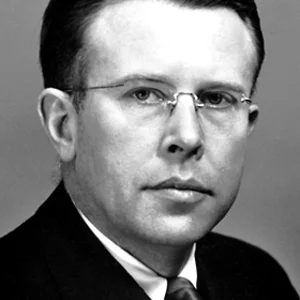

American physicist (1901–1958), inventor of the cyclotron, the first circular particle accelerator. Winner of the 1939 Nobel Prize in Physics, he paved the way for modern nuclear physics and contributed to the Manhattan Project.
Ernest Lawrence(1901 — 1958)
Ernest Orlando Lawrence
États-Unis
8 min read
Frequently asked questions
Key Facts
- 1929: invention of the cyclotron principle
- 1930: construction of the first cyclotron at the University of California, Berkeley
- 1939: Nobel Prize in Physics for the invention and development of the cyclotron
- 1941–1945: participation in the Manhattan Project for the separation of uranium-235
- 1952: founding of the Lawrence Livermore National Laboratory
Works & Achievements
A revolutionary invention that made it possible to accelerate charged particles to unprecedented energies without resorting to dangerous electrical voltages. The cyclotron paved the way for all of modern experimental nuclear physics.
An improved version capable of accelerating protons to 4.8 million electron volts. This device was used to produce the first artificial radioisotopes at Berkeley and demonstrated the power of the design.
A machine capable of accelerating deuterons to 20 million electron volts, it enabled major advances in nuclear physics and the production of medical radioisotopes, including for the first therapies against leukemia.
Lawrence established this university laboratory, which became a worldwide model for "Big Science": a mode of research that mobilizes large teams, heavy infrastructure, and massive funding — a sharp departure from the small-scale physics of the nineteenth century.
Lawrence adapted the principle of the cyclotron to create large-scale isotope separators for producing the uranium-235 needed for the atomic bomb. The Y-12 plant at Oak Ridge housed hundreds of calutrons operating simultaneously.
A national laboratory co-founded by Lawrence during the Cold War to develop the American hydrogen bomb. It remains to this day one of the most important nuclear physics research centers in the world.
Anecdotes
In 1929, Lawrence stumbled upon an article by Norwegian physicist Rolf Wideröe on the acceleration of charged particles. Unable to read German, he focused on the diagrams and mathematical formulas, and intuitively understood how to make particles travel in circles to accelerate them indefinitely. From this improvised reading, the idea of the cyclotron was born.
His first cyclotron, built in 1930 at Berkeley, fit in the palm of a hand: it measured barely 10 centimeters in diameter and was largely assembled from salvaged materials, including copper wire and glass plates. Despite its rudimentary appearance, it accelerated protons to 80,000 electron volts, proving the concept worked.
Lawrence received the Nobel Prize in Physics in December 1939, just as World War II had broken out in Europe. The ceremony in Stockholm was one of the last to be held normally for years to come. Lawrence, only 38 years old at the time, was the youngest Nobel laureate in physics in decades.
During the Manhattan Project, Lawrence developed “calutrons,” giant electromagnetic separators derived from the cyclotron, to isolate uranium-235 from uranium-238. Thousands of young women from the Oak Ridge area operated these machines without knowing they were helping build an atomic bomb.
Ernest’s brother, John Lawrence, a physician, used the Berkeley cyclotron to produce radioisotopes and treat leukemia patients as early as 1937. Their mother was among the first patients treated with these new techniques. This collaboration between fundamental physics and medicine ushered in the era of nuclear medicine.
Primary Sources
By applying an oscillating potential difference between two D-shaped electrodes placed within a magnetic field, it is possible to accelerate ions along successive circular trajectories, reaching very high energies without resorting to dangerous voltages.
The cyclotron, in its design, rests on the principle of magnetic resonance: the frequency of rotation of an ion in a uniform magnetic field is independent of its velocity, which allows cumulative acceleration through synchronized electrical impulses.
I am convinced that if we concentrate our efforts on electromagnetic separation, we can obtain sufficient quantities of uranium-235 within the timescales required by the program.
The 60-inch cyclotron made it possible to accelerate heavy nuclei to energies sufficient to induce a variety of artificial nuclear reactions, opening new prospects in experimental nuclear physics.
Key Places
Ernest Lawrence's birthplace, born on August 8, 1901. The son of a school superintendent, he grew up in the American Midwest in a modest but intellectually stimulating environment.
The site of Lawrence's entire scientific career from 1928 onward. It was here that he conceived, built, and refined the cyclotron, and where he founded the Radiation Laboratory (today known as Lawrence Berkeley National Laboratory).
The secret Manhattan Project site where Lawrence oversaw the installation of calutrons at the Y-12 plant. Thousands of workers there carried out the separation of fissile uranium, unaware of the true nature of their mission.
The city where Ernest Lawrence received his Nobel Prize in Physics on December 11, 1939, in the midst of World War II. The ceremony marked international recognition of the cyclotron's importance to modern physics.
The city where Lawrence co-founded the Lawrence Livermore National Laboratory in 1952, dedicated to thermonuclear weapons research during the Cold War. The laboratory still bears his name today.
Typical Objects

A circular particle accelerator invented by Lawrence in 1930, consisting of two D-shaped electrodes (the "dees") placed within a magnetic field. It is the defining object of his entire career, which he continually enlarged to reach ever-higher energies.

Lawrence's cyclotrons required increasingly massive electromagnets to bend the trajectories of accelerated particles. The magnet for the 184-inch cyclotron weighed several hundred tons and demanded extraordinary feats of engineering.

An electromagnetic isotope separator derived from the cyclotron, developed by Lawrence during the Manhattan Project at Oak Ridge. The device was used to isolate fissile uranium-235 from uranium-238 — a key step in the production of the atomic bomb.

A hermetically sealed enclosure essential to the cyclotron's operation, in which a vacuum is maintained to prevent accelerated particles from being slowed by air molecules. Manufacturing a sufficiently airtight chamber was a major technical challenge in the 1930s.

An alternating-current generator synchronized with the rotation frequency of the particles inside the cyclotron. It delivered precisely timed electrical pulses to accelerate the particles — the fundamental operating principle of the cyclotron.

Artificial radioactive substances produced by the Berkeley cyclotron, used by John Lawrence (Ernest's brother) to treat cancers as early as the 1930s. They stand as a direct symbol of how fundamental physics research can be applied to medicine.
School Curriculum
Vocabulary & Tags
Key Vocabulary
Tags
Daily Life
Morning
Lawrence arrived at the Radiation Laboratory at Berkeley very early, often before 8 a.m. He would begin by making the rounds of the workshops and experimental rooms, personally inspecting the state of the machines and encouraging his teams. As much an administrator as a researcher, he read his mail and planned the day's priorities during a quick meeting with his immediate colleagues.
Afternoon
Afternoons were devoted to experiments proper: adjusting cyclotron parameters, analyzing the results of target bombardment, and discussing data with his doctoral and postdoctoral students. Lawrence personally oversaw technical modifications and stepped in directly to work on the equipment whenever an engineering problem arose, bridging the gap between physical theory and mechanical implementation.
Evening
Lawrence often worked late into the evening, especially during critical phases of construction or experimentation. He frequently hosted colleagues and students at his Berkeley home to discuss physics over a meal. A natural organizer, he also used these evenings to maintain his network of relationships with the industrialists, military figures, and political officials who funded his research.
Food
Lawrence lived in the typical American middle-class comfort of the 1930s–1950s, with no particular diet. He enjoyed family meals with his wife Mary Blumer and their six children. During the intense phases of the Manhattan Project, he often ate in the cafeterias of the secret laboratories, favoring convenience over refinement.
Clothing
In the laboratory, Lawrence wore a business suit or a white lab coat depending on the activity. Unlike many theoretical physicists, he worked directly on the machines and had no qualms about getting his clothes dirty during hands-on technical work. In public or at official meetings, he paid careful attention to his appearance, aware of the image he needed to project in order to secure funding and institutional recognition.
Housing
Lawrence lived in a comfortable house in the Berkeley hills, above the university, with a view over San Francisco Bay. This pleasant setting reflected his standing as a distinguished professor and recognized laboratory director. His home was a hub of active social life, where he regularly entertained scientists, donors, and political figures.
Historical Timeline
Period Vocabulary
Liens externes & ressources
Références
Œuvres
Le cyclotron (premier accélérateur circulaire)
1930
Cyclotron de 27 pouces (69 cm)
1932
Cyclotron de 60 pouces (152 cm)
1939
Fondation du Radiation Laboratory de Berkeley
1931
Programme Calutron (Projet Manhattan)
1943-1945
Lawrence Livermore National Laboratory
1952