Imaginary interview with Haruki Murakami
by Charactorium · Haruki Murakami (1949 — ?) · Literature · 6 min read
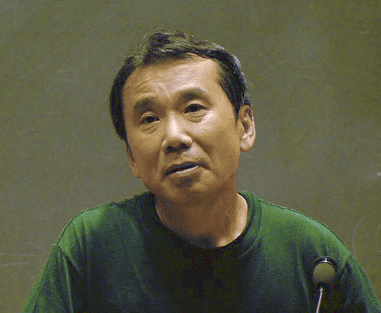
Four in the morning, somewhere in Tokyo. An old jazz record plays softly, thousands of vinyls cover the walls, and a cup of coffee cools on the desk. Haruki Murakami, in his running tracksuit with a calm voice, agrees to talk before his morning run.
—How did a bar owner become, almost by accident, one of the world's most widely read novelists?
The Peter Cat — I ran it for seven years, named after my cat. By day I served coffee; by evening, cocktails, and in between I listened to my records until the grooves wore out. Nothing destined me to write. And then there was that afternoon in April 1978, at Jingu Stadium, a nearly empty baseball game. A batter hit a double, the ball cracked cleanly, and at that precise moment — I can't explain it otherwise — I knew I could write a novel. Not that I had to: that I could. I went home, bought paper and a pen, and started Hear the Wind Sing that very evening, after closing, in the fatigue of the counter.
A batter hit a double, and at that moment I knew I could write a novel.
—What role does music play in the very way you construct a sentence?
When asked who my masters are, I rarely mention writers first. I think of a jazz record on the turntable. I learned rhythm, the breathing of a sentence, by listening to musicians improvise — that way of holding a note, releasing it, starting again. At the Peter Cat, I listened to the same pieces hundreds of times, and without knowing it, I was learning to build a paragraph. Writing, for me, is first a matter of swing: if the prose doesn't swing, no idea will save it. I still keep thousands of vinyls at home, arranged as others arrange their memories. The silence of four in the morning and an old record — that's my real office.
If the prose doesn't swing, no idea will save it.
—You often say that running and writing are one and the same. What has the road taught you that books couldn't?
You ask what running taught me? Almost everything. In What I Talk About When I Talk About Running, I wrote it plainly: "Most of what I know about novel writing, I learned by running every morning on the road." That's not a clever phrase, it's literal. Since the early 1980s, I run a marathon each year; I've even completed a hundred-kilometer ultra, and I can tell you that at sixty kilometers, you stop thinking. A long novel is exactly that: holding on when nothing carries you, putting one foot in front of the other, every morning, without waiting for inspiration. My running shoes taught me more about discipline than any style manual.
At the sixtieth kilometer, you stop thinking; a novel begins there.
—Many imagine the writer waiting for the muse. What does one of your days really look like when you're in the middle of a novel?
People imagine me waiting for inspiration. It's the opposite. When I'm writing a novel, I get up around four, work five or six hours in silence, then run or swim, and go to bed early. I repeat this for months, without exception, until the body itself knows the time. In Novelist as a Vocation, I summed up my conviction: "Talent, you either have it or you don't. But concentration and endurance can be acquired and improved through training." Talent is a spring that flows when it wants; concentration, on the other hand, can be muscled. I've made my life a deliberately boring routine so that my books, on the other hand, never are.
I made my life boring so that my books would never be.
—In your novels, fish fall from the sky and cats talk without anyone being surprised. Where does this porosity between the real and the strange come from?
Magical realism, as it's called, is not a device I choose in the morning. It's rather that the boundary between the ordinary world and the other side has always seemed porous to me. In Kafka on the Shore, fish fall from the sky, an old man talks with cats, and no one in the book finds it really abnormal — because neither do I. The cat appears again and again in my work; it passes through a door that we humans don't see. I grew up near Kobe, between the bookshops and record stores of a port open to the world, and very early I felt that reality had a double. Writing is going down into that dark cellar under the house, staying as long as needed, and coming back with what you found there.
Reality has always, for me, had a double.
—Do you remember what gave birth to The Wind-Up Bird Chronicle, that novel where a man descends to the bottom of a well?
It all started with a missing cat and a dry well. A perfectly ordinary man climbs down a well to think, and it's there, in the dark, that history resurfaces — war, Manchuria, the violence that Japan long preferred to forget. I believe that dream and memory are not separate: you go down into one, you meet the other. That novel took me years, written partly in the United States, at Princeton, where distance paradoxically brought me closer to my country. My characters are never heroes; they are quiet people to whom something immense happens, and who must cross, alone, their own night.
You go down into the dream and you meet memory.
—Even before being published, you were translating American literature. What did that work as a bridge give you?
Before publishing, I was already translating. Fitzgerald first — Gatsby is the book of my life — then Raymond Carver, whose entire work I translated, and Salinger, to whom I gave a Japanese voice in The Catcher in the Rye. Translating is the opposite of writing and yet the same gesture: you dismantle another's sentence to understand how it stands. I learned my craft there, on the typewriter, spending hours on a single sentence by Carver. Some say my prose doesn't "sound" Japanese; that's true, and I embrace it. I shaped it by listening to American, just as I had trained my ear by listening to jazz.
Translating is dismantling another's sentence to understand how it stands.

—Your books now live in more than fifty languages. How do you feel about this worldwide reach?
That my books now breathe in more than fifty languages still leaves me a bit incredulous. 1Q84 was published in Japan in 2009, and a few months later readers were queuing in New York, Paris, Seoul, for a novel written by a man who gets up at four in a silent office. That is globalization: a translated book becomes a door between solitudes that will never meet. Yet I don't write for the world; I write for a single person, at night, who can't sleep. If that person exists in Tokyo as in Lisbon, it's because modern unease itself needs no translator.
A translated book is a door between solitudes that will never meet.
—How did the year 1995, with the Kobe earthquake and the sarin gas attack, change your way of writing?
The year 1995 split Japan in two. In January, the Kobe earthquake razed the city of my childhood; in March, the Aum sect spread sarin gas in the Tokyo subway, on a weekday morning, among people simply going to work. I felt I could no longer continue as before. I spent a year collecting the words of the victims, one by one, without commentary, because newspapers reduced them to numbers. The economic bubble had burst four years earlier; a rich, self-assured country discovered its fragility. My dreamlike novels and those very real testimonies are, at bottom, one and the same inquiry: where does the violence that sleeps within us come from?
My dreams and those real testimonies are one inquiry: where does the violence that sleeps within us come from?
—If you had to name the thread running through all your work, what would it be?
If I had to sum up what drives me, I'd think back to what I said when receiving a prize in Jerusalem, in 2009, before an audience my words might disturb: "Between a high, solid wall and an egg that breaks against it, I will always stand on the side of the egg." The wall is systems, states, dogmas; the egg is each of us, fragile, unique, mortal. A novelist has only one duty: to stand on the side of beings, never of institutions. My entire work, from talking cats to men crouching at the bottom of a well, tells only that — the tiny, stubborn dignity of the individual against what would crush it.
The wall is systems; the egg is each of us — I choose the egg.


This imaginary interview was generated by artificial intelligence from sources documented in Haruki Murakami's profile. It dramatises what the figure might have said based on what we know about them, but does not constitute attested historical testimony. For primary sources and factual documentation, refer to the full profile.