
Nigerian writer
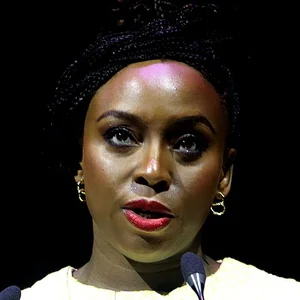
Chimamanda Ngozi Adichie(1977 — )
Chimamanda Ngozi Adichie
Nigeria
7 min read
Frequently asked questions
Famous Quotes
« Nous sommes tous des féministes.»
« Le danger de l'histoire unique, c'est qu'elle crée des stéréotypes. Et le problème avec les stéréotypes, ce n'est pas qu'ils sont faux, mais qu'ils sont incomplets.»
Key Facts
- Naissance en 1977 à Enugu, au Nigeria, dans une famille intellectuelle.
- Publication de 'L'hibiscus pourpre' (2003), son premier roman acclamé par la critique internationale.
- Publication de 'L'autre moitié du soleil' (2006), sur la guerre du Biafra, prix Orange de la fiction 2007.
- Publication d''Americanah' (2013), explorant race et identité entre Nigeria et États-Unis.
- Son TED Talk 'Nous devrions tous être féministes' (2012) devient un essai mondial traduit dans plus de 30 langues.
Works & Achievements
Adichie's debut novel, it tells the story of a Nigerian family under the grip of an authoritarian and devout father. Awarded the Commonwealth Writers' Prize, it reveals her talent for weaving together the intimate and the political.
A novel about the Biafran War (1967–1970) that explores the devastation of colonialism and shattered identities. Considered her masterpiece, it won the Orange Prize for Fiction in 2007.
A short story collection exploring the experiences of Nigerian women between Africa and America, with a voice that is at once poetic and political.
A landmark novel about racial identity, immigration, and love, following a young Nigerian woman who discovers the social construction of race in the United States. Named best book of the year by the New York Times.
An essay drawn from her TED talk, translated into more than 30 languages. It redefines feminism in an accessible and universal way, becoming a generational manifesto worldwide.
An open letter to a friend on how to raise a feminist daughter, offering 15 practical pieces of advice on gender equality from childhood.
A short, poignant essay on mourning, written after the death of her father during the COVID-19 pandemic. An intimate meditation on loss and memory.
Anecdotes
Chimamanda Ngozi Adichie was born in 1977 in Enugu, Nigeria, into an intellectual family: her father was the first professor of statistics at the University of Nigeria in Nsukka, and her mother the first female registrar of the same university. This childhood in a cultured household profoundly shaped her literary vocation.
At the age of 19, Adichie left Nigeria to study in the United States, first at Drexel University and then at Eastern Connecticut State University. This cultural shock between her Nigerian upbringing and American reality would directly feed into her novel Americanah, in which she explores with irony and clarity what it means to be 'Black' across different societies.
Her essay 'We Should All Be Feminists', drawn from a TED talk given in 2012, was distributed to every sixteen-year-old girl in Sweden in 2015. Singer Beyoncé also sampled an excerpt from it in her song 'Flawless' that same year, propelling Adichie onto the global cultural stage.
Adichie grew up in the house previously occupied by writer Chinua Achebe in Nsukka. She regards Achebe, author of 'Things Fall Apart', as one of her major literary mentors, although she has also critiqued his treatment of female characters in his works.
Primary Sources
My own definition of a feminist is a man or a woman who says, 'Yes, there's a problem with gender as it is today and we must fix it, we must do better.' All of us, women and men, must do better.
The only reason you say that race was not an issue is because you wish it was not. We all wish it was not. But it's a lie. I came from a country where race was not an issue; I did not think of myself as black and I only became black when I came to America.
The silence was heavy between us, heavy like something palpable. Papa was sitting at the end of the table, his hands laid flat on the white tablecloth, and he was looking at neither me nor Jaja.
The single story creates stereotypes, and the problem with stereotypes is not that they are untrue, but that they are incomplete. They make one story become the only story.
Key Places
Adichie's hometown, capital of Enugu State in southeastern Nigeria. This Igbo territory, marked by the Biafran War, is at the heart of her family and cultural memory.
The university campus where her father taught and where Adichie grew up. She began studying medicine there before leaving for the United States to pursue a career in literature.
Nigeria's economic megalopolis where Adichie spends part of the year. This cosmopolitan and chaotic city serves as a recurring setting in her stories.
The American city where Adichie studied at Johns Hopkins University and where part of the novel Americanah takes place. It symbolizes the cultural and racial shock experienced by the protagonist.
Adichie was writer-in-residence at Princeton University, one of the most prestigious academic institutions in the United States.
Typical Objects

Adichie writes her first drafts by hand in notebooks before moving to the computer. For her, handwriting represents a direct link between thought and creation.

These boldly patterned fabrics characteristic of West Africa adorn the outfits Adichie wears at public appearances, proudly asserting her Nigerian identity.

The works of the author of 'Things Fall Apart' were a foundational read for Adichie: as a child, she grew up in the house Achebe had occupied in Nsukka.

Public speaking is at the heart of Adichie's commitment. Her two TED talks transformed her voice into a tool for global social transformation.

Adichie lives between Nigeria and the United States, and this dual geographical belonging fuels the essence of her literary work and her reflection on identity.

Adichie regularly wears traditional Igbo outfits at official events, asserting her belonging to this culture and challenging stereotypes about Africa.
School Curriculum
Vocabulary & Tags
Key Vocabulary
Daily Life
Morning
Adichie starts her mornings early, often in Lagos or Baltimore depending on the season. She places great importance on family breakfast and reads the Nigerian and international press before beginning to write.
Afternoon
Afternoons are dedicated to writing: she works for several hours at a stretch, often by hand for first drafts. She sometimes meets with students or gives interviews from her home.
Evening
Evenings are an important social time: family dinners, cultural outings in Lagos, or attendance at literary events. Adichie enjoys cooking traditional Nigerian dishes with her loved ones.
Food
Her diet reflects Igbo and Yoruba cuisine: egusi soup with pumpkin seeds, spiced jollof rice, fried plantains, grilled fish. She has stated that she never deprives herself of food for aesthetic reasons.
Clothing
Adichie embraces a personal style that blends international haute couture with contemporary African designers. She often wears ankara fabric dresses at public events, and dresses with care as an act of cultural pride.
Housing
She splits her time between Lagos, where she owns a home in a residential neighborhood, and the United States (Baltimore, Princeton). She is committed to maintaining a genuine presence in Nigeria despite her international success.
Historical Timeline
Period Vocabulary
Visual Style
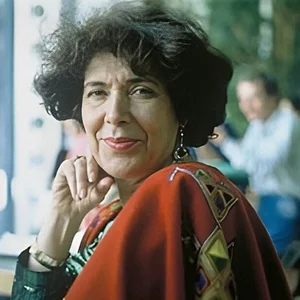
Portrait alliant l'élégance des tissus traditionnels igbo aux codes visuels de la femme intellectuelle contemporaine, dans une lumière chaude et dorée évocatrice du Nigeria.
Sound Ambience
Ambiance sonore entre le Lagos contemporain et les campus américains feutrés : le bruit vivant de la mégalopole nigériane se mêle au silence studieux des bibliothèques universitaires américaines.
Liens externes & ressources
Références
Œuvres
Purple Hibiscus (L'hibiscus pourpre)
2003
Half of a Yellow Sun (L'autre moitié du soleil)
2006
The Thing Around Your Neck (Autour de ton cou)
2009
Americanah
2013
We Should All Be Feminists
2014
Dear Ijeawele, or A Feminist Manifesto in Fifteen Suggestions
2017
Notes on Grief
2021