Imaginary interview with Lê Lợi
by Charactorium · Lê Lợi (1384 — 1433) · Politics · Military · 7 min read

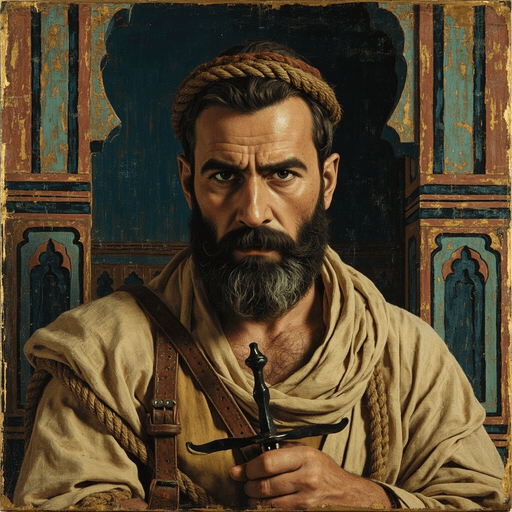
We are received in the citadel of Đông Kinh, two years after the last Ming junks sailed down the Red River toward the north. The man facing us still bears on his shoulder the birthmark that his court chroniclers say was engraved by Heaven. He speaks slowly, as a soldier turned king, his voice — they say — like a bell.
—Before speaking of your battles, where does your family come from, and why does this place Lam Sơn always return in your words?
It all began long before me, with my great-grandfather Lê Hối. The tradition of my house recounts that one day he passed by the foot of a hill at Lam Sơn, in Thanh Hóa, and saw flocks of birds circling there like a crowd gathering for a festival. He read in it the mark of a favorable land, built his dwelling there, and within three years our family prospered. Heaven does not speak to men with words; it sends them signs in the flight of birds, in the shape of a mountain. My fathers thereafter became hereditary chiefs of these valleys, quân trưởng from father to son. When I look at my life, I do not believe I am the author of it all: I am the branch that an omen a century old caused to grow.
Heaven does not speak to men with words; it sends them signs in the flight of birds.
—So you were a local notable, a phụ đạo. What drives such a man, already provided with lands, to defy the greatest empire in the world?
I was phụ đạo of Lam Sơn, chief of a canton, lord of a handful of hills — that ordinarily suffices to fill a man's life. But when Hồ Quý Ly had seized the throne from the Trần and Ming China descended upon us under pretext of avenging them, I saw our country become a đô hộ, an occupied land. According to what our annalists report, I remained at home reading books and meditating on the arts of war, keeping my calm in expectation of the hour. I was thought inactive; I was weighing the weight of Heaven and that of the Ming. A chief who has received from his fathers authority over a people cannot watch that people emasculated, starved, its writings taken away, without betraying the mandate he holds from above. I waited, not out of fear, but because the right hour had not come.
I was thought inactive; I was weighing the weight of Heaven and that of the Ming.
—When you finally raised the banner in 1418, you had only a few thousand men. How do you stand against armies ten times larger?
In 1418, I raised the banner of Lam Sơn with a few thousand men, and the Ming sent tens of thousands to crush us at one blow. To fight a pitched battle would have been to lead my nghĩa quân, my army of justice, to the slaughter. So I did the opposite of what is expected of a chief with heart: I refused battle. For six years we lived in the highlands of Thanh Hóa, sleeping under shelters of branches, striking the enemy by surprise then melting into the forest — the chiến thuật phục kích, the art of ambush. I even negotiated truces, swallowed humiliations, to gain time. A reed that bends in the storm stands up again; the proud great tree breaks. Patience is not cowardice: it is letting Heaven ripen your strength while the enemy exhausts himself.
A reed that bends in the storm stands up again; the proud great tree breaks.
—Was there a moment when you felt the tide turn, that the guerrilla war became a war of liberation?
The year 1426, at Tốt Động – Chúc Động, near what is now called the land of Chương Mỹ. Until then we bit the enemy like the tiger bites from the thickets; that day, for the first time, we broke him in open field. The forces of General Wang Tong were cut to pieces and had to hole up in the citadel of Đông Quan. I still hear the war drums, the trống, echoing from hill to hill to gather troops that the mountain had scattered. That was the turning point: the besieger became the besieged. Wang Tong, cornered, negotiated peace himself without even consulting his emperor — an unprecedented thing. Twenty years of occupation had just cracked, not by a miracle, but because the patiently ripened fruit had finally fallen from the tree.
Until then we bit the enemy like the tiger from the thickets; that day, we broke him in open field.
—In 1427, the enemy is on the ground. Your generals demand vengeance. Yet you choose to let Wang Tong go. Tell us about that moment.
All the relief armies that China dispatched — the generals Liễu Thăng, Mộc Thạnh — we had defeated them. Wang Tong and his soldiers were at my mercy in Đông Quan. My own generals, and the entire people who had seen their books burned and their sons die, demanded blood. What they wanted was just according to pain; it was not just according to Heaven. I granted the defeated enemy a safe and dignified withdrawal. They thought me mad. But a man who tramples the half-dead snake risks being bitten by its last convulsion: China is vast and its rancor eternal. Sparing a hundred thousand men meant sparing my people a new war. True victory is not to humiliate the adversary; it is to ensure that he never returns.
True victory is not to humiliate the adversary; it is to ensure that he never returns.

—It is said that you went even further, even equipping the departure of the vanquished yourself. Why such a gesture?
I did not content myself with opening the door for them. I had them provided with junks, those thuyền of wood that carry our people on the rivers, and I had the roads repaired so that their return northward would be without obstacle. My army grumbled; we were giving the enemy the very means to flee safe and sound. But a peace that is humiliated is only a war postponed. In treating the beaten adversary with honor, I was speaking less to Wang Tong than to his emperor, there in Beijing: See, Đại Việt neither begs nor provokes; it only takes back what Heaven has given it, and it returns to the vanquished his dignity. A birthmark on my shoulder, they say, marked my destiny; but a king is not judged by his omens, he is judged by the peace he knows how to build.
A peace that is humiliated is only a war postponed.
—Then comes the time of words. Why entrust Nguyễn Trãi with proclaiming your victory, rather than proclaiming it yourself?
A king conquers by the sword, but he only founds by the written word. When the Ming had left our soil, in 1428, I charged Nguyễn Trãi with composing in my name the Bình Ngô đại cáo, the great proclamation of victory over the Wu. “Bình Ngô”: pacifying the Wu, that old name given to the people of the North. Nguyễn Trãi possessed what I did not: the pen that engraves events in the memory of peoples. A won battle is forgotten in a generation; a text endures. It was necessary to announce not only that the Ming were gone, but that Đại Việt existed again, with its own laws and its own civilization, as ancient as that of the North. This text was affixed under my imperial seal, the ấn tín, and it was worth a thousand victories: for it told the world why we had fought.
A king conquers by the sword, but he only founds by the written word.

—Upon ascending the throne, you chose the era name Thuận Thiên and proclaimed a general amnesty. What did you mean to signify by these gestures?
The day I ascended the throne, I took as niên hiệu, as era name, Thuận Thiên — “Obeying Heaven.” It was not pride, but acknowledgment: I did not rule by right of my blood, but because Heaven had withdrawn its mandate from the occupiers to entrust it to me. That same day, I proclaimed the đại xá, the general amnesty: prisons opened, sentences were erased, and I restored to our country its true name, Đại Việt. A kingdom that is reborn must not begin with vengeances but with a great pardon, like the land after the flood is again covered with rice. I had spent ten years destroying an occupation; I still had to prove that a war chief could also be a father to his people. The amnesty was my first edict as king, not my last order as general.
A kingdom that is reborn must not begin with vengeances but with a great pardon.
—The Ming had not only occupied the country, they had wanted to erase its soul. How does one rebuild what has been burned?
The occupier had not only taken our cities; he had tried to tear out our memory. Our books were burned or carted off to the North, our schools closed. They even went so far as to ban fermented brine, that nước mắm that the humblest peasant of Thanh Hóa pours over his rice — starving a people of its own taste, that was their idea of conquest. Rebuilding therefore began with seeking: I sent collectors everywhere for manuscripts that had escaped the fire, copies hidden under roofs, every surviving page of our knowledge. One does not rebuild a nation with walls alone, but with its writings, its rites, its cuisine and its language. A people that has lost its books is like a man who has lost the memory of his ancestors: he no longer knows who he is. Restoring to Đại Việt its letters was worth a second war.
Starving a people of its own taste, that was their idea of conquest.
—You reopened the mandarin exams, you opened schools. A general who bets on scholars rather than arms: is that not surprising?
People are surprised that a man who spent his youth meditating on war treatises, those binh pháp rolled on bamboo, devoted his reign to reopening the mandarin exams. But the sword serves only for a time. Arms drive out the invader; only scholars make a kingdom endure. I had schools rebuilt throughout the country, laws codified, men of learning whom the war had scattered recalled, so that state service would return to merit and not to birth alone. When I have returned to my ancestors — and I feel it near — it will not be my ambushes that will be reread, but the institutions I have left standing. A man builds his house for his sons, not for himself. The dynasty I have founded will last as long as it honors the books the Ming wanted to burn. That is my true testament.
Arms drive out the invader; only scholars make a kingdom endure.

This imaginary interview was generated by artificial intelligence from sources documented in Lê Lợi's profile. It dramatises what the figure might have said based on what we know about them, but does not constitute attested historical testimony. For primary sources and factual documentation, refer to the full profile.