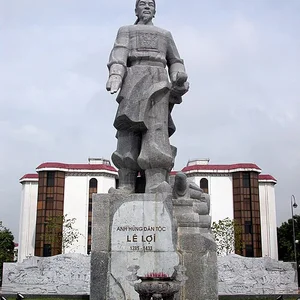

Vietnamese military and political leader (1385–1433), he led ten years of resistance against Ming occupation (1418–1428) and founded the Later Lê dynasty by restoring the independence of Đại Việt.
Lê Lợi(1384 — 1433)
Lê Lợi
Dynastie Lê
9 min read
Frequently asked questions
Key Facts
- 1385: born in Lam Sơn (Thanh Hóa), into a family of local notables who had exercised authority over the region for several generations
- 1418: launch of the Lam Sơn uprising against Ming occupation, with only a few thousand men
- 1426–1427: decisive victories at the battles of Tốt Động and Chúc Động; the Ming, pushed back into their garrisons, negotiate their withdrawal
- 1427: official withdrawal of Ming troops (17th day of the 12th lunar month); Nguyễn Trãi composes the Proclamation of the Pacification of the Wu (Bình Ngô đại cáo)
- 1428: proclamation of the empire, founding of the Hậu Lê dynasty, reorganization of the country (civil examinations, law, economy, education)
Works & Achievements
A ten-year insurrection organized and led from the mountains of Thanh Hóa until the complete expulsion of Ming forces. Regarded as one of the great military epics in Vietnamese history.
A founding text commissioned from Nguyễn Trãi to proclaim the expulsion of the Ming and the restoration of Đại Việt's independence; often compared to a declaration of national independence.
Lê Lợi ascended the throne, proclaimed a general amnesty, restored the name Đại Việt, and made Đông Kinh the capital, founding a dynasty that ruled until 1789.
Rebuilding of the mandarin examination system, codification of laws, revival of the economy, recovery of books and manuscripts destroyed or taken by the Ming, and the opening of schools throughout the country.
Military expeditions to subdue warlords in the northwestern border regions (Bế Khắc Thiệu, Nông Đắc Thái in Thạch Lâm, Đèo Cát Hãn in Mường Lễ) and repel a Laotian army sent to their aid.
Anecdotes
In 1427, after repelling all the relief armies sent by Ming China, Lê Lợi made a gesture that astonished his own generals: he granted the defeated general Wang Tong (Vương Thông) and his soldiers a safe and dignified withdrawal. Not only did he spare them death or captivity, but he provided them with boats and had the roads repaired to ease their departure to China. This magnanimity toward the invader, taken despite protests from his army and the people, was aimed at avoiding a new war with the powerful Ming dynasty.
In 1418, when Lê Lợi launched the Lam Sơn uprising, he had only a few thousand fighters against the tens of thousands of Ming soldiers who came to crush him. For six years, he refused pitched battle, taking refuge in the mountains, setting ambushes, and negotiating truces to buy time. This patient guerrilla strategy allowed him to gradually build an army capable of liberating the entire country.
The Battle of Tốt Động – Chúc Động (1426) was a decisive turning point: the Lam Sơn army crushed the Ming forces and forced General Wang Tong to retreat into the citadel of Đông Quan. Cornered on all sides after the defeat of the reinforcements sent from China, Wang Tong negotiated peace himself without referring the matter to the Ming emperor — an unprecedented act that marked the effective end of twenty years of occupation.
The Đại Việt sử ký toàn thư describes Lê Lợi as a man of uncommon physical presence: bright eyes, a wide mouth, a high nose, a voice “like a bell,” and a gait “like that of a dragon and a tiger.” He bore a birthmark on his shoulder that court chroniclers interpreted as a sign of royal destiny inscribed in his flesh from birth.
Lê Lợi’s great-great-grandfather Lê Hối chose to settle at Lam Sơn after observing flocks of birds swirling at the foot of the hill “like a crowd gathering.” He saw in this an omen of prosperity, settled there, and within three years the family grew wealthy. Subsequent generations became hereditary military chiefs (quân trưởng) of the region — laying the family groundwork from which, a century later, the national resistance would emerge.
Primary Sources
Lê Lợi was of an extraordinary nature; as he grew, his bearing was magnificent: bright eyes, a wide mouth, a high nose, a birthmark on his shoulder, a voice like a bell, a gait like a dragon, a step like a tiger.
A text composed by Nguyễn Trãi in the name of Lê Lợi to announce to the world the expulsion of the Ming, the end of fighting between North and South, and the great restoration of order under heaven.
Lê Hối came one day to Lam Sơn and saw birds wheeling in great flocks at the foot of the hill, like a gathered crowd; he judged the land to be auspicious and settled his household there; within three years, the family prospered.
During the period when Hồ Quý Ly seized the Trần throne, Lê Lợi remained at home reading books and studying the arts of war, biding his time calmly while awaiting the right moment; he secretly harbored the ambition to restore the nation.
Lê Lợi is said to have served under the reign of Trùng Quang Đế with the title of General Guardian of Gold (Kim ngô Tướng quân) before striking out on his own and launching his own insurrection.
Key Places
Birthplace of Lê Lợi's family and the starting point of the uprising in 1418. His great-grandfather Lê Hối settled there after witnessing a favorable omen; it was here that Lê Lợi gathered his first followers and launched ten years of resistance.
Site of the decisive battle of 1426, where the Lam Sơn army crushed the Ming forces and compelled General Wang Tong to retreat into Đông Quan, sealing the fate of the occupation.
The country's main citadel, besieged by the Lam Sơn forces and then chosen by Lê Lợi as the capital of the restored state in 1428. He ascended the throne there and set about rebuilding the nation.
The central province where Lê Lợi launched his offensive in 1424, marking the turning point of the war. The capture of Nghệ An allowed the insurgents to control a broad coastal strip before pushing northward.
Lê Lợi's command camp during the final siege of Đông Quan. It was from Bồ Đề that he organized the Ming surrender and made his ceremonial entry into the capital in 1428.
Liens externes & ressources
Références
Œuvres
Soulèvement de Lam Sơn (Khởi nghĩa Lam Sơn)
1418–1428
Bình Ngô đại cáo (Grande Proclamation de la victoire sur les Wu)
1428
Fondation de la dynasty Lê postérieure (Nhà Hậu Lê)
1428
Réformes administratives et culturelles
1428–1433
Campagnes de pacification des frontières
1428–1432