Imaginary interview with Lin Lanying
by Charactorium · Lin Lanying (1918 — 2003) · Technology · Sciences · 5 min read
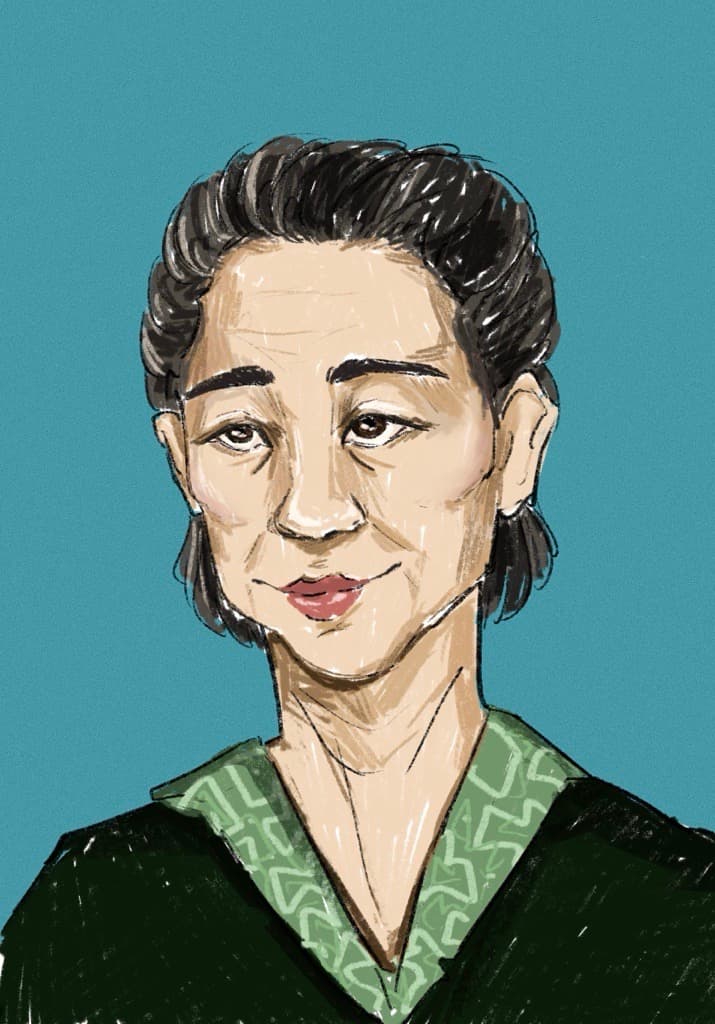
Beijing, a gray morning in the late 1990s. In a narrow office at the Institute of Semiconductors, cluttered with reprints and boxes containing thin, shiny wafers, a small woman receives us without ceremony. She speaks softly, with the precision of someone who has spent her life measuring the purity of things.
—Do you remember the first battle of your life, when you were a child in Putian?
Yes, and it took place not in a laboratory but around the family table in Putian, Fujian. There, custom dictated that a girl close her books after primary school and await a husband. I refused. I argued, insisted, stood my ground—which for a little girl from that coastal province was not easy. In the end, they let me continue, and I made sure to stay first in my class, not out of pride, but because it was the one argument they could not take from me. I believe all my later work stems from that childhood act: refusing to accept that a door closes simply because others have decided it for you.
Staying first in my class was the one argument they could not take from me.
—In 1957, you left a well-paid job in the United States to return. How does one make such a decision?
I had earned my doctorate in solid-state physics at the University of Pennsylvania in 1955, and I was working at an American electronics company, well paid, in a country that already had everything needed for research. But I looked at China and saw a country that, in terms of semiconductors, was starting almost from nothing. The question was not where one lives better; it was where one is most needed. In 1957, I returned. People sometimes asked if I regretted the comfort I left behind. No. Comfort does not build an industry, and there was no one else to fill the position I was going to take.
The question was not where one lives better, but where one is most needed.
—Tell us concretely: how does one bring forth a country's first silicon monocrystal?
You grow it, literally. In a pulling furnace, you melt the material, then dip a seed and pull it up very slowly while rotating: the crystal forms drop by drop, all atoms aligning into a single regular lattice—that is a monocrystal. The difficulty is not the heat; it is cleanliness. The slightest impurity ruins the lattice. Between 1957 and 1958, with my colleagues, we obtained China's first monocrystalline silicon, and soon after the first gallium arsenide crystal. It sounds abstract, but without these ultra-pure wafers, there are no transistors, no computers, nothing that lights up laboratories today. We were building the invisible foundation for everything else.
The difficulty is not the heat; it is cleanliness: the slightest impurity ruins the lattice.
—Why did you also insist on gallium arsenide, in addition to silicon?
Because silicon is robust and reliable, but slow for certain tasks. Gallium arsenide is faster at high frequencies, and it can emit light—diodes, lasers, solar cells depend on it. A country that wants to be modern cannot make do with a single material; it needs the full palette. The process remains the same spirit: purify obsessively, then pull the crystal from the melt. But GaAs is capricious; arsenic escapes, the balance is more fragile. That is precisely why it had to be mastered in China, so as not to depend forever on what others were willing to sell us.
—You conducted this research during a politically very hard period. How did you work then?
One must remember the context. In 1956, the country launched its 'March Toward Science,' a grand twelve-year plan to catch up, and in 1960 the Institute of Semiconductors was founded, where I spent most of my life. That was the momentum. Then came the Cultural Revolution in 1966, and for scientists those were very difficult years, when a researcher's worth was no longer measured by results. We lived modestly, in housing assigned near the institute, with rations sometimes. One could not always choose one's conditions; one chose to keep growing crystals despite everything. Matter, after all, does not care about politics: it demands the same rigor no matter the climate outside.
Matter does not care about politics: it demands the same rigor no matter the climate outside.
—What did the slogan of the 'Four Modernizations,' which was everywhere, mean to you?
The Four Modernizations—agriculture, industry, defense, science and technology—were the official framework in which our work took on its full meaning. A silicon crystal is not a laboratory curiosity: it is the brick of microelectronics, and thus of both modern industry and defense. When I was elected academician of the Chinese Academy of Sciences in 1980, I did not experience it as a personal honor, but as a sign that this material foundation was finally recognized as essential. People once believed that modernity lay in large visible machines. It actually lies first in these tiny wafers that almost no one sees.
People believed modernity lay in large machines; it actually lies first in wafers that no one sees.
—In 1987, you grew crystals in space. Where did this unique idea come from?
On the ground, gravity always slightly disturbs growth: the molten material moves, mixes, and the crystal retains defects. In microgravity, these movements calm down, and one can hope for a more perfect lattice. In 1987, we therefore grew gallium arsenide crystals aboard a Chinese recoverable satellite—a craft designed to return to Earth with its samples. It was one of the very first times this type of semiconductor was cultivated in weightlessness. Directing an experiment that you cannot monitor with your own hands, whose furnace flies hundreds of kilometers above you, is a lesson in humility: you prepare everything meticulously, then trust the protocol and wait for its return.
—How did you feel when the satellite came back down with its samples?
Impatience, above all, and a particular kind of tension. All my life, I could open the pulling furnace, extract the crystal, measure it immediately. Now it had traveled in space, and I had to wait for someone to bring me that little box returned from the sky. What we sought was not the space feat for its own sake—it was to understand how gravity damages our materials, so we could better manufacture them on the ground. Weightlessness was not a destination, but an exceptional laboratory. Seeing a GaAs crystal formed far from all gravity return intact, after decades spent patiently pulling them from a crucible, was like closing a very long loop.
Weightlessness was not a destination, but an exceptional laboratory.
—A significant part of your work was training other researchers. How important was that?
It was central, perhaps the most enduring part. A crystal ends up in a machine; a well-trained student continues to grow others long after you. At the Institute of Semiconductors, my afternoons were spent around the furnaces and measuring instruments, monitoring material purity with the younger ones, showing them that microelectronics tolerates no approximation. I never had children; I never married. I devoted that time to research and to those who would carry it forward. Building a semiconductor industry is not about signing a discovery: it is about passing on know-how until it no longer depends on a single person.
A crystal ends up in a machine; a well-trained student grows others long after you.
—Looking back, how do you judge this life entirely devoted to the laboratory?
Without regret, but without naivety either. I made a choice in 1957, returning from America: to serve where the need was greatest, and that choice consumed everything else. My evenings in Beijing were spent reading journals, preparing the next day's experiments, writing my notes. I am sometimes called the 'mother of semiconductor materials' of my country—a strange title for someone who had no children, but I think I understand: my children are those crystals and those researchers. If asked what I built, I answer: a foundation. Discreet, invisible, but without which nothing that follows would stand.
My children are those crystals and those researchers.
This imaginary interview was generated by artificial intelligence from sources documented in Lin Lanying's profile. It dramatises what the figure might have said based on what we know about them, but does not constitute attested historical testimony. For primary sources and factual documentation, refer to the full profile.