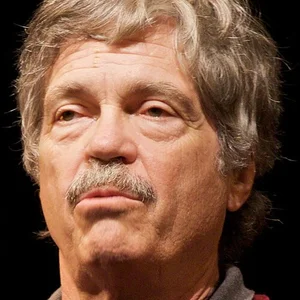

A pioneering American computer scientist in object-oriented programming, Alan Kay designed the Smalltalk language and envisioned the concept of a portable personal computer (the Dynabook) in the 1970s. His work at the Xerox PARC laboratories transformed modern computing.
Alan Kay(1940 — ?)
Alan Kay
États-Unis
9 min read
Frequently asked questions
Famous Quotes
« The best way to predict the future is to invent it.»
« Point of view is worth 80 IQ points.»
Key Facts
- Born in 1940 in Springfield, Massachusetts
- Joined Xerox PARC in 1970, the iconic research center at the heart of the computing revolution
- Designed the Smalltalk language (1972), the first fully realized object-oriented programming language
- Proposed the concept of the Dynabook (1972), a forerunner of tablets and laptops
- Received the Turing Award in 2003 for his contributions to object-oriented programming
Works & Achievements
A vision of a flat, portable personal computer accessible to children — the theoretical ancestor of the laptop and tablet. Formally described in a 1972 memo, this concept shaped decades of computing development.
The first fully object-oriented language, in which every program is made up of objects that communicate by passing messages. Smalltalk introduced concepts — inheritance, encapsulation, polymorphism — that still underpin nearly every modern language today (Java, Python, C++, Swift).
A landmark article published in IEEE Computer describing how the computer can become a creative meta-medium for everyone. This text distills Kay's philosophy of computing as a tool for expression and learning.
The world's first computer with a graphical interface and mouse, developed collaboratively at PARC. The Alto was the first partial realization of the Dynabook and directly inspired Apple's Macintosh.
An open-source, cross-platform implementation of Smalltalk co-developed by Kay to spread his educational ideas into schools. Squeak gave rise to Etoys, an educational environment used in dozens of countries.
An autobiographical and historical text published in ACM SIGPLAN Notices, tracing the origins of Smalltalk and the ideas behind object-oriented programming. An essential primary source for understanding the history of modern computing.
Anecdotes
In 1968, when he was still just a young researcher, Alan Kay sketched on a sheet of paper a flat, portable device the size of a notebook that any child could use to learn and create. He called it the Dynabook. No technology of the time could actually build it, but that sketch would go on to inspire, decades later, the laptops and touchscreen tablets we know today.
When Steve Jobs visited Xerox PARC in December 1979, he was dazzled by the graphical interface with windows and icons developed by Kay and his colleagues. Kay would later remark, not without irony, that Jobs had “only stolen the wrong parts”: he had grasped the visual look but had not understood the deeper ideas about how computers could transform human learning.
Alan Kay invented the very term ‘object-oriented programming’ and designed Smalltalk, a language in which everything — absolutely everything — is an ‘object’ that sends and receives ‘messages’. He had drawn inspiration from biological cells, which communicate through chemical signals without needing to know the inner workings of other cells — a metaphor he found more fitting than that of a machine.
Passionate about education, Kay was deeply influenced by the work of psychologist Jean Piaget and mathematician Seymour Papert, who showed that children learn better by building than by listening. Throughout his entire career, he sought to create computing tools that would give children the power to think, explore, and invent — not merely to consume.
In 2003, Alan Kay received the Turing Award, the highest honor in computer science, for his foundational work on object-oriented programming and the concept of the personal computer. In his acceptance speech, he delivered a line that has since become famous in the scientific community: “The best way to predict the future is to invent it.”
Primary Sources
The Dynabook is a personal computer for children of all ages. It is a dynamic medium which can be used to simulate, and thereby explain and explore, the structures and processes of the real and imaginary worlds. It is small enough to be always with its owner.
The Learning Research Group at Xerox PARC has been working on a vision of a personal computer as a medium for creative thought... Smalltalk is an attempt to organize a computer system so that it can be understood and used by a wide range of people.
Most ideas come from previous ideas... The Smalltalk design—and that of several other systems—grew out of a long line of thought about programming and computation that began in the late 1950s and early 1960s.
Software is 'soft' precisely because it lacks the physical constraints that make hardware design so difficult and so expensive to change. A program can grow and change over time without the costs associated with making physical objects.
The most important single aspect of software development is to be clear about what you are trying to build... We are still using the computer mostly as a fast calculator and data handler, not yet as a true metamedium that can simulate anything.
Key Places
Birthplace of Alan Kay, born on May 17, 1940. It is in this postwar American context, marked by economic prosperity and technological optimism, that his passion for science and music took root.
Kay earned his Ph.D. in computer science here in 1969. It was there that he discovered Ivan Sutherland's work on graphical interfaces (Sketchpad) and began developing the ideas that would lead to Smalltalk.
A research laboratory founded by Xerox in 1970, where Kay spent his most productive years (1970–1983). This is where Smalltalk, the graphical user interface, the consumer mouse, and the concept of the Dynabook were born — an unprecedented concentration of inventions in the history of computing.
Kay joined Apple in 1984, drawn by Steve Jobs's ambition to bring graphical interfaces to the mainstream. There he continued his research on education and contributed to the development of creative tools for children.
Kay led research at Disney from 1996 to 2001, working on interactive and educational experiences that blended technology with storytelling. This period reflects his enduring interest in learning through experience and play.
Typical Objects
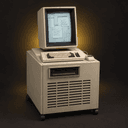
The world's first computer equipped with a graphical interface, a mouse, and bitmap display, developed at PARC from 1973. Kay contributed directly to it and viewed it as a prototype of the Dynabook while awaiting the miniaturization it required.
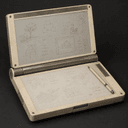
An object envisioned by Kay in 1968 and described as a flat, portable notebook capable of simulating any medium — book, typewriter, musical instrument. No technology of the era could make it real, but this tablet concept guided his entire thinking.
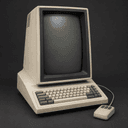
An interactive development environment created by Kay at PARC in which the entire system is made up of objects modifiable in real time. Students and researchers could explore and reprogram the environment itself, making learning immediate and alive.
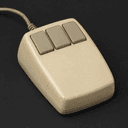
An improved pointing device developed and used at PARC, derived from Engelbart's prototype. Kay and his colleagues integrated it as a central tool of the graphical interface, before Apple popularized the concept with the Macintosh.
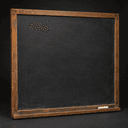
A ubiquitous tool at PARC meetings and seminars where Kay presented his ideas. A committed educator, he constantly relied on diagrams and live demonstrations to persuade his colleagues and convey his vision.
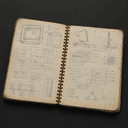
Xerox PARC researchers recorded their ideas, sketches, and experiments in notebooks. Kay used them to sketch the earliest representations of the Dynabook and the diagrams of Smalltalk's object architecture.
School Curriculum
Vocabulary & Tags
Key Vocabulary
Tags
Daily Life
Morning
In the 1970s at PARC, Alan Kay arrives early at the lab, often before 9 a.m. He starts with a round of the teams, discussing with researchers what they accomplished the day before. PARC operates like a university campus: hours are flexible, and the priority is ideas, not attendance.
Afternoon
Afternoons are devoted to experiments on Alto terminals and Smalltalk programming sessions, often with children invited to test the interfaces. Kay regularly organizes demonstrations and takes part in seminars where researchers challenge each other's assumptions in an atmosphere that is both rigorous and creative.
Evening
Kay is also a musician — he plays guitar and is deeply interested in music theory, which he connects to his thinking about creativity and complex systems. In the evenings he reads voraciously: philosophy, educational psychology (Piaget, Bruner), biology, and science fiction that fuels his vision of the future.
Food
In the Silicon Valley of the 1970s, PARC engineers often eat in the lab cafeteria or at the many Asian and Californian restaurants around Palo Alto. Kay, a frequent traveler to conferences in Europe and Japan, adapts easily to local cuisines.
Clothing
Kay favors the casual dress typical of Silicon Valley researchers: jeans, a plaid shirt or polo, no tie or jacket. This informality reflects PARC's anti-hierarchical culture, where a junior researcher can contradict a director if their argument is stronger.
Housing
Kay lives in the residential suburbs of Palo Alto or the surrounding area, in the neighborhoods of single-family homes with gardens that define Silicon Valley. The drive to PARC is short — just a few minutes — and the lab itself resembles a quiet, spacious campus, far from the bustle of a big city.
Historical Timeline
Period Vocabulary
Liens externes & ressources
Références
Œuvres
Concept du Dynabook
1968-1972
Langage de programmation Smalltalk
1972-1983
Personal Dynamic Media (avec Adele Goldberg)
1977
Contribution au Xerox Alto
1973
Squeak (environnement Smalltalk libre)
1995
The Early History of Smalltalk
1993