Imaginary interview with Naré Maghann Konaté
by Charactorium · Naré Maghann Konaté (1135 — 1212) · Politics · Military · Culture · 6 min read
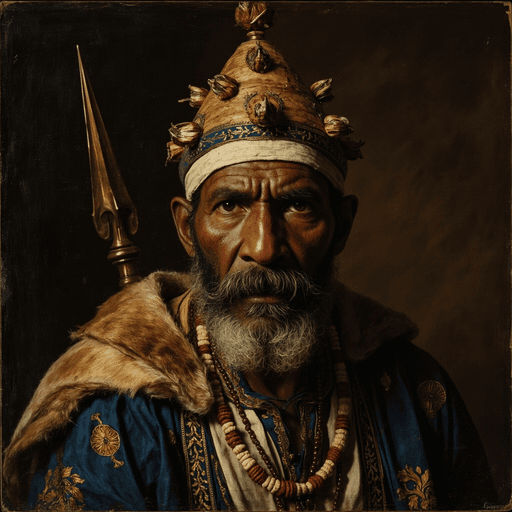
We are in Dakajalan, at the heart of the Mandinka country, in the great enclosure of round huts where the evening tam-tams resound. Mansa Naré Maghann Konaté receives us seated on a leopard skin, a calabash of scented water within reach, his griot silent at his side. He agrees to speak with us about the signs of destiny, a son who could not walk, and a lineage he dreams will be imperishable.
—How would you describe the kingdom you inherited and the world around it?
I received a small throne in the upper Niger valley, where the savanna bends to the river and rises again toward the mountains. My duty was to make the Keita lineage an authority that no faama would think to challenge, here in Dakajalan. I have not forgotten what the elders tell: long before my birth, the great city of Koumbi Saleh fell, and the old empire of Ghana cracked like a calabash thrown to the ground. From that crack were born kingdoms like mine. A wise king knows he holds his power not from his spear alone, but from custom, the ancestors, and the given word. I kept the gold routes open and the neighboring chiefs bound by tribute. That is never quite enough: to the east, the Sosso is awakening.
The old empire of Ghana cracked like a calabash thrown to the ground; from that crack were born kingdoms like mine.
—What threat loomed over the Mandinka kingdoms in your time?
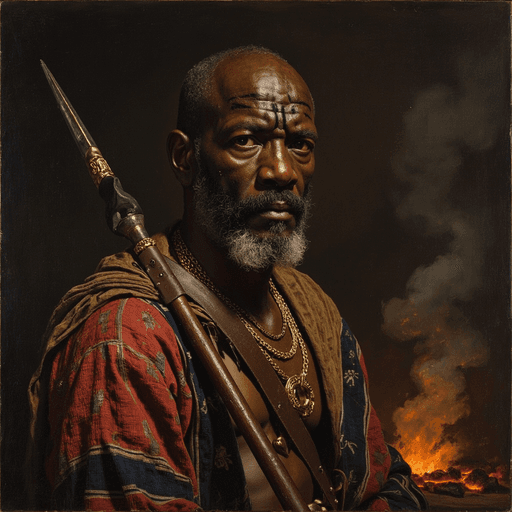
The Sosso. I am told that Soumaoro Kanté subjugates the neighboring kingdoms one after another, that he humiliates the chiefs and raises armies as one raises dust in the harmattan. A mansa must watch as the hunter watches at night: I carry the war chief's spear not for glory, but because protecting my people is the first duty the ancestors bequeathed to me. I know I may not see the outcome of this quarrel. But I build for those to come: a solid lineage, loyal faamas, a memory that the griot keeps intact. A kingdom is not defended only by armed men; it is defended by legitimacy, that invisible thing that makes a people obey without being forced.
—Do you remember the day two hunters appeared at your court?
How could I forget? Two unknown donso, the dust of long roads on their sandals, requested an audience. These are not ordinary men: the initiated hunter walks between our world and that of invisible forces, and when he speaks, a wise king listens. They brought me a word that troubled the whole assembly: a woman of unappealing appearance, whom any man would be tempted to reject, would give birth to a conqueror whose glory would cover all the Mandinka country. I could have laughed, as some of my advisors did. But who am I to mock the signs that destiny places on my path? I received these hunters with all honors, I offered them kola nuts, and I kept their words in my heart as one keeps an ember under the ashes.
Who am I to mock the signs that destiny places on my path?
—Why did you marry Sogolon Condé despite the mockery of your court?
When the hunters led before me Sogolon Condé, from the distant kingdom of Do, the court did not hide its laughter: a woman with a hunched back, they said, unworthy of a mansa's bed. I hesitated, I admit — a king is not made of stone. But the prophecy and my word weighed heavier than the jeers. A man who breaks his word before the ancestors is nothing, even if he is king. So I married her, not for what the eyes saw, but for what the signs foretold. Faith must sometimes walk where reason retreats. I already had other wives, including Sassouma Bérété, whose pride never forgave this union; but I knew that from Sogolon's womb something would rise that the Mandinka country would never forget.
Faith must sometimes walk where reason retreats.
—How did you feel watching your son Sundiata grow up unable to walk?
Pain, yes, but never doubt. My son reached the age when other children chase goats, and he remained on the ground, his legs refusing to carry him. Sassouma Bérété triumphed openly, sure that the prophecy was nothing but wind and that her own son, Dankaran Touman, would reign alone. The court murmured. But I remembered the two hunters and the word of Do. The seed that is slow to sprout is not a dead seed; it waits for its hour and its rain. I looked at that seated boy and I saw, not the cripple they laughed at, but the sleeping lion. A father who believes in his son gives him a strength that no leg can equal. I continued to hope against all, for signs do not lie to those who know how to wait.
The seed that is slow to sprout is not a dead seed; it waits for its hour and its rain.
—Why did you pass the royal bow to Sundiata rather than to your eldest son?
Before my breath left me, I wanted to accomplish the gesture that counts more than a thousand words. I summoned Sundiata, who could not yet walk, and I gave him the Mandinka royal bow, that weapon that the Keita pass from father to son as an insignia of power. In the eyes of custom, the eldest should have had it; but custom itself bows before destiny when a king designates it. By placing this bow in the hands of my disabled child, I named him legitimate heir, whatever the court and Sassouma might think. It was to seal the prophecy in the order of blood. A bow is not just bent wood and string: it is the promise that the hand that holds it will one day raise up an entire people. I died in peace, for I had stretched that bow toward the future.
Custom itself bows before destiny when a king designates it.
—What place does the griot hold with a king like you?
The jeli is the mansa's shadow and his living memory. Each morning, even before the audiences, my griot recites the praises of my ancestors, reminds me who comes to my court and what the villages whisper. We do not write, we people of Manding: our history lives in the mouth of the jeli, passed from generation to generation without a single word being lost. When he makes his kora of twenty-one strings resound, these are not mere songs — it is the blood of the lineage speaking. A king without a griot is a man without a past, and a man without a past has no right to the future. That is why I wanted this bond between the mansa and his jeli to be held sacred: without him, my memory would die with me.
A king without a griot is a man without a past, and a man without a past has no right to the future.
—What does it mean to you to have attached a griot to Sundiata's person?
I wanted my son never to be alone facing his destiny. I had the young Balla Fasséké attached to his person, so that he would become his griot for life, his voice and his counsel. Thus, wherever the prophecy might lead him — and I foresaw exile, trials, wars — his memory and that of our ancestors would accompany him. In the evening, around the great fire, when the tam-tams fall silent and the balafon begins its song, it is the griot who reminds the living where they come from. By binding Balla Fasséké to Sundiata, I bound my son to all the lineage that had preceded him. A conqueror without memory is merely a plunderer; a conqueror who carries within him the voice of the ancestors becomes a founder. That is what I wished for him.
A conqueror without memory is merely a plunderer.
—What does an ordinary day in the life of a mansa look like?
I rise before the sun for my ablutions and prayer — I bow before the One while honoring the spirits of our fathers, for in Manding the two paths do not contradict each other. Then comes my griot, with news and praises. The afternoon belongs to audiences: village chiefs, merchants from the Saharan roads, emissaries and warriors present themselves in my large banco hut, and I arbitrate their quarrels according to custom. I decide, I weigh, and I distribute gifts and favors, for a king who gives is a king who is followed. In the evening, everyone shares the tô, the millet porridge, in separate circles according to rank, and we listen to the griot until deep night. To govern is not only to command: it is to listen, to feed, and to let oneself be seen as just.
—What would you say about the role of hospitality in the exercise of your power?
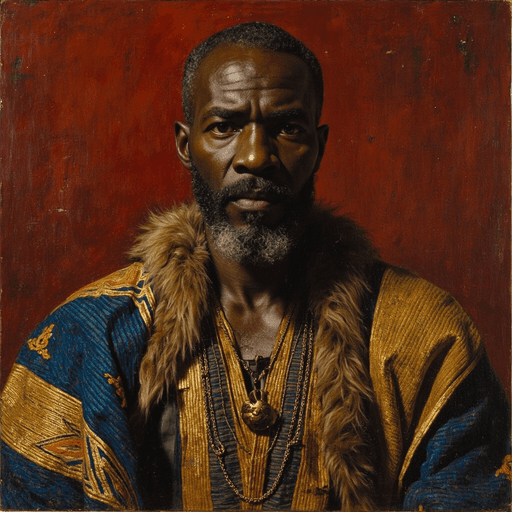
Hospitality is not politeness; it is the invisible cement of my authority. When a distinguished guest crosses the earthen wall of my enclosure, I have the royal calabash filled with scented water or millet beer presented to him, and we share kola nuts, that bitter seed that seals alliances between chiefs. To offer is already to reign. My gold bracelets and the cowries sewn onto my cap declare my rank, yes, but it is by giving, not by keeping, that a mansa binds men to him. A stingy king soon becomes a king alone. Each gift, each offered meal, each shared kola weaves a bond that neither war nor death easily undoes. Thus I have held my throne: not by fear alone, but by the thousand threads of generosity.
To offer is already to reign; a stingy king soon becomes a king alone.
This imaginary interview was generated by artificial intelligence from sources documented in Naré Maghann Konaté's profile. It dramatises what the figure might have said based on what we know about them, but does not constitute attested historical testimony. For primary sources and factual documentation, refer to the full profile.