Imaginary interview with Uthman ibn Affan
by Charactorium · Uthman ibn Affan (574 — 656) · Politics · 6 min read
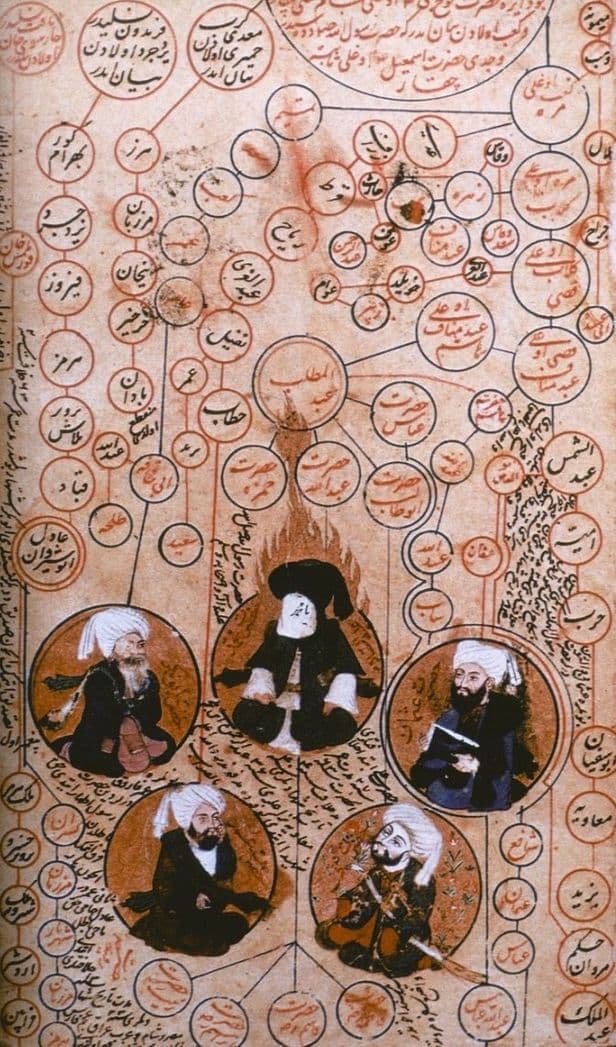
Medina, under the declining sun of the month of Dhu al-Hijja. The third caliph receives us in the courtyard of his stone dwelling, not far from the Prophet's Mosque, a copy of the Qur'an placed beside him on a leather cushion. His voice is soft, almost faint, but his hands retain the firmness of the merchant who weighed gold as he now weighs words.
—You are called Dhu al-Nurayn, he of the two lights. What does this nickname tell of your life?
Praise be to God who has granted me an honor that no one else has received. I married Ruqayya, daughter of the Messenger of God, and when death took her from me, he gave me her sister Umm Kulthum. Two daughters of the Prophet under my roof, one after the other: that is why the believers call me Dhu al-Nurayn, he of the two lights. I take no vanity from it, for it is not my merit but a sign of the trust he placed in me. With Ruqayya, I took the path of exile to Axum, in the land of Abyssinia, when our people fled the hatred of the Quraysh. A merchant turned fugitive for the love of a single word: there is no god but God. These two lights still illuminate my vigils, when I recite in the silence.
Two daughters of the Prophet under my roof: that is why I am called he of the two lights.
—Do you remember that first emigration, when you had to leave Mecca for Abyssinia?
How could I forget it? I was of the tribe of the Quraysh, guardians of the Kaaba, and now my own kin hunted me like a renegade. Persecutions fell upon the weak, upon the converted slaves whom I ransomed with my purse to set them free. So, around the sixth year of the revelation, I took Ruqayya by the hand and we crossed the sea to the kingdom of the Negus, at Axum. This Christian king, a man of justice under the cross, welcomed us and refused to hand us over. Strange thing to find refuge among the People of the Book when your own people drive you out. I learned there that faith has no homeland, only the heart of righteous men. We returned later, but I keep from that land the taste of a hospitality that God will reward.
I learned there that faith has no homeland, only the heart of righteous men.
—Before the caliphate, your generosity was already praised. How did you come to finance the army of Tabuk?
God had given me trade and fortune, and I knew that wealth hoarded rots like grain unsown. Came the year 630 and the expedition to Tabuk, which was called the army of distress, for the heat was oppressive and provisions scarce. The Messenger of God called: 'Whoever finances the army of the hour of distress will have Paradise.' I rose and said: I will take care of it. I brought nine hundred saddled camels and one hundred horses, with gold and provisions, enough to equip a third of the army. The Prophet rejoiced and prayed for me. It was not prodigality, but the only trade that knows no loss: giving to God what He first lent you.
Wealth hoarded rots like grain unsown.
—You speak of trade as a school. What did it teach the caliph you became?
The merchant of Mecca learns two things: to weigh justly and to wait for his hour. I had built my fortune on the caravans of the Quraysh, in my long white linen tunic, between the stalls and the wells. When God made me caliph through the shura of the six companions, in the year 644, I did not cease to be that merchant; simply, my goods became the provinces of the empire and the tax of the believers. I once ransomed slaves to set them free; I then strove to make governors just and roads safe. I was reproached for my wealth, but I lived on barley bread and dates, drinking camel's milk as in the desert. Fortune is not a sin; it is a trust for which one will give account on the Day when no caravan can redeem the soul.
My goods became the provinces of the empire and the tax of the believers.
—Your name remains attached to the writing down of the Qur'an. What decided you to undertake this?
The fear of discord, nothing else. The empire stretched from Persia to Ifriqiya, and the new believers recited the Book each in his own dialect, so that in the garrisons they began to quarrel over the very word of God. That I could not bear. So I entrusted to Zayd ibn Thabit, who had already served as scribe to the Messenger of God, the task of gathering the scattered leaves, collating them on parchment with reed pens, and establishing a single mushaf. Then I ordered that authentic copies be sent to the great cities, and that the other versions be burned. I was blamed for it, as if I were destroying the word; but I was only destroying confusion. One single text, so that the ummah would never divide over what founds it.
I was not destroying the word; I was only burning confusion.
—Were you not afraid of being accused of tampering with a sacred text?
Indeed, I feared it, and that fear was my prayer every night. Who am I to lay hands on revelation? So I changed not a single letter: I only had gathered and copied what reliable memories and attested leaves had preserved. Zayd ibn Thabit did not work from memory alone; he required witnesses for every verse. The mushaf we established neither adds nor subtracts: it fixes. Consider that even today, from one end of the land of believers to the other, this same text is recited, without variation. If my name survives my remains, let it be for this service. For an empire crumbles, a fleet rots, a caliph is buried; but the word of God, once fixed on parchment, knows neither wear nor oblivion.
An empire crumbles, a fleet rots, a caliph is buried; but the word fixed knows no oblivion.
—Under your reign, Islam took to the sea for the first time. How did this fleet come into being?
The sea frightened the sons of the desert, and my predecessor Umar had always refused to risk the believers upon it. But my governor of Syria, Mu'awiya ibn Abi Sufyan, whom I had appointed to Damascus, pressed me relentlessly: Byzantium harasses us from its ships, he said, and one cannot defend a coast by staying on the sand. After much hesitation, I authorized him to build a fleet. Galleys with oars were constructed in the ports of Syria and Egypt, and lo, Arabs of the caravan became people of the sail. They took Cyprus, then faced the emperor himself at the Battle of the Masts, where our ships grappled with theirs as one ties two caravans. The cross retreated on the waves. It was a break; I believe God wanted to show that His religion has no shore to stop it.
Arabs of the caravan became people of the sail, and the cross retreated on the waves.
—This opening toward the sea and toward the Caucasus — was it for you a glory or a burden?
Both, for every conquest is a weight as much as a triumph. In the year 652, my armies pushed to Armenia and toward the Caucasus, while Abdallah ibn Saad led the horsemen into Ifriqiya, at the gates of ancient Carthage. The empire grew faster than I could appoint governors worthy of trust. And the larger the house, the more servants it needs, and the easier it is for an unfaithful steward to slip among them. Each conquered province brought me a tax and a worry. I reorganized the administration, appointed emirs, had canals dug and buildings erected even in distant cities. But I knew: he who extends his walls must keep watch at night. The glory of Islam on sea and land was real; the burden of the jealous and the ambitious was equally so.
Each conquered province brought me a tax and a worry.
—It is said that rebels besieged your dwelling for forty days. What did you feel behind those walls?
A strange peace, mixed with sorrow. Insurgents from Egypt and Iraq surrounded my house, here in Medina, accusing me of a thousand wrongs I had not committed. My loyal followers wanted to draw the sword of the caliph and fight; I opened my door a crack and ordered them to return to their homes. How could I allow the blood of a believer to be shed to preserve my old remains? I was, it is said, one of the ten to whom Paradise was promised during his lifetime; why should I fear death? The fitna, that discord which tears the ummah apart — that is what I dreaded, not death. So I sat down, took the Book I had had copied, and recited. Since I had to die, let it be with my eyes on the word of God, not with sword in hand against my brothers.
How could I allow the blood of a believer to be shed to preserve my old remains?
—Many would have advised you to flee or defend yourself. Why this absolute refusal to fight?
Because I knew the price of first blood. The first sword drawn between believers is never the last; it opens a wound that generations do not close. I sensed it: my death would not extinguish the fire, but if I armed my partisans, I would pour oil on it. I was once told an ill omen, the day when the signet ring of the Prophet, which I had received after Abu Bakr and Umar, slipped from my finger into a well in Medina and no one found it. I saw in it the sign that something sealed was coming undone. So I chose to fall alone rather than drag the ummah into the fitna. The cup of civil war, my successors would drink it soon enough; I did not wish to hand it to them with my own hand. Better a caliph slaughtered than a community torn apart.
The first sword drawn between believers is never the last; it opens a wound that generations do not close.
This imaginary interview was generated by artificial intelligence from sources documented in Uthman ibn Affan's profile. It dramatises what the figure might have said based on what we know about them, but does not constitute attested historical testimony. For primary sources and factual documentation, refer to the full profile.