Imaginary interview with Roland Topor
by Charactorium · Roland Topor · Visual Arts · Literature · Performing Arts · 6 min read

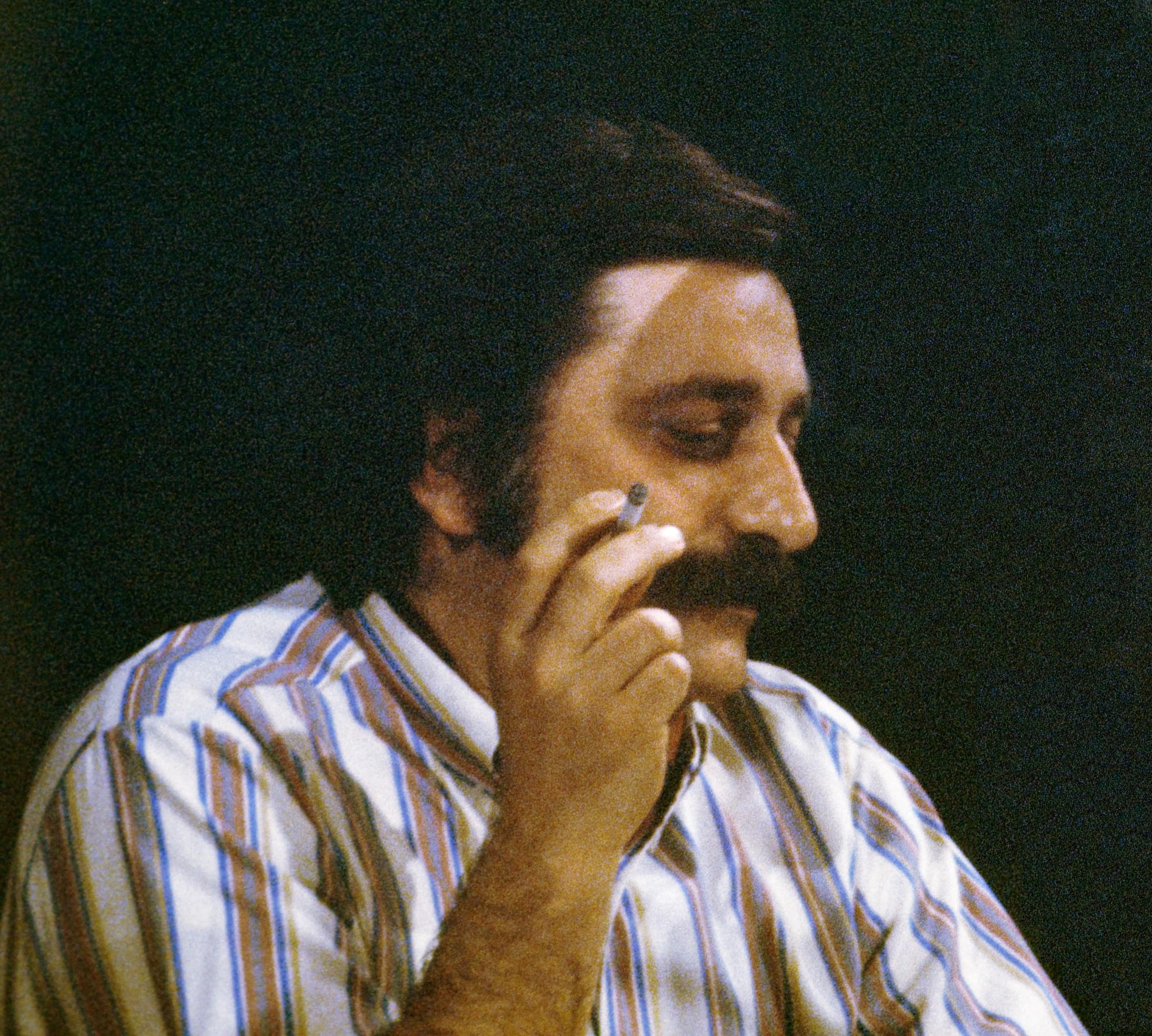
Late 1970s, somewhere in a Parisian apartment cluttered with papers, bottles of India ink, and barely started projects. Roland Topor receives us with a pen still in hand, a mischievous eye behind his beard, and a laugh ready to burst out like a knife. Around us, black humor drawings dry, pinned to the wall.
—How was that famous Panic Movement born, in 1962, with Jodorowsky and Arrabal?
In 1962, we were three crackpots convinced that art was taking itself far too tragically seriously. With Alejandro Jodorowsky and Fernando Arrabal, we decided to found something that would definitely not be a school, nor a dogma, nor a clique. We took the god Pan, the old Greek goat, as a patron — hence Panic, not fear but joyful panic, the kind that makes everything overflow at once. It was an art of confusion, terror, and euphoria mixed together, a way to set fire to the feet of all those who wanted to pigeonhole us. The manifesto refused any fixed definition: that was our definition. We laughed a lot, and laughter, believe me, is more subversive than any program.
Panic, not fear but joyful panic, the kind that makes everything overflow at once.
—Why insist that Panic should never become a true artistic school?
Because as soon as a movement gives itself rules, it produces teachers, and teachers produce boredom. Surrealism, which I admire, ended up excommunicating its own members like a little Church with its pope. We didn't want that. Panic had to remain a primed bomb, never defused by doctrine. I've always thought that an artist who explains too well what he does is already dead, or worse, a minister. We preferred the fertile disorder of the Parisian avant-garde of the post-war period, where forms were invented for the pleasure of breaking the previous ones. Coherence is good for accountants. I wanted to wake up the spectator, not tuck him into a well-made system.
An artist who explains too well what he does is already dead, or worse, a minister.
—What exactly does your novel The Chimera Tenant, published in 1964, tell?
It's the story of a man, Trelkovsky, who rents an apartment in Paris and gradually begins to believe he is inhabited by the previous tenant, a woman who threw herself out the window. He slides — slowly, inexorably — into a madness from which he will not return. I wrote The Chimera Tenant in 1964, on my typewriter, in one of those apartments where my drawings and books piled up. Parisian buildings are machines of anguish: those hallways, those neighbors who listen through the walls, those toilets on the landing. I invented nothing, I simply listened to the fear seeping from the walls. One loses one's mind, in my work, as one loses one's keys: by distraction, and never finding them again.
Parisian buildings are machines of anguish.
—Roman Polanski adapted this novel to film in 1976. How did you experience that adaptation?
Polanski made The Tenant into a film in 1976, and he pushed the audacity so far as to play Trelkovsky himself. Seeing another take hold of your nightmare is strange: it's like lending your own apartment to a stranger and discovering that he sleeps there better than you. He understood the essential — that horror, in my work, is not in the blood, but in the slippage, in that moment when you no longer know if you are still yourself. Trelkovsky realizes he has become someone else, and that is the true vertigo: not the monster at the end of the hall, but the mirror. Polanski, who knows persecution, filmed it without an ounce of fat. I am grateful to him, even if a father never quite likes seeing his child grow up away from him.
Lending your own nightmare to a stranger and discovering that he sleeps there better than you.
—How did you come up with the idea for Téléchat, that children's TV news show populated with puppets?
In 1983, with Henri Xhonneux, we had this outlandish idea: what if the TV news, that dreary adult ritual, were presented by a cat named Groucha and an ostrich named Lola? We created a world where everyday objects speak, where a sponge or an alarm clock have their say on events. The puppets bore my style, my taste for the strange and grotesque. I deeply believe that you should not lie to children by serving them saccharine: they love what is bizarre, a little unsettling, poetic. Téléchat was a parody, of course, but a tender one — a way to make the adult world as absurd as it really is, seen from a cat's height.
You should not lie to children by serving them saccharine: they love what is a little unsettling.

—You often subverted the puppet. What attracts you so much to that object?
The puppet has this wonderful quality: it is both dead and alive, an object that you make breathe. With Téléchat, and later in cinema with Henri Xhonneux for Marquis, I loved giving voice to figures of cloth and foam. A puppet speaks truths that an actor of flesh and blood would not dare: it has the freedom of the jester, that insolence of one who has nothing to lose since he is not even fully alive. And then there is the artisan's pleasure, almost childlike, of cobbling together a being from nothing, like assembling a creature in a workshop. The grotesque is born there, in that gap between the ridiculous puppet and the sudden humanity that pierces through its fixed gaze.
A puppet speaks truths that an actor of flesh and blood would not dare.
—Draftsman, novelist, filmmaker, man of the theater: how do you move from one profession to another?
I don't move from one to another: I make no difference between them. In the morning, I am at my table with my pen and India ink, blackening sheets with swarming little details; in the afternoon, I receive a publisher, I sketch an opera set, I discuss a film; in the evening, I remake the world in a café. All of it is the same gesture: waking people up. Professions are boxes invented by those who want to classify artists like pinned butterflies. I am a voracious jack-of-all-trades, what is nicely called a polymath, and I claim it. A drawing, a novel, a song — they are different traps to catch the same beast: unease beneath laughter.
Professions are boxes invented by those who want to classify artists like pinned butterflies.
—People imagine you as a night owl and partygoer. What does a workday look like for you?
People think I am only a provocateur, a drinker, and a loudmouth — that's true in the evening, when I haunt Parisian cafés and laugh too loudly around a well-laden table and good wine. But they don't know that in the morning, bent over my India ink, I work with the discipline of a monk copyist. The fine line requires patience; black humor is built detail by detail, meticulously, like a nightmare clockwork. There is no contradiction: it is because I furiously love life, the table, friends, that I can look death in the face in my drawings. The darkness of my art is the tribute I pay to my appetite for the world. A well-fed pessimist always makes better monsters than a bitter hungry one.
It is because I furiously love life that I can look death in the face in my drawings.
—You were born in Paris in 1938. What do you remember of your childhood under the Occupation?
I was born in Paris in 1938, into a Jewish family from Poland. Then came the war, and with it the need to disappear: we had to flee and hide in Savoie to escape the anti-Semitic roundups. A hidden child learns very early a terrible and precious thing — that the adult world, with its uniforms and laws, can become a perfectly absurd killing machine. That absurdity, I never left it behind. When you have seen, as a little one, that barbarity can wear a tie and sign proper papers, you never again fully believe in the seriousness of grown-ups. My black humor is not a draftsman's whim: it is a way to survive what you understood too young.
When you have seen, as a little one, that barbarity can wear a tie, you never again believe in the seriousness of grown-ups.
—Your beginnings were in Hara-Kiri, that magazine that called itself stupid and mean. What did you find there?
From 1961, I published my black humor drawings in Hara-Kiri, that satirical magazine that proudly proclaimed itself bête et méchant (stupid and mean). It was a refuge and a playground: nowhere else could we laugh in such bad taste, with so much freedom, at death, disease, ordinary cruelty. Press cartoons there were a weapon, a permanent thumbing of the nose at propriety. For me, who had grown up in fear, there was something liberating in deliberately provoking, in sullying society's pious images. We were accused of being macabre; we replied that it was the world that was macabre, we were just holding up the mirror. Laughing at what scares you is still the best way not to obey it.
Laughing at what scares you is still the best way not to obey it.
Read further

Sources
This imaginary interview was generated by artificial intelligence from sources documented in Roland Topor's profile. It dramatises what the figure might have said based on what we know about them, but does not constitute attested historical testimony. For primary sources and factual documentation, refer to the full profile.