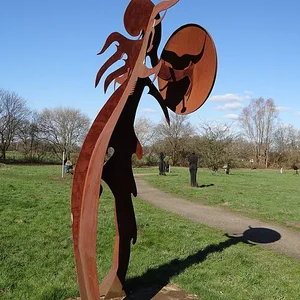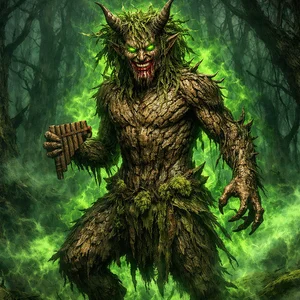

Greek deity of wild nature, shepherds, and flocks, Pan is depicted as half-man, half-goat. Inventor of the reed flute (syrinx), he embodies the uncontrollable forces of nature and is the origin of the word "panic."
Pan
Pan
8 min read
Frequently asked questions
Famous Quotes
« "All is full of Pan" (a saying attributed by ancient philosophical tradition, notably by Heraclitus)»
Key Facts
- Son of Hermes according to the most widespread tradition, born in Arcadia (central Greece) — Archaic period, around the 6th century BCE
- Inventor of the syrinx (reed flute) following the metamorphosis of the nymph Syrinx, whom he had been pursuing
- His terrible cry is said to be the origin of the word "panic" (Greek: panikon deima, "terror of Pan")
- According to Herodotus (5th century BCE), Pan allegedly helped the Athenians at Marathon (490 BCE) by sowing panic among the Persians
- Preserved through Greek oral tradition and later set down in texts: the Homeric Hymns (Hymn to Pan), Theocritus, Ovid (Metamorphoses)
Works & Achievements
Pan is credited with the invention of the multi-pipe flute made of bound reeds, born from the myth of Syrinx. This instrument became the symbol of all pastoral and bucolic music in Antiquity.
Pan's primary cultic function was to guard shepherds and their flocks from predators and disease. The shepherds of Arcadia offered him libations and animal horns to secure his favor.
According to Herodotus and Athenian tradition, Pan spread panic through the Persian army and helped secure the Greek victory. This episode earned him an official cult in Athens and cemented his role as protector of Greek cities.
Through his association with shepherds and the flute, Pan is the patron of an entire musical and poetic genre: bucolic poetry. Theocritus, Virgil, and many others attribute to him the origin of the simple, natural music of the countryside.
The duel between Pan's syrinx and Apollo's lyre symbolizes in mythology the opposition between wild nature and civilized culture, between instinct and reason — a fundamental theme in Greek thought.
Anecdotes
At the Battle of Marathon in 490 BC, the runner Pheidippides reported encountering Pan on Mount Parthenion while traveling to Sparta to ask for aid. Pan allegedly rebuked him for the Athenians' insufficient worship. After the victory, the Athenians dedicated a grotto on the Acropolis to him and established torch races in his honor.
Pan fell in love with the nymph Syrinx, who rejected his advances and begged her naiad sisters to transform her. They granted her wish by turning her into reeds at the water's edge. Pan, inconsolable, cut these reeds into unequal lengths and bound them together to create the flute now known as the syrinx, or Pan flute, forever carrying the memory of his beloved nymph.
Pan is said to have challenged Apollo to a musical contest: Pan played the syrinx while Apollo played the lyre. King Midas, named as judge, had the audacity to declare Pan the winner. Apollo, furious, caused donkey's ears to grow on him as punishment for his poor taste. This story illustrates the rivalry between Pan's wild, natural music and Apollo's refined, civilized art.
Pan is the origin of the word “panic.” He was said to let out terrifying cries that spread irrational terror among men and animals, particularly herds of livestock. The Greeks attributed to Pan the unexplained frights that seized soldiers or travelers out in the wilderness, especially in the forests or mountains of Arcadia.
In some accounts, Pan was the son of Hermes and a nymph. When he was born, covered in fur and half-human half-goat, his mother is said to have been frightened and abandoned him. Hermes, by contrast, was so proud of his unusual son that he brought him to Mount Olympus to present him to the gods, who all rejoiced at his birth and gave him the name Pan, meaning “all,” for he had brought joy to every heart.
Primary Sources
Tell me, Muse, of the dear son of Hermes, the goat-footed, two-horned lover of noise, who roams through the shadowy woods with the dancing nymphs… He is called Pan by the gods, because he charmed the hearts of all.
Pheidippides claimed that Pan had appeared to him on Mount Parthenion and asked why the Athenians paid him no worship, he who was favorable to them and had always been so in the past.
Syrinx fled Pan through the forests… On the bank of the sandy-bedded river Ladon, she implored her sisters of the waters to transform her. Pan, thinking he had seized Syrinx, found in his arms nothing but marsh reeds.
Let us not wake Pan who, wearied from the hunt, has fallen asleep; for he is quick to anger when his midday rest is disturbed.
In Arcadia, Pan is venerated more than anywhere else. On Mount Lykaion there are sanctuaries dedicated to him, and the Arcadians regard him as the greatest of their gods.
Key Places
A mountainous region of the Peloponnese considered the birthplace and sacred territory of Pan. According to tradition, it is where he was born, and where his cult is oldest and most deeply rooted.
A sacred mountain in Arcadia where Pausanias mentions important sanctuaries dedicated to Pan. This isolated peak was considered one of the places where the god's presence was felt most strongly.
After the Battle of Marathon (490 BCE), the Athenians dedicated a natural cave on the north slope of the Acropolis to Pan in gratitude for his aid. The site became a sanctuary frequented by shepherds and soldiers alike.
It is on this mountain pass that Herodotus places Pan's appearance to Pheidippides during his run to Sparta. The site became a symbolic waypoint associated with the god.
An Arcadian river on whose banks the myth of Syrinx unfolds, according to Ovid. It is here that the nymph was transformed into reeds, giving rise to Pan's flute.
Typical Objects

An instrument invented by Pan from reeds of unequal lengths bound together, after the nymph Syrinx was transformed. The syrinx is Pan's emblematic attribute, a symbol of wild, natural music.

A curved staff used by shepherds to guide and gather their flocks. Pan carries it as the protector of shepherds and the herds of Arcadia.

Pan is often depicted crowned with pine branches or needles, the pine being a sacred tree of the Arcadian forests. It symbolizes his deep bond with wild nature and mountain woodlands.

As a half-goat deity, Pan is naturally associated with goats — he himself bears their legs, horns, and tail. Goat skins evoke pastoral simplicity and rustic life.

When he joins Dionysus in Bacchic processions, Pan sometimes carries the thyrsus or ivy branches, symbols of intoxication and wild revelry.

Pan is often depicted carrying a wineskin or feasting with satyrs and nymphs. It embodies the joy of rustic banquets and the uninhibited pleasure associated with life in nature.
School Curriculum
Vocabulary & Tags
Key Vocabulary
Tags
Daily Life
Morning
At sunrise, Pan roams the hills and forests of Arcadia, guiding the flocks to fresh pastures. He plays his pipes to gather the animals and ward off predators that might threaten lambs and kids.
Afternoon
At midday, when the heat is at its peak, Pan falls asleep in a shaded cave or beneath mountain pines. According to ancient texts, he is particularly irritable if disturbed during this midday nap — it is at this hour that 'panic' is most fearsome.
Evening
At nightfall, Pan joined the nymphs and satyrs to dance and feast in forest clearings. He played the syrinx to liven these rustic celebrations, courted the nymphs, and celebrated with Dionysus the unbridled pleasures of nature.
Food
As a pastoral deity, Pan is associated with milk, goat's cheese, and wild fruits from the Arcadian forests. He shared the simple meals of shepherds: barley bread, olives, mountain honey, and wine diluted with water at Dionysian festivals.
Clothing
Pan is rarely depicted clothed: he bears his own goat's pelt on the lower half of his body, complete with legs, hooves, and a small tail. He sometimes wears a panther skin or a *nebris* (fawn skin) draped over his shoulder, in the manner of the companions of Dionysus.
Housing
Pan does not live in a palace but in the natural caves of the Arcadian mountains, under rocky outcrops, or in dense woodland. His sanctuaries were always caves or natural spaces, never built temples — nature itself was his home and his shrine.