Imaginary interview with Sameera Moussa
by Charactorium · Sameera Moussa (1917 — 1952) · Sciences · 6 min read
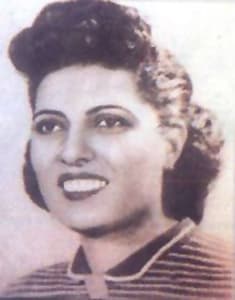
Cairo, early 1950s. In a laboratory at Cairo University where a Geiger counter crackles, a young physicist in a white coat barely looks up from her measurement notebooks. Samira Moussa, the first woman to teach science at this faculty, agrees to set aside her instruments for a moment to talk about the atom, her mother, and the Egypt she dreams of healing.
—Do you remember the moment your vocation was decided?
When my mother was taken by cancer, I was still a child in Cairo, helpless before a disease that no doctor could conquer. That day I vowed not to remain empty-handed in the face of pain. That is why I oriented all my research toward the medical use of radiation: not for the abstraction of equations, but for suffering flesh. Radiotherapy seemed to me a promise—the idea that an invisible beam could burn the tumor without destroying the patient. Every time I handle a radium source in its lead case, I think of her. Science, for me, was never a career; it is a debt I pay to a dead woman.
Science was never a career; it is a debt I pay to a dead woman.
—What did you mean by promising to make nuclear treatment accessible to all?
I often say a phrase that makes my colleagues smile: 'I will make nuclear treatment as accessible and cheap as aspirin.' They see naivety; I see a program. What is the point of taming the atom if only the rich can be healed by it? In the hospitals of Cairo, I saw peasants from the delta leave without treatment, lacking an exorbitantly priced gram of radium. My work aims precisely to make radiotherapy effective and affordable, to multiply cheap isotopes rather than reserving nuclear energy for wealthy laboratories. A discovery that does not reach the humblest patient is, in my eyes, only half a discovery.
—How did you experience becoming the first woman to teach science at Cairo University?
In 1939, I graduated top of my class in radiology. Shortly after, I was given a position at the Faculty of Science of Cairo University—the first woman to teach there. I didn't always grasp the audacity; I was too busy preparing my lessons and experiments. But I felt the stares in the hallways at this young woman in a white coat writing atomic equations on the board. That coat, I wore it as armor as much as a work garment. Every female student who saw me at the blackboard learned, without a word, that a place was now possible for her. Opening that door was worth a few murmurs.
—What role did physicist Mostafa Mosharafa play in your journey?
Mostafa Mosharafa was more than a teacher: he believed in me before I dared to believe in myself. He was a first-rate physicist, one of the few in Egypt who understood where nuclear physics was heading. He saw, he told anyone who would listen, an exceptional researcher in the student I was. It was he who pushed me toward atomic radiation, that brand-new field where almost nothing was written, when I could have settled for a quieter career. I prepared my doctorate in his wake, with the dizzying feeling of breaking new ground. Without his encouragement, I would never have dared to touch the atom; one becomes a scientist only if someone, one day, reaches out a hand.
—What does one of your days in the laboratory look like?
The morning belongs to teaching; the afternoon, to the laboratory. There, everything becomes clicking and patience. The Geiger counter ticks away as soon as a source approaches—it is the pulse of the atomic age, that dry sound betraying the presence of the invisible. I like to sit in front of the Wilson cloud chamber, that little theater of fog where particles finally leave a visible trace, fleeting filaments of a world that no eye perceives. Around me, X-ray tubes, lead cases, measurement notebooks. Then comes library time, where I read publications from Europe and America, because nuclear physics runs faster than any of us. A good day, for me, is one more trajectory deciphered in the fog.
—Beyond instruments, how do your evenings as a scholar in Cairo unfold?
The laboratory never fully leaves me. In the evening, back in my lodgings in Cairo, I continue my reading and write to researchers in Europe and America—this correspondence is my true nocturnal laboratory, the laboratory of ideas. The city, in those years, buzzes with debate; the scholarly elite meet, discussing atoms over glasses of tea. I prepare my lectures, recheck my X-ray measurements, dream of devices our hospitals do not yet have. An educated woman, I live simply, among books and notebooks. People imagine me austere; I mostly feel rushed, as if time were short and I had to understand everything before night falls.
—Why did you organize, around 1951, a meeting for atomic energy in the service of peace?
How could I not think of it? In 1945, two Japanese cities vanished under fire mushrooms, and the world suddenly understood what the nucleus could destroy. I had chosen this field to heal, not to annihilate. So around 1951, I gathered scientists to defend the idea that the atom could serve health and peace rather than war. People found me presumptuous, an Egyptian woman, wanting the Arab world to access this nascent science. But I refused that nuclear energy remain solely in the hands of bomb-makers. The same force that razes a city can irradiate a tumor: it all depends on the hand that holds it, and the intention that guides it.
The same force that razes a city can irradiate a tumor; it all depends on the hand that holds it.
—Do you truly believe that Egypt and the Arab world can take part in this atomic revolution?
People often ask me, with a polite smile that means no. I reply that nuclear fission was discovered in 1938 by Europeans, but the laws of the nucleus belong to no race or empire. Why should Egypt, which traced geometry on the banks of the Nile, be condemned to be merely a customer of others' science? We need isotopes, instruments, trained researchers—and above all the will not to wait for knowledge to be handed to us. I grew up under foreign tutelage, I saw my country demand its independence: science is another name for that emancipation. A people that masters the atom to heal is no longer entirely a subjugated people.
—What did your research stay in the United States represent for you?
Receiving a Fulbright scholarship in 1951 meant finally being able to touch what I had only read about in journals. I visited several atomic research centers, all the way to the laboratories at Berkeley, where America then concentrated the most advanced nuclear physics. I went not as a student begging for knowledge, but as an envoy of my country, determined to bring back home what I would learn. Every instrument I discovered, I already imagined in a Cairo hospital. People often think science has no homeland: that is true of the laws of nature, false of the laboratories that serve them. I wanted Egypt to have its own, and the Arab world not to remain a spectator of the atomic age.
—It is said you were offered to stay in America. Why refuse such an offer?
Over there, I was offered American citizenship, to remain among the best laboratories in the world. I refused without hesitation. What good is all this science if I do not bring it back to where my mother died, where the sick in the delta still await treatment? My country educated me, it awaits me; I owe it my return. I know this journey has its shadows—a road in California, a car, paths one barely knows. In a field where one handles forces greater than oneself, one learns not to tremble too much for one's own person. What I fear is dying empty-handed, before having given back to Egypt the knowledge it sowed in me.
What I fear is dying empty-handed, before having given back to Egypt the knowledge it sowed in me.
This imaginary interview was generated by artificial intelligence from sources documented in Sameera Moussa's profile. It dramatises what the figure might have said based on what we know about them, but does not constitute attested historical testimony. For primary sources and factual documentation, refer to the full profile.