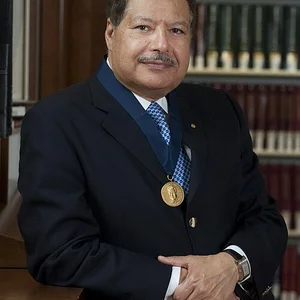

Egyptian-American chemist and pioneer of femtochemistry, he revolutionized the observation of chemical reactions by filming the movement of atoms at the femtosecond timescale. Winner of the Nobel Prize in Chemistry in 1999, he is regarded as the father of ultrafast chemistry.
Ahmed Zewail(1946 — 2016)
Ahmed Zewail
États-Unis, Égypte
8 min read
Frequently asked questions
Famous Quotes
« Science is the greatest collective endeavor. It contributes to the GDP but, more than that, it contributes to human welfare.»
Key Facts
- Born on February 26, 1946, in Damanhour, Egypt
- Developed femtochemistry in the 1980s at Caltech
- Nobel Prize in Chemistry in 1999 for his work on the transition states of chemical reactions
- First direct observation of molecules in the act of breaking apart and reforming
- Died on August 2, 2016, in Pasadena, California
Works & Achievements
A series of pioneering experimental studies using femtosecond lasers to observe, in real time, the motion of atoms during a chemical reaction. This discovery founded an entirely new scientific discipline.
A landmark review article that codifies and officially names femtochemistry, describing the theoretical and experimental foundations for observing chemical transition states on the femtosecond timescale.
A memoir blending life and science in which Zewail traces his journey from Egypt to the United States. Written in an accessible style, it has become an inspiring reference for young scientists across the Arab world.
A major scientific work presenting the full body of research produced by Zewail's group at Caltech, and the founding reference text for femtochemistry within the international scientific community.
Zewail applied the time-resolved principles of femtochemistry to electron microscopy, achieving resolution that is simultaneously atomic in space and femtosecond in time, opening the door to dynamic nanoscience.
A major non-scientific achievement: the creation of a research university in Egypt dedicated to training the next generation of scientists from the Arab world, giving concrete form to Zewail's conviction that science is a lever for national development.
Anecdotes
Ahmed Zewail grew up in Desouk and then Damanhour, Egypt, in a modest family. His father, a civil servant with a passion for culture, hung a photo of Einstein on the living room wall — it was before that image that young Ahmed decided he would become a scientist. That ambition would lead him, decades later, to join the pantheon of Nobel Prize winners.
In 1987, in his laboratory at the California Institute of Technology (Caltech), Zewail carried out a groundbreaking experiment: using laser pulses lasting just a few femtoseconds (one millionth of a billionth of a second), he became the first to 'photograph' chemical bonds in the act of breaking. He had just invented femtochemistry — an entirely new scientific discipline.
When he received the Nobel Prize in Chemistry in 1999, Ahmed Zewail became the first Arab and African scientist to win the prize in a scientific field. In Stockholm, he delivered his acceptance speech wearing a tie in the colors of the Egyptian flag, as a tribute to his homeland. News of his award sparked spontaneous celebrations in the streets of Cairo.
In 2009, President Barack Obama appointed Zewail as the first United States Science Envoy to the Middle East, as part of his administration's outreach to the Muslim world. Zewail accepted the diplomatic role while continuing his research, firmly believing that science could serve as a bridge between cultures and nations.
Shortly after the Egyptian revolution of 2011, Ahmed Zewail launched a project to build a world-class research university in Egypt — Zewail City of Science and Technology (ZSU), inaugurated in 2011 near Cairo. His goal was to give young Egyptians access to world-class scientific education without having to leave their country.
Primary Sources
The 1999 Nobel Lecture by Ahmed Zewail describes how femtosecond laser pulses allow the direct observation of atoms in motion during a chemical reaction, transforming chemistry from a science of before-and-after snapshots to one of real-time molecular movies.
Zewail recounts his childhood in Egypt, his arrival in the United States, and the intellectual milestones that led him to femtochemistry: "Science has no borders, but scientists have roots."
Published in Science, this paper reports the first direct real-time observation of a transition state in a chemical reaction, using a pump-probe femtosecond laser technique applied to the dissociation of ICN molecules.
Delivered in the context of Obama's Cairo speech, with Zewail present, this occasion illustrates the symbolic role assigned to science as a vehicle for dialogue: Zewail argued for scientific education as a prerequisite for the development of Arab nations.
Key Places
City in the Nile Delta where Ahmed Zewail was born in 1946. It was in this modest yet culturally stimulating family environment that he first developed his scientific curiosity.
The institution where Zewail earned his bachelor's degree in chemistry in 1967. This solid grounding in classical chemistry provided the foundation on which he would later build his revolutionary work.
Where Zewail completed and defended his doctoral dissertation in 1974, discovering the world of American research and its experimental resources, which were inaccessible to him in Egypt at the time.
The center of his entire scientific career from 1976 until his death in 2016. It was in Caltech's laboratories that he invented femtochemistry and trained several generations of researchers.
The place where Zewail received the Nobel Prize in Chemistry in December 1999. The ceremony marked worldwide recognition of femtochemistry and was celebrated as a source of national pride in Egypt.
An institution founded by Zewail himself in 2011 near Cairo to provide Egyptian youth with world-class scientific training — a lasting legacy of his lifelong commitment to education.
Typical Objects

The central instrument of Zewail's entire body of work. These lasers emit pulses of light lasting less than 100 femtoseconds, making it possible to "photograph" atoms in motion during a chemical reaction, much like an ultra-high-speed strobe light.

Coupled with the laser, it identifies the molecular fragments produced at the precise moment a chemical bond breaks, giving Zewail a signature of the transition state of the molecules under study.

A device that shoots molecules into a vacuum at high speed as a controlled jet, isolating them from their surroundings so that elementary chemical reactions can be observed without interference.

An essential visualization tool in Zewail's laboratory for analyzing the light signals detected after each laser pulse and reconstructing the timeline of a reaction.

An instrument Zewail helped develop late in his career, combining atomic spatial resolution with femtosecond temporal resolution to film matter at the finest scale ever achieved.

As with any experimental researcher, Zewail's lab notebook meticulously recorded every protocol, every measurement, and every hypothesis — a fundamental scientific tradition he passed on to his students.
School Curriculum
Vocabulary & Tags
Key Vocabulary
Tags
Daily Life
Morning
Ahmed Zewail arrived very early at his Caltech laboratory, often before 7 a.m. He would begin by reviewing the experimental results from the night before, which his doctoral students had typically generated during long laser measurement sessions. He liked to annotate the graphs by hand before heading to team meetings.
Afternoon
Afternoons were devoted to scientific discussions with his students and postdoctoral researchers: Zewail was known for intense whiteboard sessions, during which he would reformulate problems in terms of fundamental physics. He wrote articles and grant applications from his office overlooking the green campus of Pasadena.
Evening
In the evenings, Zewail returned home to his family — he was the father of four children and placed great importance on family life. He read, listened to classical and Arabic music, and pondered the big questions of chemical physics. He often brought articles home to annotate for the following day.
Food
Zewail had kept eating habits close to Egyptian cuisine: vegetables, legumes, rice, and slow-cooked dishes. He was fond of sweet mint tea, a drink from his childhood. His wife Dema regularly prepared Levantine dishes that reminded him of his roots.
Clothing
In the laboratory, Zewail wore the requisite white coat, usually paired with a dress shirt and tie — an outfit he maintained even during informal seminars, reflecting a polished professional style inherited from his formal academic training. At official ceremonies, he would sometimes wear accessories in the colors of Egypt.
Housing
Zewail lived in a comfortable house in the suburbs of Pasadena, a few minutes from Caltech. Unlike some of his colleagues, he had chosen not to live in upscale neighborhoods: he was keen to maintain a simple lifestyle centered on family and intellectual work.
Historical Timeline
Period Vocabulary
Liens externes & ressources
Références
Œuvres
Invention de la femtochimie
1987-1988
Article 'Femtochemistry' dans Journal of Physical Chemistry
1993
Voyage Through Time: Walks of Life to the Nobel Prize (autobiographie)
2002
Femtochemistry: Ultrafast Dynamics of the Chemical Bond (2 volumes)
1994
Développement de la microscopie électronique ultrarapide à 4 dimensions (4D-EM)
2005-2016
Fondation de l'Université Zewail des Sciences et de la Technologie (ZSU)
2011